WRLD

Search

#Capitana
Luciano Magaldi Sardella (PhD) 7d

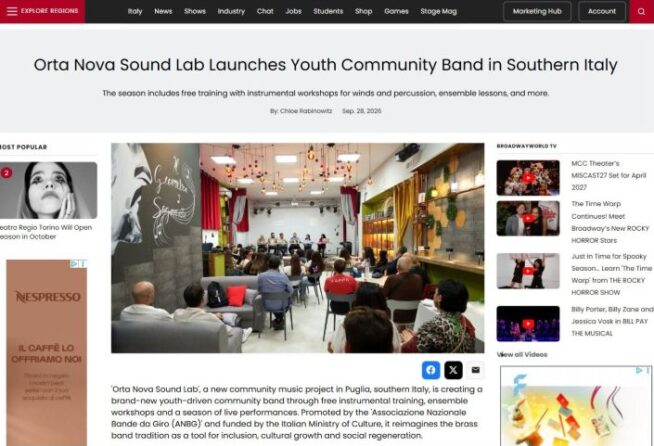
CIVICO 33 - "ORTA NOVA SOUND LAB": FROM CAPITANATA TO "BROADWAY WORLD", THE "COMMUNITY BAND" PROJECT CONQUERS NEW YORK The social laboratory promoted by ANBG and the Ministry of Culture lands on the largest theatrical network in the world thanks to the article co-written by Chris Rabinowitz and the Orthese author Luciano Magaldi Sardella. There is a brass thread connecting Piazza Mario Frasca to Broadway. "Orta Nova Sound Lab" is the Community and Social Regeneration Band through Music, the project officially presented on September 21 at the C-Lab MAO FM 19.77 by brothers Luca and Erminio Ferrandina, which is experiencing unprecedented media attention for a band initiative born in the province of Foggia. The journalistic success is marked by its appearance on September 28 in Broadway World, the most authoritative global portal dedicated to theater and live performance, based in New York with over 1.5 million monthly global visits. This is not an insignificant result, projecting a story from the Apulian periphery into the realm of international cultural information. The article, titled "Orta Nova Sound Lab Launches Youth Community Band in Southern Italy," is co-authored by New York editor Chris Rabinowitz, a journalist for the American publication, and his Italian co-author Luciano Magaldi Sardella, an international author originally from Orta Nova, an engineer, academic journalist, and researcher active between Italy and abroad. The dual Italian-American signature symbolizes how a "good local practice" can become global news when told with expertise and roots. The Project: the Band as Social Regeneration "Orta Nova Sound Lab" is promoted by the National Association of Marching Bands (ANBG), chaired by Benedetto Grillo, and has been approved for funding under the public notice of the Ministry of Culture as per D.D.G. April 7, 2026, rep. n. 149, aimed at "Enhancing research and dissemination of musical practices in peripheral and areas of high social vulnerability." It is realized with the support of the Municipality of Orta Nova and with the collaboration of a solid civic network: the A.P.S. MAO FM 19.77, the "A. Olivetti" Higher Education Institute, the "Sandro Pertini" Comprehensive Institute, the Music Art association, and the C.I.S.A. of Foggia. As highlighted by "Broadway World," this is the first initiative in Italy to reinterpret the distinctive tradition of marching bands and youth orchestras within a ministry grant dedicated to urban peripheries and social vulnerability. A model that explicitly dialogues with the spirit of the so-called "Caivano Decree" (D.L. 123/2023) for combating youth discomfort, educational poverty, and juvenile delinquency. The idea, in its disarming simplicity, was summarized by the project director for ANBG, Antonella Spagnoletti: "The band is aggregation! The band is cohesion. Bringing these kids together to learn and live differently from the social world is among the primary objectives of our association." This concept was reiterated by the Mayor of Orta Nova, Ing. Domenico Di Vito: "This is an important project that can definitely make a difference compared to the past because it has all the ingredients to connect the entire world of culture and social issues that exists in Orta Nova and needs to be valued. The administration's commitment is to ensure sustainability, structure, and continuity over time." At the press conference presentation, moderated by journalist Giuseppe Di Bisceglie, participated alongside President Grillo, Director Spagnoletti, and Mayor Di Vito, Regional Councillor Grazia Maria Starace, Councillor for relationships with the third sector Sebastiano Battista, Councillor for Culture Vittoria Mastrogiacomo, and educational professor Alfredo Coppola, delegate of the Olivetti Institute. Why the News Became International The "Orta Nova Sound Lab" marching band project demonstrates that when a project has anti-mafia roots, pedagogical value, and a credible institutional network, the press responds. From local and national outlets like Cassa Armonica, Ansa Puglia, TGNorba, Corriere della Sera Bari, RaiNews TGR Puglia, La Gazzetta del Mezzogiorno, Amica9TV, Brindisi In, Blasting News Italia, TRM Network, Secolo XIX, FoggiaToday, PlayNews24, Stato Quotidiano, and many others that well-documented the conference, it reached BroadwayWorld, which viewed the Orthese experience as a "social laboratory" capable of responding to the mafia with music. This leap in scale comes from joint efforts and the bridging work done by Luciano Magaldi Sardella, who managed to translate for the English-speaking audience alongside New York editor Chris Rabinowitz the deep meaning of a village band that in Apulia is not folklore, but a civil presence, a concrete alternative to screens and disintegration. In a South often narrated only for its emergencies, Orta Nova chooses to be told for its ability to generate community. And this time, the news has made its way around the world, starting from a square in Daunia. The Schedule The path, entirely free, includes instrumental workshops for brass and percussion, ensemble music lessons, and collective rehearsals with qualified teachers and conductors, open to aspiring musicians, families, schools, and citizens. The program that attracted the attention of national and now international press is organized as follows: October 2026: parade of bands marching through the streets and public spaces of Orta Nova, to recover the historical value of the band as a popular and identity expression. November-December 2026: high-profile concert season with the Grand Band Concert of Conversano and the Grand Band Concert "Biagio Abbate" City of Bisceglie, artistic training for the young students. Focus on inclusion: a special evening dedicated to female music with the Orchestra Note di Puglia, a formation composed entirely of professionals, to reinforce the values of equal opportunities. January 2027: first official concert of the newly formed Community Band of Orta Nova, a foundational act and public restitution of the work done. (translated)

www.civico93.it
"ORTA NOVA SOUND LaAB": DALLA CAPITANATA A "BROADWAYWORLD", IL PROGETTO “BANDA DI COMUNITA’ CONQUISTA NEW YORK - Civico93 | Be original
454
Luciano Magaldi Sardella (PhD) 7d

CIVICO 33 — “ORTA NOVA SOUND LAB”: FROM CAPITANATA TO “BROADWAYWORLD”, THE “COMMUNITY BAND” PROJECT CONQUERS NEW YORK SOURCE: https://www.civico93.it/orta-nova-sound-laab-dalla-capitanata-a-broadwayworld-il-progetto-banda-di-comunita-conquista-new-york/ The social laboratory promoted by ANBG and the Ministry of Culture has landed on the world’s largest theatre network, thanks to the article co-authored by Chris Rabinowitz and the Orta Nova-born author Luciano Magaldi Sardella. There is a brass thread linking Piazza Mario Frasca to Broadway. It is called “Orta Nova Sound Lab” — the Community and Social Regeneration Band through Music — the project officially presented on 21 September last at the C-Lab MAO FM 19.77 of brothers Luca and Erminio Ferrandina, which is enjoying unprecedented media coverage for a band-cultural initiative born in the Province of Foggia. Its journalistic success was sealed on 28 September last by its arrival on BroadwayWorld, the world’s most authoritative portal dedicated to theatre and live performance, based in New York with over 1.5 million global monthly visits. A result that was by no means a foregone conclusion, which projects a story from the Apulian periphery into the international cultural news circuit. The article, entitled Orta Nova Sound Lab Launches Youth Community Band in Southern Italy, is jointly by-lined by New York editor Chris Rabinowitz, journalist for the American publication, and his Italian co-author Luciano Magaldi Sardella, an international author originally from Orta Nova, engineer, academic journalist, and researcher active between Italy and abroad. The dual Italo-American by-line symbolises how a “local good practice” can become global news when it is recounted with expertise and rootedness. The Project: The Band as Social Regeneration “Orta Nova Sound Lab” is promoted by the Associazione Nazionale Bande da Giro (ANBG), chaired by Benedetto Grillo, and was admitted for funding under the public call of the Ministry of Culture pursuant to Director General Decree of 7 April 2026, reg. no. 149, aimed at the “Strengthening of research activities and dissemination of musical practices in peripheries and in areas of high social vulnerability”. It is realized with the support of the Comune di Orta Nova and with the collaboration of a solid civic network: A.P.S. MAO FM 19.77, the Istituto di Istruzione Superiore “A. Olivetti”, the Istituto Comprensivo “Sandro Pertini”, the Music Art association, and the C.I.S.A. of Foggia. As BroadwayWorld itself emphasised, this is the first initiative in Italy to reinterpret the distinctive tradition of touring bands (bande da giro) and youth orchestras within a ministerial call dedicated to urban peripheries and social vulnerability. A model that dialogues explicitly with the spirit of the so-called “Caivano Decree” (Law Decree 123/2023) for combating youth distress, educational poverty, and juvenile crime. The idea, in its disarming simplicity, was summarised by the project director for ANBG, Antonella Spagnoletti: “The band is aggregation! The band is cohesion. Bringing these youngsters together, educating them, and enabling them to live in a manner different from the social-media world is among the primary objectives of our association.” A concept reiterated by the Mayor of Orta Nova, Eng. Domenico Di Vito: “This is an important project that can certainly make a difference compared with the past, because all the ingredients are there to network the entire cultural and social world that exists in Orta Nova and that must be valorised. The administration’s commitment is to ensure sustainability, structure, and continuity over time.” Taking part in the launch press conference, moderated by journalist Giuseppe Di Bisceglie, in addition to President Grillo, Director Spagnoletti, and Mayor Di Vito, were Regional Councillor Grazia Maria Starace, Councillor for relations with the third sector Sebastiano Battista, Councillor for Culture Vittoria Mastrogiacomo, and educational professor Alfredo Coppola, contact person for the Olivetti Institute. Why the Story Went International The “Orta Nova Sound Lab” band project demonstrates that when a project has anti-mafia roots, pedagogical value, and a credible institutional network, the press responds. From local and national titles such as Cassa Armonica, Ansa Puglia, TGNorba, Corriere della Sera Bari, RaiNews TGR Puglia, La Gazzetta del Mezzogiorno, Amica9TV, Brindisi In, Blasting News Italia, TRM Network, Secolo XIX, FoggiaToday, PlayNews24, Stato Quotidiano, and many others, which thoroughly documented the conference, the coverage reached “Broadway World”, which read the Orta Nova experience as a “social laboratory” capable of answering the mafia with music. This change of scale derives from joint work and also from the liaison work carried out by Luciano Magaldi Sardella, who, together with New York editor Chris Rabinowitz, succeeded in translating for an Anglophone audience the profound meaning of a town band which, in Apulia, is not folklore, but a civil garrison, a concrete alternative to the screen and to social disintegration. In a South often narrated only for its emergencies, Orta Nova chooses to be recounted for its capacity to generate community. And this time, the news has travelled around the world, starting from a piazza in the Daunia. The Calendar The pathway, which is entirely free of charge, provides instrumental workshops for wind and percussion, ensemble music lessons, and collective rehearsals with qualified teachers and conductors, open to aspiring musicians, families, schools, and citizens. The programme that has attracted the attention of the national and now international press is structured as follows: October 2026: parade of marching bands through the streets and public spaces of Orta Nova, to recover the historic value of the band as a popular and identity-based expression. November–December 2026: high-profile concert season with the Gran Concerto Bandistico di Conversano and the Gran Concerto Bandistico “Biagio Abbate” Città di Bisceglie, an artistic training ground for young pupils. Inclusion Focus: a special evening dedicated to women in music with the Orchestra Note di Puglia, an ensemble composed entirely of professional women musicians, to reinforce the values of equal opportunities. January 2027: first official concert of the newborn Community Band of Orta Nova, a foundational act and public restitution of the work accomplished. (translated)

www.civico93.it
"ORTA NOVA SOUND LaAB": DALLA CAPITANATA A "BROADWAYWORLD", IL PROGETTO “BANDA DI COMUNITA’ CONQUISTA NEW YORK - Civico93 | Be original
794
Luciano Magaldi Sardella (PhD) 1w

“PUGLIA IN”: “ORTA NOVA SOUND LAB” CONQUERS NEW YORK: THE “COMMUNITY BAND” LANDS ON “BROADWAY WORLD” SOURCE: https://www.pugliain.net/303862-orta-nova-sound-lab-new-york-banda/ I am delighted that my article submitted to editor Chloe Rabinowitz has been accepted and published. In any case, we are not talking about just any website, but the largest theatre website in the world on the internet, the one that covers Broadway, the West End and beyond, with over 6 million visitors per month, present in 100 US cities, 45 countries and in 12 languages worldwide. __________________________________________________________________________ Orta Nova (FG) — The social and musical project “Orta Nova Sound Lab” debuted last week on the prestigious US portal BroadwayWorld, an international live performance network based in New York. The initiative, born in Orta Nova in the heart of Capitanata, nothern Puglia region in South Italy, to create a youth community band, was presented overseas as an innovative model of inclusion and urban regeneration for the Mezzogiorno. The Pulgian model of social regeneration through music, promoted by the “Associazione Nazionale Bande da Giro (ANBG)” chaired by Benedetto Grillo and supported by the Municipality of Orta Nova, has been admitted for funding by the Ministry of Culture under the call for strengthening music in suburbs and vulnerable areas. The project follows in the wake of interventions to counter youth distress and educational poverty envisaged in the spirit of the “Caivano Decree”. The article published in the American outlet is co-authored by New York editor Chris Rabinowitz and by Orta Nova author and researcher Luciano Magaldi Sardella. The text illustrates how the centuries-old Puglian wind-band tradition has been reinterpreted as an instrument of prevention and civic cohesion, thanks to collaboration between the MAO FM 19.77 association, the Olivetti Institute, the Pertini Institute, Music Art and the C.I.S.A. of Foggia. Why the News Went International The “Orta Nova Sound Lab” band project demonstrates that when a project has anti-mafia roots, pedagogical value, and a credible institutional network, the press responds. From local and national outlets such as Cassarmonica, Ansa Puglia, TGNorba, Corriere della Sera Bari, RaiNews TGR Puglia, La Gazzetta del Mezzogiorno, Amica9TV, Brindisi In, Puglia IN, Blasting News Italia, TRM Network, Secolo XIX, FoggiaToday, PlayNews24, Stato Quotidiano, and many others, which thoroughly documented the press conference, coverage has now reached “Broadway World”, which has interpreted the Orta Nova experience as a “social laboratory” capable of answering the mafia with music. This leap in scale derives from joint work and from the liaison work carried out by Luciano Magaldi Sardella, who, together with New York editor Chris Rabinowitz, succeeded in translating for an Anglophone audience the profound meaning of a town band that in Puglia is not folklore, but a civic garrison, a concrete alternative to young people’s dependence on electronic screens and to social disintegration. In a southern Italy often narrated solely through its emergencies, Orta Nova chooses to be narrated for its capacity to generate community. And this time, the news has travelled around the world, starting from a square in the Basso Tavoliere. The Stages of the Programme and the Major Concerts in Capitanata The programme, entirely free of charge for participants, offers training courses for wind and percussion instruments alongside ensemble music lessons. During October 2026, the streets of Orta Nova will host band parades and processions, whilst between November and December the area will see performances by the prestigious Gran Concerti Bandistici of Conversano and Bisceglie. The bill will reserve a specific space for equal opportunities with the all-female performance of the Orchestra Note di Puglia. The journey will culminate in January 2027 with the first official concert of the newly formed Banda di Comunità of Orta Nova, the culmination of a training itinerary that projects the social redemption of the Province of Foggia onto the global cultural scene.

www.pugliain.net
Orta Nova Sound Lab conquista New York: la banda di comunità approda su BroadwayWorld
1027
Luciano Magaldi Sardella (PhD) 1w

“PUGLIA IN”: “ORTA NOVA SOUND LAB” CONQUISTA NEW YORK: LA “BANDA DI COMUNITA’ “APPRODA SU “BROADWAY WORLD” SOURCE: https://www.pugliain.net/303862-orta-nova-sound-lab-new-york-banda/ Lieto che il mio articolo inviato all’editor Chloe Rabinowitz sia stato accettato e pubblicato. Comunque, non stiamo parlando di un sito qualsiasi, ma de il più grande sito di teatro al mondo su internet, quello che copre Broadway, il West End e oltre, con oltre 6 milioni di visitatori al mese, presente in 100 città USA, 45 paesi e in 12 lingue nel mondo. _________________________________________________________________ ORTA NOVA (FG) — Il progetto sociale e musicale “Orta Nova Sound Lab” ha debuttato la scorsa settimana sul prestigioso portale statunitense BroadwayWorld, network internazionale dello spettacolo dal vivo con sede a New York. L’iniziativa, nata a Orta Nova nel cuore della Capitanata per creare una banda giovanile di comunità, è stata presentata oltreoceano come un modello innovativo di inclusione e rigenerazione urbana per il Mezzogiorno. Il modello pugliese di rigenerazione sociale attraverso la musica promosso dall’ “Associazione Nazionale Bande da Giro (ANBG)” presieduta da Benedetto Grillo e sostenuto dal Comune di Orta Nova, il laboratorio è stato ammesso a finanziamento dal Ministero della Cultura nell’ambito del bando per il potenziamento della musica nelle periferie e nelle aree vulnerabili. Il progetto si inserisce nel solco degli interventi di contrasto al disagio giovanile e alla povertà educativa previsti dallo spirito del “Decreto Caivano”. L’articolo pubblicato sulla testata americana porta la firma dell’editor newyorchese Chris Rabinowitz e dell’autore e ricercatore di Orta Nova Luciano Magaldi Sardella. Il testo illustra come la secolare tradizione bandistica pugliese sia stata reinterpretata quale strumento di prevenzione e coesione civica, grazie alla collaborazione tra l’associazione MAO FM 19.77, l’Istituto Olivetti, l’Istituto Pertini, Music Art e il C.I.S.A. di Foggia. Perché la Notizia è Diventata Internazionale Il progetto bandistico “Orta Nova Sound Lab” dimostra che quando un progetto ha radici antimafia, valenza pedagogica e una rete istituzionale credibile, la stampa risponde. Dalle testate locali e nazionali come Cassarmonica, Ansa Puglia, TGNorba, Corriere della Sera Bari, RaiNews TGR Puglia, La Gazzetta del Mezzogiorno, Amica9TV, Brindisi In, Puglia IN, Blasting News Italia, TRM Network, Secolo XIX, FoggiaToday, PlayNews24, Stato Quotidiano, e tanti altri, che hanno ben documentato la conferenza, si è arrivati a “Broadway World”, che ha letto l’esperienza ortese come “laboratorio sociale” capace di rispondere alla mafia con la musica. Questo salto di scala deriva dal lavoro congiunto anche al lavoro di raccordo svolto da Luciano Magaldi Sardella, che ha saputo tradurre per il pubblico anglofono insieme alla redattrice newyorchese Chris Rabinowitz il significato profondo di una banda di paese che in Puglia non è folklore, ma presidio civile, alternativa concreta alle dipendenze giovanili dagli schermi elettronici e alla disgregazione sociale. In un Sud spesso narrato solo per le sue emergenze, Orta Nova sceglie di farsi raccontare per la sua capacità di generare comunità. E questa volta, la notizia ha fatto il giro del mondo, partendo da una piazza del Basso Tavoliere. Le tappe del programma e i grandi concerti in Capitanata La programmazione, totalmente gratuita per i partecipanti, propone percorsi formativi per strumenti a fiato e percussioni affiancati da lezioni di musica d’insieme. Durante il mese di ottobre 2026, le vie di Orta Nova ospiteranno sfilate e parate bandistiche, mentre tra novembre e dicembre il territorio vedrà l’esibizione dei prestigiosi Gran Concerti Bandistici di Conversano e Bisceglie. Il cartellone riserverà uno spazio specifico alle pari opportunità con l’esibizione al femminile dell’Orchestra Note di Puglia. Il percorso culminerà a gennaio 2027 con il primo concerto ufficiale della neonata Banda di Comunità di Orta Nova, traguardo di un itinerario formativo che proietta il riscatto sociale della provincia di Foggia sulla scena culturale globale.

www.pugliain.net
Orta Nova Sound Lab conquista New York: la banda di comunità approda su BroadwayWorld
1027
Quindici Zero 🎾 2w

Dopo due meravigliosi trionfi consecutivi, l’Italia capitanata da Garbin si ferma quest’anno in semifinale di Billie Jean King Cup ☹️🇮🇹 Dopo la sconfitta di Tyra Grant contro Kalinina nel primo singolare, Jasmine Paolini non è riuscita a superare Elina Svitolina e a portare l’Italia al doppio decisivo, come invece aveva fatto ai quarti di finale contro le padrone di casa della Cina. Elina si è imposta con un netto 6-2 6-2, regalando al suo team uno storico accesso in finale, dove sfideranno la Cechia! #BillieJeanKingCup #Tennis #Italia

12778
Sapphic+quotes 3w

Ya lo dijo Claudia, la capitana del ship, es cuestión de principios y Fina ya vimos que en eso anda mal mal. #mafin https://t.co/g0s7TZShBU #principios #Fina #ship

18571
Selección Nacional de México Femenil 3w

⚽️⚽️ ¡UNO NO ERA SUFICIENTE, REBEEE! ¡DOBLETE DE NUESTRA CAPITANA EN SU PRIMERA TITULARIDAD CON EL MANCHESTER UNITED! ❤️🔥 https://t.co/mocavbrAkF #ManchesterUnited #Fútbol #Golazos

13737
CINE+ 3w

¡CONFIRMADO! - - - - La escena post-créditos de “Avengers Endgame Encore ” que conecta con “Avengers Doomsday” confirma que los universos de la Capitana Cárter y de Los Cuatro Fantásticos de 2015 han sido destruidos. https://t.co/kDQWvtnaGx #Avengers #Marvel #Cine

24129
Luciano Magaldi Sardella (PhD) 3w

"FOGGIA SERA": DA SAN SEVERO ALLA STANFORD UNIVERSITY: LA "RIVOLUZIONE A SEI POSTI" DEL TEATRO EDICOLA SOURCE: https://foggiasera.it/2026/09/19/da-san-severo-alla-stanford-university-la-rivoluzione-a-sei-posti-del-teatro-edicola-by-luciano-magaldi-sardella/ SAN SEVERO (FG) - La Stanford Social Innovation Review (SSIR), la rivista accademica pubblicata dallo Stanford Center on Philanthropy and Civil Society della prestigiosa Stanford University, la seconda al mondo nello Shanghai Ranking of World Universities, è il punto di riferimento mondiale per ricercatori, policy maker e operatori dell'imprenditoria innovativa e della filantropia che ha pubblicato il reportage "The Six-Seat Revolution" sul Teatro Edicola di San Severo, il teatro più piccolo del mondo nato dall'intuizione di Francesco Gravino, direttore artistico della compagnia Foyer '97. A firmarlo è Luciano Magaldi Sardella, ricercatore indipendente e giornalista internazionale, originario di Orta Nova con radici materne sanseveresi, già autore di studi pubblicati su riviste accademiche internazionali. Il pezzo è apparso nell'edizione settembrina (Fall 2026) della review accademica, nell'ambito della sezione dedicata ad Arti e Cultura. Una presenza che proietta San Severo, e più in generale la Capitanata, nell'élite internazionale della ricerca sull'innovazione culturale e urbana. Il teatro nasce da una edicola dismessa Tutto comincia il 27 marzo 2026, Giornata Mondiale del Teatro, in Piazza Municipio a San Severo. Un'edicola inutilizzata da anni in via Matteo Tondi apre la sua saracinesca per rivelare, al posto di giornali e sigarette, un attore in scena. Dentro: sei sedie. Ogni quindici minuti, un nuovo pubblico prende posto. Prendendo ispirazione dal formato televisivo di Edicola Fiore del noto presentatore siciliano di di radio e tv, nasce il Teatro Edicola, una struttura ormai mediaticamente riconosciuta come il teatro più piccolo al mondo per dimensioni e capienza: quattro metri quadrati complessivi, con uno spazio scenico inferiore ai due metri. Gravino guida la Foyer '97 da quasi trent'anni, costruendo un percorso artistico esigente in un contesto, quello dell'Italia meridionale, storicamente penalizzato dal punto di vista dei finanziamenti pubblici alla cultura. Eppure, quando ha visto quella edicola vuota, ha scelto la strada della provocazione: trasformare il minimo indispensabile in un manifesto sul senso stesso del teatro. Il modello e i suoi effetti misurabili La stagione inaugurale è durata tre giorni. Tutti gli spettacoli sono andati esauriti. In un solo pomeriggio, oltre sessanta persone hanno assistito alle rappresentazioni. Il costo dell'intera operazione pilota è stato inferiore ai tremila dollari. La formula è radicale nei suoi elementi costitutivi: spettacoli della durata di cinque-dodici minuti, pensati appositamente per lo spazio rotazione del pubblico ogni quindici minuti contatto visivo diretto e inevitabile tra attore e spettatore nessuna distanza architettonica o psicologica tra scena e platea biglietto proposto a cinque euro a persona, con un modello economico ibrido che prevede supporto municipale, sponsor locali e ricavi da botteghino. Secondo l'analisi pubblicata sulla Stanford Social Innovation Review, il Teatro Edicola rappresenta un modello replicabile di rigenerazione urbana a basso costo e alto impatto, in grado di riattivare spazi commerciali abbandonati (edicole, tabaccherie, cabine telefoniche) senza necessità di grandi investimenti infrastrutturali. La voce di chi ha costruito tutto Francesco Gravino non ha dubbi sul senso dell'operazione: «Non servono grandi teatri per cambiare un pezzo di città. Serve una buona idea e il coraggio di restituire alla collettività uno spazio che ha perso la sua funzione». E sulla portata del riconoscimento internazionale: «Teatro Edicola nasce per dimostrare che un luogo di incontro e cultura può nascere dovunque, anche in due metri quadrati. Che oggi questo lavoro venga studiato a livello internazionale e che arrivino richieste di informazioni da città come Lucca e Roma è la conferma che la strada è quella giusta». Il regista ha anche spiegato la scelta simbolica del luogo: l'edicola era il punto in cui ogni mattina ci si fermava, ci si aggiornava, ci si riconosceva come comunità. La sua scomparsa ha lacerato una trama sociale precisa. Restituirle una funzione culturale significa ricucire quel tessuto da dove si era strappato. Le sfide: scalabilità, riconoscimento istituzionale, radicamento Il reportage della SSIR non si limita a celebrare il progetto ma analizza anche i nodi critici. Il primo è la sostenibilità nel tempo: un'attivazione di tre giorni, per quanto riuscita, non costituisce ancora un programma stabile, una vera e propria programmazione stagionale (weekend dalla primavera all'autunno) con un roster rotante di compagnie locali e regionali. Il secondo nodo riguarda la replicabilità senza perdita d'identità: il Teatro Edicola funziona anche grazie alle radici profonde della Foyer '97 nel territorio sanseverese. Trapiantare il modello altrove richiede non solo un kit fisico, ma un intero processo di costruzione comunitaria. Il terzo ostacolo è istituzionale: in un sistema di finanziamento pubblico che premia le organizzazioni con sedi consolidate e metriche di output prevedibili, un progetto deliberatamente sperimentale, iperlocalista e per sua natura impermanente fatica ad accedere ai canali ordinari del Fondo Nazionale per lo Spettacolo dal Vivo (FNSV) del Ministero della Cultura. Una lezione che viaggia oltre la Puglia Nella "Stanford Social Innovation Review" l'autore conclude che le intuizioni del Teatro Edicola trascendono il contesto sanseverese: in qualsiasi comunità in cui le istituzioni culturali faticano a raggiungere pubblici giovani, diversi o economicamente marginali, il principio della prossimità si rivela dirompente: incontrare le persone dove già si trovano, negli spazi che abitano quotidianamente. Dal popoloso centro della Daunia alle pagine della Stanford University: San Severo e la sua edicola dimostrano che sei sedie, quattro metri quadrati e una visione sono sufficienti per cambiare il modo in cui una città pensa sé stessa. E per offrire al mondo un modello che costa meno di quanto si creda ma vale molto di più di quanto si immagini.

927
Luciano Magaldi Sardella (PhD) 3w

"FOGGIA SERA": FROM SAN SEVERO TO STANFORD UNIVERSITY: THE "SIX-SEAT REVOLUTION" OF THE TEATRO EDICOLA SOURCE: https://foggiasera.it/2026/09/19/da-san-severo-alla-stanford-university-la-rivoluzione-a-sei-posti-del-teatro-edicola-by-luciano-magaldi-sardella/ SAN SEVERO (FG) - The Stanford Social Innovation Review (SSIR), the scholarly journal published by the Stanford Center on Philanthropy and Civil Society of the prestigious Stanford University - ranked second in the world in the Shanghai Ranking of World Universities - and recognised as the pre-eminent global reference for researchers, policy-makers, and practitioners of innovative entrepreneurship and philanthropy, hath published the reportage "The Six-Seat Revolution" upon the Teatro Edicola of San Severo, the smallest theatre in the world by dimension and capacity, born of the intuition of Francesco Gravino, Artistic Director of the Foyer '97 company. Its author is Luciano Magaldi Sardella, independent researcher and international journalist, native of Orta Nova and of maternal Sanseverese extraction, hitherto author of studies published in international academic journals. The piece appeared in the September (Fall 2026) edition of the academic review, within the section devoted to Arts & Culture. A presence that projects San Severo, and more broadly the Capitanata, into the international élite of research upon cultural and urban innovation. The Theatre Is Born of a Disused Newsstand It all commenced on 27 March 2026, World Theatre Day, in Piazza Municipio at San Severo. A news-kiosk, disused for years in Via Matteo Tondi, raised its shutter to reveal, in lieu of newspapers and cigarettes, an actor upon the stage. Within: six chairs. At intervals of fifteen minutes, a new audience took its place. Drawing inspiration from the televisual format of Edicola Fiore by the noted Sicilian presenter of radio and television, there was born the Teatro Edicola, a structure now recognised in the media as the smallest theatre in the world for dimensions and capacity: four square metres in aggregate, with a scenic space of less than two metres. Gravino hath led Foyer '97 for nigh on thirty years, forging a most exacting artistic trajectory in a context - that of southern Italy - historically penalised in respect of public financing for culture. And yet, upon beholding that vacant kiosk, he elected the path of provocation: to transfigure the bare minimum into a manifesto concerning the very meaning of theatre. The Model and its Measurable Effects The inaugural season endured for three days. All performances were sold out. In a single afternoon, upwards of sixty persons attended the representations. The cost of the entire pilot operation was less than three thousand dollars. The formula is radical in its constitutive elements: performances of five to twelve minutes' duration, conceived expressly for the space; rotation of the audience every fifteen minutes; direct and inescapable visual contact betwixt actor and spectator; no architectural or psychological distance betwixt stage and auditorium; ticket proposed at five euros per person, within a hybrid economic model comprising municipal support, local sponsorship, and box-office receipts. According to the analysis published in the Stanford Social Innovation Review, the Teatro Edicola represents a replicable model of low-cost, high-impact urban regeneration, capable of reactivating abandoned commercial spaces (newsstands, tobacconists, telephone kiosks) without recourse to large infrastructural investment. The Voice of Him who Built it All Francesco Gravino entertaineth no doubt as to the import of the enterprise: "Grand theatres are not requisite to transform a fragment of a city. What is requisite is a sound idea and the courage to restore to the collectivity a space that hath lost its function." And upon the import of international recognition: "Teatro Edicola was born to demonstrate that a place of encounter and culture may arise wheresoever, even within two square metres. That this work should today be studied at an international level and that enquiries should arrive from cities such as Lucca and Rome is confirmation that the path pursued is the right one." The director hath further explicated the symbolic choice of place: the newsstand was the locus wherein each morn one paused, informed oneself, and recognised oneself as a community. Its disappearance rent a precise social fabric. To restore unto it a cultural function is to re-stitch that tissue at the very point wherefrom it was torn. The Challenges: Scalability, Institutional Recognition, Entrenchment The SSIR reportage doth not confine itself to celebration of the project but analyseth also the critical junctures. The first is sustainability over time: an activation of three days, howsoever successful, doth not yet constitute a stable programme, a veritable seasonal repertory (weekends from spring to autumn) with a rotating roster of local and regional companies. The second juncture concerneth replicability without loss of identity: the Teatro Edicola functioneth also by virtue of the profound roots of Foyer '97 in the Sanseverese territory. To transplant the model elsewhere requireth not merely a physical kit, but an entire process of community-building. The third obstacle is institutional: in a system of public funding that rewardeth organisations with consolidated premises and predictable output metrics, a project deliberately experimental, hyperlocalist, and by its very nature impermanent strugglest to gain access to the ordinary channels of the Fondo Nazionale per lo Spettacolo dal Vivo (FNSV) of the Ministry of Culture. A Lesson that Travels beyond Puglia In the Stanford Social Innovation Review the author concludeth that the intuitions of the Teatro Edicola transcend the Sanseverese context: in any community wherein cultural institutions struggle to reach youthful, diverse, or economically marginal publics, the principle of proximity proveth disruptive: to encounter people where they already find themselves, in the spaces they inhabit quotidianly. From the populous centre of Daunia to the pages of Stanford University: San Severo and its kiosk demonstrate that six chairs, four square metres, and a vision suffice to alter the manner in which a city conceiveth of itself. And to offer unto the world a model that costeth less than one might credit, yet is worth far more than one might imagine.

1158
Luciano Magaldi Sardella (PhD) 3w

"PUGLIA IN": FROM SAN SEVERO TO STANFORD UNIVERSITY: THE 'SIX-SEAT REVOLUTION' OF TEATRO EDICOLA SOURCE: https://www.pugliain.net/301723-san-severo-teatro-edicola/ SAN SEVERO (FG) - The "Stanford Social Innovation Review (SSIR)", the scholarly quarterly published by the "Stanford Center on Philanthropy and Civil Society" at the prestigious Stanford University — ranked second in the world in the Shanghai Ranking of World Universities — and universally regarded as the pre-eminent global point of reference for scholars, policy-makers and practitioners in the fields of innovative enterprise and philanthropy, hath published the reportage “The Six-Seat Revolution” concerning the Teatro Edicola of San Severo, the smallest theatre in the world, born of the intuition of Francesco Gravino, Artistic Director of the Foyer ’97 company. Its author is Luciano Magaldi Sardella, independent researcher and international journalist, a native of Orta Nova with maternal lineage rooted in San Severo, and erstwhile contributor of studies published in international academic journals. The piece appeared in the Septembertide (Fall 2026) edition of the academic review, within the section consecrated to Arts and Culture. A presence which projecteth San Severo, and more broadly the entirety of Capitanata, into the international élite of research on cultural and urban innovation. The theatre is born from a disused newsstand It all commenceth upon 27 March 2026, World Theatre Day, in the Piazza Municipio at San Severo. A newsstand long disused in Via Matteo Tondi raiseth its shutter to reveal, in lieu of newspapers and cigarettes, an actor upon the stage. Within: six chairs. At intervals of fifteen minutes, a new audience taketh its place. Drawing inspiration from the televisual format of "Edicola Fiore" of the celebrated Sicilian radio and television presenter, there was born Teatro Edicola, a structure now recognised in the media as the smallest theatre in the world by both dimension and capacity: four square metres in total, with a scenic space of less than two metres. Gravino hath led Foyer ’97 for nigh on thirty years, forging an exacting artistic trajectory in a context — that of Southern Italy — historically penalised with respect to public funding for culture. And yet, when he beheld that vacant kiosk, he chose the path of provocation: to transmute the bare minimum into a manifesto concerning the very signification of theatre. The model and its measurable effects The inaugural season endured for three days. All performances were sold out. In a single afternoon, upwards of sixty persons attended the representations. The cost of the entire pilot operation was less than three thousand dollars. The formula is radical in its constitutive elements: performances of five to twelve minutes' duration, conceived expressly for the space rotation of the audience every fifteen minutes direct and ineluctable visual contact betwixt actor and spectator no architectural or psychological distance betwixt stage and stalls ticket proffered at five euros per person, with a hybrid economic model envisaging municipal support, local sponsors and box-office receipts According to the analysis published in the "Stanford Social Innovation Review", Teatro Edicola representeth a replicable paradigm of low-cost, high-impact urban regeneration, capable of reactivating abandoned commercial spaces — newsstands, tobacconists, telephone kiosks — without the necessity of substantial infrastructural investment. The voice of him who built it all Francesco Gravino entertaineth no doubt as to the significance of the undertaking: “One doth not require grand theatres to transform a portion of a city. One requireth a sound idea and the courage to restore to the collectivity a space that hath lost its function.” And concerning the import of international recognition: “Teatro Edicola was born to demonstrate that a locus of encounter and culture may arise wheresoever, even within two square metres. That today this labour should be studied at an international level and that enquiries should arrive from cities such as Lucca and Rome is confirmation that the path is the right one.” The director hath also explicated the symbolic choice of place: the newsstand was the point at which, each morn, one paused, one apprised oneself, one recognised oneself as a community. Its disappearance lacerated a precise social fabric. To restore unto it a cultural function signifieth to re-stitch that fabric from the very point at which it was rent. Challenges: scalability, institutional recognition, rootedness The SSIR reportage doth not merely celebrate the project but analyseth also its critical nodes. The first is sustainability over time: an activation of three days, howsoever successful, doth not yet constitute a stable programme, a veritable seasonal programmation (weekends from springtide to autumn) with a rotating roster of local and regional companies. The second node concerneth replicability without loss of identity: Teatro Edicola functioneth also by virtue of the profound roots of Foyer ’97 within the San Severo territory. To transplant the model elsewhere requireth not merely a physical kit, but an entire process of community building. The third obstacle is institutional: in a system of public funding which rewardeth organisations possessed of consolidated premises and predictable output metrics, a project deliberately experimental, hyper-localist and by its very nature impermanent struggleth to gain access to the ordinary channels of the Fondo Nazionale per lo Spettacolo dal Vivo (FNSV) of the Ministry of Culture. A lesson which travelled beyond Puglia In the Stanford Social Innovation Review the author concludeth that the intuitions of Teatro Edicola transcend the San Severo context: in any community wherein cultural institutions struggle to reach youthful, diverse, or economically marginal publics, the principle of proximity proveth disruptive: to meet people where they already are, in the spaces they inhabit quotidianly. From the populous centre of Daunia to the pages of Stanford University: San Severo and its diminutive kiosk demonstrate that six chairs, four square metres, and a vision sufficeth to alter the manner in which a city conceiveth itself. And to proffer unto the world a model which costeth less than one might suppose yet is worth far more than one might imagine.

www.pugliain.net
Da San Severo alla Stanford University: la “Rivoluzione a Sei Posti” del Teatro Edicola
927
Luciano Magaldi Sardella (PhD) 3w

"PUGLIA IN": DA SAN SEVERO ALLA STANFORD UNIVERSITY: LA "RIVOLUZIONE A SEI POSTI" DEL TEATRO EDICOLA SOURCE: https://www.pugliain.net/301723-san-severo-teatro-edicola/ SAN SEVERO (FG) - La "Stanford Social Innovation Review (SSIR)", la rivista accademica pubblicata dallo "Stanford Center on Philanthropy and Civil Society" della prestigiosa Stanford University, la seconda al mondo nello Shanghai Ranking of World Universities, è il punto di riferimento mondiale per ricercatori, policy maker e operatori dell’imprenditoria innovativa e della filantropia che ha pubblicato il reportage “The Six-Seat Revolution” sul Teatro Edicola di San Severo, il teatro più piccolo del mondo nato dall’intuizione di Francesco Gravino, direttore artistico della compagnia Foyer ’97. A firmarlo è Luciano Magaldi Sardella (nella foto in alto), ricercatore indipendente e giornalista internazionale, originario di Orta Nova con radici materne sanseveresi, già autore di studi pubblicati su riviste accademiche internazionali. Il pezzo è apparso nell’edizione settembrina (Fall 2026) della review accademica, nell’ambito della sezione dedicata ad Arti e Cultura. Una presenza che proietta San Severo, e più in generale la Capitanata, nell’élite internazionale della ricerca sull’innovazione culturale e urbana. Il teatro nasce da una edicola dismessa Tutto comincia il 27 marzo 2026, Giornata Mondiale del Teatro, in Piazza Municipio a San Severo. Un’edicola inutilizzata da anni in via Matteo Tondi apre la sua saracinesca per rivelare, al posto di giornali e sigarette, un attore in scena. Dentro: sei sedie. Ogni quindici minuti, un nuovo pubblico prende posto. Prendendo ispirazione dal formato televisivo di Edicola Fiore del noto presentatore siciliano di di radio e tv, nasce il Teatro Edicola, una struttura ormai mediaticamente riconosciuta come il teatro più piccolo al mondo per dimensioni e capienza: quattro metri quadrati complessivi, con uno spazio scenico inferiore ai due metri. Gravino guida la Foyer ’97 da quasi trent’anni, costruendo un percorso artistico esigente in un contesto, quello dell’Italia meridionale, storicamente penalizzato dal punto di vista dei finanziamenti pubblici alla cultura. Eppure, quando ha visto quella edicola vuota, ha scelto la strada della provocazione: trasformare il minimo indispensabile in un manifesto sul senso stesso del teatro. Il modello e i suoi effetti misurabili La stagione inaugurale è durata tre giorni. Tutti gli spettacoli sono andati esauriti. In un solo pomeriggio, oltre sessanta persone hanno assistito alle rappresentazioni. Il costo dell’intera operazione pilota è stato inferiore ai tremila dollari. La formula è radicale nei suoi elementi costitutivi: spettacoli della durata di cinque-dodici minuti, pensati appositamente per lo spazio rotazione del pubblico ogni quindici minuti contatto visivo diretto e inevitabile tra attore e spettatore nessuna distanza architettonica o psicologica tra scena e platea biglietto proposto a cinque euro a persona, con un modello economico ibrido che prevede supporto municipale, sponsor locali e ricavi da botteghino Secondo l’analisi pubblicata sulla Stanford Social Innovation Review, il Teatro Edicola rappresenta un modello replicabile di rigenerazione urbana a basso costo e alto impatto, in grado di riattivare spazi commerciali abbandonati (edicole, tabaccherie, cabine telefoniche) senza necessità di grandi investimenti infrastrutturali. La voce di chi ha costruito tutto Francesco Gravino non ha dubbi sul senso dell’operazione: «Non servono grandi teatri per cambiare un pezzo di città. Serve una buona idea e il coraggio di restituire alla collettività uno spazio che ha perso la sua funzione». E sulla portata del riconoscimento internazionale: «Teatro Edicola nasce per dimostrare che un luogo di incontro e cultura può nascere dovunque, anche in due metri quadrati. Che oggi questo lavoro venga studiato a livello internazionale e che arrivino richieste di informazioni da città come Lucca e Roma è la conferma che la strada è quella giusta». Il regista ha anche spiegato la scelta simbolica del luogo: l’edicola era il punto in cui ogni mattina ci si fermava, ci si aggiornava, ci si riconosceva come comunità. La sua scomparsa ha lacerato una trama sociale precisa. Restituirle una funzione culturale significa ricucire quel tessuto da dove si era strappato. Le sfide: scalabilità, riconoscimento istituzionale, radicamento Il reportage della SSIR non si limita a celebrare il progetto ma analizza anche i nodi critici. Il primo è la sostenibilità nel tempo: un’attivazione di tre giorni, per quanto riuscita, non costituisce ancora un programma stabile, una vera e propria programmazione stagionale (weekend dalla primavera all’autunno) con un roster rotante di compagnie locali e regionali. Il secondo nodo riguarda la replicabilità senza perdita d’identità: il Teatro Edicola funziona anche grazie alle radici profonde della Foyer ’97 nel territorio sanseverese. Trapiantare il modello altrove richiede non solo un kit fisico, ma un intero processo di costruzione comunitaria. Il terzo ostacolo è istituzionale: in un sistema di finanziamento pubblico che premia le organizzazioni con sedi consolidate e metriche di output prevedibili, un progetto deliberatamente sperimentale, iperlocalista e per sua natura impermanente fatica ad accedere ai canali ordinari del Fondo Nazionale per lo Spettacolo dal Vivo (FNSV) del Ministero della Cultura. Una lezione che viaggia oltre la Puglia Nella "Stanford Social Innovation Review" l’autore conclude che le intuizioni del Teatro Edicola trascendono il contesto sanseverese: in qualsiasi comunità in cui le istituzioni culturali faticano a raggiungere pubblici giovani, diversi o economicamente marginali, il principio della prossimità si rivela dirompente: incontrare le persone dove già si trovano, negli spazi che abitano quotidianamente. Dal popoloso centro della Daunia alle pagine della Stanford University: San Severo e la sua edicola dimostrano che sei sedie, quattro metri quadrati e una visione sono sufficienti per cambiare il modo in cui una città pensa sé stessa. E per offrire al mondo un modello che costa meno di quanto si creda ma vale molto di più di quanto si immagini.

www.pugliain.net
Da San Severo alla Stanford University: la “Rivoluzione a Sei Posti” del Teatro Edicola
927
Luciano Magaldi Sardella (PhD) 3w

CIVICO 93": DA SAN SEVERO ALLA STANFORD UNIVERSITY: LA "RIVOLUZIONE A SEI POSTI" DEL TEATRO EDICOLA" SOURCE: https://www.civico93.it/da-san-severo-alla-stanford-university-la-rivoluzione-a-sei-posti-del-teatro-edicola/ SAN SEVERO (FG) - Il reportage accademico di Luciano Magaldi Sardella sul microteatro di Francesco Gravino approda sulla rivista più autorevole al mondo in materia di innovazione sociale: sei sedie e quattro metri quadrati che cambiano il modo di pensare il teatro e la città. La Stanford Social Innovation Review (SSIR), la rivista accademica pubblicata dallo Stanford Center on Philanthropy and Civil Society della prestigiosa Stanford University, la seconda al mondo nello "Shanghai Ranking of World Universities", è il punto di riferimento mondiale per ricercatori, policy maker e operatori dell'imprenditoria innovativa e della filantropia che ha pubblicato il reportage "The Six-Seat Revolution" sul Teatro Edicola di San Severo, il teatro più piccolo del mondo nato dall'intuizione di Francesco Gravino, direttore artistico della compagnia Foyer '97. A firmarlo è Luciano Magaldi Sardella, ricercatore indipendente e giornalista internazionale, originario di Orta Nova con radici materne sanseveresi, già autore di studi pubblicati su riviste accademiche internazionali. Il pezzo è apparso nell'edizione settembrina (Fall 2026) della review accademica, nell'ambito della sezione dedicata ad Arti e Cultura. Una presenza che proietta San Severo, e più in generale la Capitanata, nell'élite internazionale della ricerca sull'innovazione culturale e urbana. Il teatro nasce da una edicola dismessa Tutto comincia il 27 marzo 2026, Giornata Mondiale del Teatro, in Piazza Municipio a San Severo. Un'edicola inutilizzata da anni in via Matteo Tondi apre la sua saracinesca per rivelare, al posto di giornali e sigarette, un attore in scena. Dentro: sei sedie. Ogni quindici minuti, un nuovo pubblico prende posto. Prendendo ispirazione dal formato televisivo di Edicola Fiore del noto presentatore siciliano di di radio e tv, nasce il Teatro Edicola, una struttura ormai mediaticamente riconosciuta come il teatro più piccolo al mondo per dimensioni e capienza: quattro metri quadrati complessivi, con uno spazio scenico inferiore ai due metri. Gravino guida la Foyer '97 da quasi trent'anni, costruendo un percorso artistico esigente in un contesto, quello dell'Italia meridionale, storicamente penalizzato dal punto di vista dei finanziamenti pubblici alla cultura. Eppure, quando ha visto quella edicola vuota, ha scelto la strada della provocazione: trasformare il minimo indispensabile in un manifesto sul senso stesso del teatro. Gravino guida la Foyer '97 da quasi trent'anni, costruendo un percorso artistico esigente in un contesto, quello dell'Italia meridionale, storicamente penalizzato dal punto di vista dei finanziamenti pubblici alla cultura. Eppure, quando ha visto quella edicola vuota, ha scelto la strada della provocazione: trasformare il minimo indispensabile in un manifesto sul senso stesso del teatro. Il modello e i suoi effetti misurabili La stagione inaugurale è durata tre giorni. Tutti gli spettacoli sono andati esauriti. In un solo pomeriggio, oltre sessanta persone hanno assistito alle rappresentazioni. Il costo dell'intera operazione pilota è stato inferiore ai tremila dollari. La formula è radicale nei suoi elementi costitutivi: ● spettacoli della durata di cinque-dodici minuti, pensati appositamente per lo spazio ● rotazione del pubblico ogni quindici minuti ● contatto visivo diretto e inevitabile tra attore e spettatore ● nessuna distanza architettonica o psicologica tra scena e platea ● biglietto proposto a cinque euro a persona, con un modello economico ibrido che prevede supporto municipale, sponsor locali e ricavi da botteghino Secondo l'analisi pubblicata sulla Stanford Social Innovation Review, il Teatro Edicola rappresenta un modello replicabile di rigenerazione urbana a basso costo e alto impatto, in grado di riattivare spazi commerciali abbandonati (edicole, tabaccherie, cabine telefoniche) senza necessità di grandi investimenti infrastrutturali. La voce di chi ha costruito tutto Francesco Gravino non ha dubbi sul senso dell'operazione: «Non servono grandi teatri per cambiare un pezzo di città. Serve una buona idea e il coraggio di restituire alla collettività uno spazio che ha perso la sua funzione». E sulla portata del riconoscimento internazionale: «Teatro Edicola nasce per dimostrare che un luogo di incontro e cultura può nascere dovunque, anche in due metri quadrati. Che oggi questo lavoro venga studiato a livello internazionale e che arrivino richieste di informazioni da città come Lucca e Roma è la conferma che la strada è quella giusta». Il regista ha anche spiegato la scelta simbolica del luogo: l'edicola era il punto in cui ogni mattina ci si fermava, ci si aggiornava, ci si riconosceva come comunità. La sua scomparsa ha lacerato una trama sociale precisa. Restituirle una funzione culturale significa ricucire quel tessuto da dove si era strappato. Le sfide: scalabilità, riconoscimento istituzionale, radicamento Il reportage della SSIR non si limita a celebrare il progetto ma analizza anche i nodi critici. Il primo è la sostenibilità nel tempo: un'attivazione di tre giorni, per quanto riuscita, non costituisce ancora un programma stabile, una vera e propria programmazione stagionale (weekend dalla primavera all'autunno) con un roster rotante di compagnie locali e regionali. Il secondo nodo riguarda la replicabilità senza perdita d'identità: il Teatro Edicola funziona anche grazie alle radici profonde della Foyer '97 nel territorio sanseverese. Trapiantare il modello altrove richiede non solo un kit fisico, ma un intero processo di costruzione comunitaria. Il terzo ostacolo è istituzionale: in un sistema di finanziamento pubblico che premia le organizzazioni con sedi consolidate e metriche di output prevedibili, un progetto deliberatamente sperimentale, iperlocalista e per sua natura impermanente fatica ad accedere ai canali ordinari del Fondo Nazionale per lo Spettacolo dal Vivo (FNSV) del Ministero della Cultura. Una lezione che viaggia oltre la Puglia Nella Stanford Social Innovation Review l'autore conclude che le intuizioni del Teatro Edicola trascendono il contesto sanseverese: in qualsiasi comunità in cui le istituzioni culturali faticano a raggiungere pubblici giovani, diversi o economicamente marginali, il principio della prossimità si rivela dirompente: incontrare le persone dove già si trovano, negli spazi che abitano quotidianamente. Dal popoloso centro della Daunia alle pagine della Stanford University: San Severo e la sua edicola dimostrano che sei sedie, quattro metri quadrati e una visione sono sufficienti per cambiare il modo in cui una città pensa sé stessa. E per offrire al mondo un modello che costa meno di quanto si creda ma vale molto di più di quanto si immagini.

www.civico93.it
DA SAN SEVERO ALLA STANFORD UNIVERSITY: LA “RIVOLUZIONE A SEI POSTI” DEL TEATRO EDICOLA - Civico93 | Be original
348
Luciano Magaldi Sardella (PhD) 3w

"CIVICO 93": FROM SAN SEVERO TO STANFORD UNIVERSITY: THE 'SIX-SEAT REVOLUTION' OF TEATRO EDICOLA" SOURCE: https://www.civico93.it/da-san-severo-alla-stanford-university-la-rivoluzione-a-sei-posti-del-teatro-edicola/ SAN SEVERO (FG) - The scholarly reportage by Luciano Magaldi Sardella on the micro-theatre of Francesco Gravino has appeared in the most authoritative journal in the world in the field of social innovation: six chairs and four square metres that are transforming the manner in which we conceive theatre and the city. The "Stanford Social Innovation Review (SSIR)", the academic review published by the Stanford Center on Philanthropy and Civil Society of the prestigious Stanford University, ranked second in the world in the Shanghai Ranking of World Universities, constitutes the global point of reference for researchers, policy-makers and practitioners of innovative enterprise and philanthropy. It has published the reportage "The Six-Seat Revolution" on the Teatro Edicola of San Severo, the smallest theatre in the world by dimension and capacity, born from the intuition of Francesco Gravino, artistic director of the company Foyer '97. Its author is Luciano Magaldi Sardella, an independent researcher and international journalist, a native of Orta Nova with maternal roots in San Severo, already the author of studies published in international academic journals. The piece appeared in the autumnal edition [Fall 2026] of the academic review, within the section dedicated to Arts and Culture. A presence that projects San Severo, and more generally the Capitanata, into the international élite of research on cultural and urban innovation. The theatre originates from a disused newsstand It all began on 27th March 2026, World Theatre Day, in the Piazza Municipio in San Severo. A newsstand disused for years in Via Matteo Tondi raised its shutter to reveal, in place of newspapers and cigarettes, an actor upon the stage. Within: six chairs. Every fifteen minutes, a new audience takes its place. Taking inspiration from the televisual format of Edicola Fiore by the well-known Sicilian radio and television presenter, there was born the Teatro Edicola, a structure now recognised in the media as the smallest theatre in the world by dimension and capacity: four square metres in total, with a stage area of less than two metres. Gravino has led Foyer '97 for almost thirty years, constructing a rigorous artistic trajectory within a context, that of southern Italy, historically penalised from the standpoint of public funding for culture. And yet, when he beheld that empty newsstand, he chose the path of provocation: to transform the bare minimum into a manifesto on the very meaning of theatre. Gravino has led Foyer '97 for almost thirty years, constructing a rigorous artistic trajectory within a context, that of southern Italy, historically penalised from the standpoint of public funding for culture. And yet, when he beheld that empty newsstand, he chose the path of provocation: to transform the bare minimum into a manifesto on the very meaning of theatre. The model and its measurable effects The inaugural season lasted three days. All performances were sold out. In a single afternoon, more than sixty persons attended the representations. The cost of the entire pilot operation was less than three thousand dollars. The formula is radical in its constitutive elements: ● performances of five to twelve minutes' duration, conceived expressly for the space ● rotation of the audience every fifteen minutes ● direct and ineluctable visual contact between actor and spectator ● no architectural or psychological distance between stage and auditorium ● ticket offered at five euros per person, with a hybrid economic model providing for municipal support, local sponsors, and box-office receipts. According to the analysis published in the "Stanford Social Innovation Review", the Teatro Edicola represents a replicable model of urban regeneration at low cost and high impact, capable of reactivating abandoned commercial spaces [newsstands, tobacconists, telephone boxes] without the necessity for major infrastructural investment. The voice of him who built it all Francesco Gravino has no doubt as to the meaning of the undertaking: "One does not need grand theatres to change a fragment of a city. What is needed is a good idea and the courage to restore to the community a space that has lost its function." And on the import of the international recognition: "Teatro Edicola was born to demonstrate that a place of encounter and culture may come into being anywhere, even in two square metres. That today this work should be studied at an international level and that requests for information should arrive from cities such as Lucca and Rome is confirmation that we are upon the right path." The director has also explicated the symbolic choice of the site: the newsstand was the point at which each morning one would pause, catch up on news, recognise oneself as a community. Its disappearance lacerated a precise social fabric. To restore to it a cultural function is to mend that tissue at the very point where it was torn. The challenges: scalability, institutional recognition, rootedness The SSIR reportage does not confine itself to celebrating the project but analyses also the critical nodes. The first is sustainability over time: an activation of three days, however successful, does not yet constitute a stable programme, a veritable seasonal programme (at weekends from spring to autumn) with a rotating roster of local and regional companies. The second node concerns replicability without loss of identity: the Teatro Edicola functions also by virtue of the profound roots of Foyer '97 in the territory of San Severo. To transplant the model elsewhere requires not merely a physical kit, but an entire process of community building. The third obstacle is institutional: in a system of public funding that rewards organisations with consolidated premises and predictable output metrics, a project deliberately experimental, hyper-localist and by its very nature impermanent struggles to gain access to the ordinary channels of the National Fund for Live Performance (Fondo Nazionale per lo Spettacolo dal Vivo - FNSV) of the Ministry of Culture. A lesson that travels beyond Puglia In the Stanford Social Innovation Review the author concludes that the intuitions of the Teatro Edicola transcend the context of San Severo: in any community wherein cultural institutions struggle to reach youthful, diverse, or economically marginal publics, the principle of proximity proves disruptive: to meet people where they already are, in the spaces they inhabit daily. From the populous centre of Daunia to the pages of Stanford University: San Severo and its newsstand demonstrate that six chairs, four square metres, and a vision are sufficient to alter the way in which a city conceives itself. And to offer the world a model that costs less than one might suppose but is worth a great deal more than one might imagine.

www.civico93.it
DA SAN SEVERO ALLA STANFORD UNIVERSITY: LA “RIVOLUZIONE A SEI POSTI” DEL TEATRO EDICOLA - Civico93 | Be original
1159
Instant Foot ⚽️ 3w

🚨 Zinédine Zidane s'exprime sur le capitanat en Équipe de France et sur les discussions autour du Ballon d'Or : 🗣️ "De toute façon il y aura toujours des discussions mais je ne vais pas rentrer dans ces discussions là, Kylian sera mon capitaine, ça c'est CLAIR. Pour le reste, je ne vais pas rentrer dans ces considérations et ces discussions là." #ZinedineZidane #KylianMbappé #BallonDor

13216
Marco Setaccioli 4w

La Segretaria dei Giovani Democratici Virginia Libero è nata nel 1998, l’anno in cui nelle sale italiane usciva “Aprile”. In quel film Nanni Moretti, guardando in tv un dibattito con Berlusconi, urlava contro la tv chiedendo a D’Alema di dire “qualcosa di sinistra”. Sono certo che la capitana dei giocatori della primavera del PD, alla Festa dell’Unità di Reggio Emilia, abbia pensato di dire qualcosa di sinistra nel momento in cui ha trasformato il trito e ritrito manifesto pacifista in un elogio della diserzione. E invece così facendo ha in realtà contribuito a dimostrare l’assunto per cui la pace e il pacifismo sono diventati strumenti che un pezzo della sinistra non riesce più a maneggiare senza provare imbarazzo, intrappolata com’è tra chi li brandisce ormai come fossero categorie dello spirito e chi pretende invece che vengano coniugati come un rifiuto delle sole guerre di aggressione. Di certo, chi confidava che dal laboratorio della futura classe dirigente Dem emergesse un pensiero articolato e nuovo, si è trovato davanti ad una semplificazione buona per un discorso da aspirante miss, che taglia argomenti complessi in linee rette, che non distingue le armi impugnate per opprimere i popoli da quelle utilizzate per resistere e difendere la propria famiglia o la propria nazione. Ho colto nel discorso della giovane Virginia soprattutto la scarsa consapevolezza del privilegio di appartenere ad una generazione che la guerra non l’ha mai vissuta sulla propria pelle in un paese che dalla guerra è uscito grazie proprio a chi ha combattuto anziché disertare. Il diritto di non impugnare un’arma lo deve a chi ottant’anni fa è morto perché non ha avuto la sua stessa possibilità di scegliere ed anche a chi, ad una manciata di chilometri da noi, alla sua stessa età, è, suo malgrado, immerso nella polvere e nel fango delle trincee, non solo per permettere alla propria nazione di continuare ad esistere, ma anche perché in Europa si possa ancora credere che democrazia e libertà crescano spontaneamente sugli alberi e persino che la diserzione sia un valore, anziché un gesto di arroganza ammantato di etica. L’Italia non può costruire un futuro di diritti e di libertà sulla presunzione di generazioni che non guardano indietro e non si guardano attorno. Cara Virginia, vieni anche tu in Ucraina e potrai fare entrambe le cose: abbracciare quelli che potrebbero essere tuoi fratelli che lottano per ciò per cui hanno combattuto i tuoi nonni, per dare un giorno anche ai loro figli e nipoti la possibilità, sbagliando, di rivendicare il tuo stesso diritto di disertare. #Politica #Sinistra #Pacifismo

12771
gimenez hater Sep 9

Buongiorno, sono tornato da un mese di ban Con calma oggi andiamo a recuperare tutte le porcate fatte in appena 3 giornate da quei figli di puttana capitanati da Beppe Ciclope #Buongiorno #Calma #Recupero

17022
Invictos Sep 8

Se llama Scarlett Camberos, tiene 25 años de edad, es la capitana del Club América y se acaba de convertir en LA PRIMERA FUTBOLISTA MEXICANA EN TODA LA HISTORIA que logra ser nominada al Balón de Oro Femenino. Campeona de la Liga MX marcando en cuartos, semifinales y final. Campeona de la Concachampions siendo la MVP del torneo. Y campeona del Campeón de Campeones marcando el penal decisivo. Después de todo eso, France Football no podía ignorar a la jugadora de la Selección Mexicana. La 10 del club más grande de México consiguió meterse en una lista en la que también están figuras del fútbol mundial como Alexia Putellas, Claudia Pina, Wendie Renard, Vivianne Miedema o Rose Lavelle. Sí, por primera vez en toda la historia, una jugadora logró llevar a México a la gala más importante del planeta fútbol. DIRECTO DESDE MÉXICO HASTA EL BALÓN DE ORO. #BalónDeOro #FútbolFemenino #OrgulloMexicano

28809
Luciano Magaldi Sardella (PhD) Sep 5

After “Broadway World”, Marina (1888) from the Teatro Umberto Giordano’s “GIO Festival” in Foggia now reaches the Belgian “Opera Gazet” SOURCE: https://medium.com/@ingnucllms/after-broadway-world-marina-1888-from-the-teatro-umberto-giordanos-gio-festival-in-foggia-73ba01e5f50a SOURCE: https://www.operagazet.com/marina-by-giordano-its-world-stage-premiere-in-foggia/ SOURCE: https://www.operagazet.com/marina-by-giordano-its-world-stage-premiere-in-foggia/ From the homepage of “Broadway World” to the pages of an authoritative international magazine: the world stage première of Umberto Giordano’s youthful melodrama now consecrates Foggia as the capital of a “rediscovered verismo”. There is a destiny that waits, patiently, to be fulfilled. It is the destiny of Marina, a one‑act melodrama with music by Umberto Giordano and a libretto by Enrico Golisciani, composed in 1888 for the celebrated Sonzogno competition and subsequently withdrawn by the composer himself, falling into an oblivion that lasted 138 years. That destiny was fulfilled on 5 June 2026 at the Teatro Umberto Giordano in Foggia, with the World Staging Première of the opera, the inaugural event of the first edition of the “GIO Festival” — “Giordano International Opera Festival”, the new international showcase which, from 5 to 20 June, transformed the Capitanata into a widespread stage devoted to the Maestro from Foggia. A cultural enterprise of European breadth, promoted by the Chamber of Commerce of Foggia together with the Municipality and the Province, supported by the Region of Puglia and the Fondazione Monti Uniti, and capable of restoring to history a fundamental fragment of nascent verismo. The Foggia production — directed by Giandomenico Vaccari, conducted and coordinated by Matteo Dal Maso, with sets and costumes by Alfredo Troisi, lighting by Massimo Russo, and soprano Valeria Sepe in the eponymous role — represented not a mere performance, but the scenic resurrection of an opera long believed lost. Its autograph score was rediscovered only recently at Yale University’s “Beinecke Rare Book and Manuscript Library”, within the “Frederick R. Koch” Collection, thanks to the philological work of the conductor and musicologist of Venetian and German heritage, Andreas Gies, who prepared its critical edition. After the transatlantic resonance that saw the “GIO Festival” reach the homepage of “Broadway World” thanks to the world première of Marina, complete with exclusive photographs of the historic debut, a new and prestigious international recognition now arrives. The authoritative Belgian opera magazine “Opera Gazet” dedicates an extensive musicological review to the Foggia event with the article: “ “MARINA” (by Giordano) — ITS WORLD STAGE PREMIÈRE IN FOGGIA”. An arrival far from secondary. If “Broadway World” marked the opera’s transatlantic debut, “Opera Gazet” now seals its critical consecration among the most discerning and specialised audiences: the melomaniacs, scholars, and professionals of the operatic world. From Foggia to New York, from New York to the circuit of the international opera press. The trajectory of Marina confirms what the “GIO Festival” has sought to demonstrate since its inception: Giordano’s legacy is not a local memory, but a living repertoire, capable of conversing with major stages and with the world’s most prestigious cultural outlets. The rediscovery born in Foggia is now a heritage shared by all.

818
Luciano Magaldi Sardella (PhD) Sep 5

Dopo “Broadway World”, la Marina (1888) del Teatro Umberto Giordano (GIO Festival) di Foggia approda sul belga “Opera Gazet” SOURCE: https://medium.com/@ingnucllms/dopo-broadway-world-la-marina-1888-del-teatro-umberto-giordano-gio-festival-di-foggia-d8a501107038 SOURCE: https://www.operagazet.com/marina-by-giordano-its-world-stage-premiere-in-foggia/ Dalla homepage di “Broadway World” alle pagine dell’autorevole magazine internazionale: la prima scenica mondiale del melodramma giovanile di Umberto Giordano consacra Foggia capitale del verismo ritrovato. FOGGIA, 29 agosto 2026 — Vi è un destino che attende, paziente, di compiersi. È il destino di Marina, melodramma in un atto su musica di Umberto Giordano e libretto di Enrico Golisciani, composta nel 1888 per il celebre concorso Sonzogno e poi ritirata dallo stesso compositore, caduta in un oblio lungo 138 anni. Quel destino si è compiuto il 5 giugno 2026 al Teatro Umberto Giordano di Foggia, con la World Staging Premiere dell’opera, evento inaugurale della prima edizione del GIO Festival — Giordano International Opera Festival, la nuova manifestazione internazionale che dal 5 al 20 giugno ha trasformato la Capitanata in un palcoscenico diffuso dedicato al Maestro foggiano. Un’impresa culturale di respiro europeo, promossa dalla Camera di Commercio di Foggia insieme al Comune e alla Provincia, con il sostegno della Regione Puglia e della Fondazione Monti Uniti, che ha saputo restituire alla storia un tassello fondamentale del verismo nascente. L’allestimento foggiano — regia di Giandomenico Vaccari, direzione e concertazione di Matteo Dal Maso, scene e costumi di Alfredo Troisi, luci di Massimo Russo, nel ruolo eponimo il soprano Valeria Sepe — ha rappresentato non una semplice esecuzione, ma la resurrezione scenica di un’opera creduta perduta, la cui partitura autografa è stata riscoperta solo recentemente presso la Beinecke Rare Book and Manuscript Library della Yale University, nella Frederick R. Koch Collection, grazie al lavoro filologico del direttore d’orchestra e musicologo veneto di origini tedesche, Andreas Gies, che ne ha curato l’edizione critica. Dopo l’eco transatlantica che ha visto il GIO Festival conquistare la homepage di BroadwayWorld grazie alla prima mondiale di Marina, con foto esclusive dello storico debutto, giunge oggi un nuovo, prestigioso riconoscimento internazionale. L’autorevole magazine operistico belga Opera Gazet dedica infatti un’ampia recensione musicologica all’evento foggiano con l’articolo: “ “MARINA” (by Giordano) — ITS WORLD STAGE PREMIÈRE IN FOGGIA”. Un approdo tutt’altro che secondario. Se “Broadway World” ha segnato il debutto transatlantico dell’opera del grande compositore foggiano, Opera Gazet ne suggella la consacrazione critica presso il pubblico più esigente e specializzato: quello dei melomani, degli studiosi e degli addetti ai lavori di tutto il mondo. Da Foggia a New York, da New York al circuito della stampa lirica internazionale. Il percorso di Marina conferma ciò che il GIO Festival ha inteso dimostrare sin dalla sua fondazione: il patrimonio giordaniano non è memoria locale, ma repertorio vivo, capace di dialogare con i grandi palcoscenici e con le più prestigiose testate del mondo. La riscoperta di Foggia è ormai patrimonio di tutti.

934