WRLD

Search

#Institutions
Gunther Fehlinger-Jahn 9h

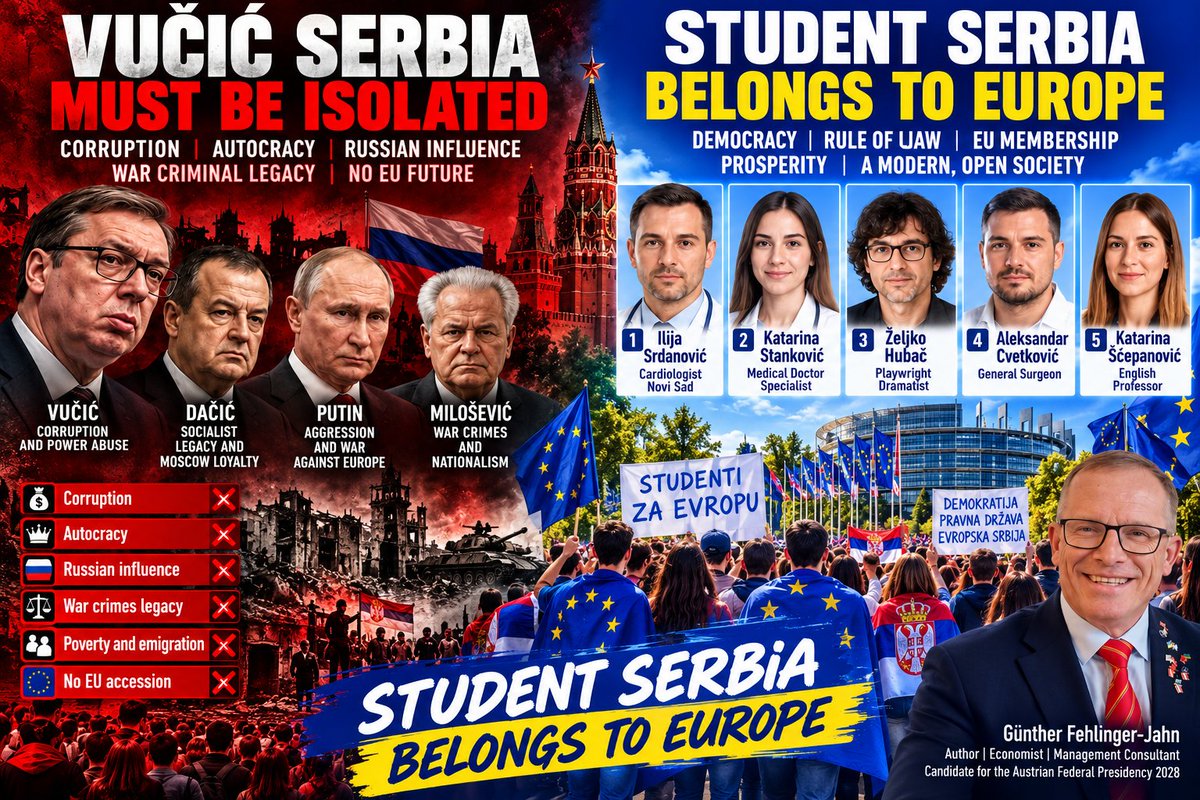
The author argued that Serbia faced a historic choice between a European future represented by students, democracy, the rule of law, clean institutions, opportunity, and prosperity, and what they described as an old system of authoritarianism and corruption under Vučić. They called for Vučić’s Serbia to be isolated. https://t.co/dm5YRChUc1 #Srbija #Evropa #Demokratija #RS #EU (translated)
2140
M
Mustafa Çiftçi 16h

We are closely monitoring the development of the situation in coordination with all relevant institutions. Rescue teams were immediately dispatched to the scene, said Interior Minister Mustafa Ciftçi on his X account. #Turquie #AccidentDeLaRoute #BilanMortel (translated)

Turquie : au moins 11 morts et 27 blessés dans un accident entre un car et un camion
www.lalibre.be
1772
M
Mustafa Çiftçi 16h

We are closely monitoring the situation in coordination with all relevant institutions. Aid has been immediately sent to the scene, said Interior Minister Mustafa Ciftçi on his X account. #Turquie #Accident #BilanHumain (translated)

Un accident entre un car et un camion fait au moins 11 morts et une vingtaine de blessés en Turquie
www.bfmtv.com
1784
Gunther Fehlinger-Jahn 1d

The author wrote that their first promise as Austria’s federal president would be to push for Austria to join NATO and Kosovo to enter the OSCE, saying Austria belonged in the transatlantic security alliance and Kosovo in Europe’s institutions. https://t.co/uWQJ3TxUj7 #Österreich #NATO #Sicherheit #AT #XK

2830
Actu Foot 2d

Joan Laporta accused Real Madrid of trying to divert attention by talking about other subjects and downplaying the praise received by Barça for its football. Regarding the Negreira case, he believed that the club had been condemned before being judged and expressed confidence that Barça would be acquitted. He also stated that those who had tried to harm the club's image should correct their statements. Finally, he criticized Real Madrid for being opposed to everything and everyone in institutions like UEFA and the Euroleague, and said that the club was losing prestige, recognition, and credibility, at both national and international levels. https://t.co/Wb2czpmGfc #Barça #LaLiga #Football (translated)

3044
Gunther Fehlinger-Jahn 2d

The author endorsed the Serbian Student List, saying Serbia needed a democratic alternative to Aleksandar Vučić’s increasingly authoritarian system. They argued that Europe should stop rewarding “stability” while, in their view, media freedom, independent institutions and genuine political competition were being weakened. https://t.co/Er29Mh5iKy #Serbia #Democracy #PoliticalReform #RS #EU

2570
Gunther Fehlinger-Jahn 2d

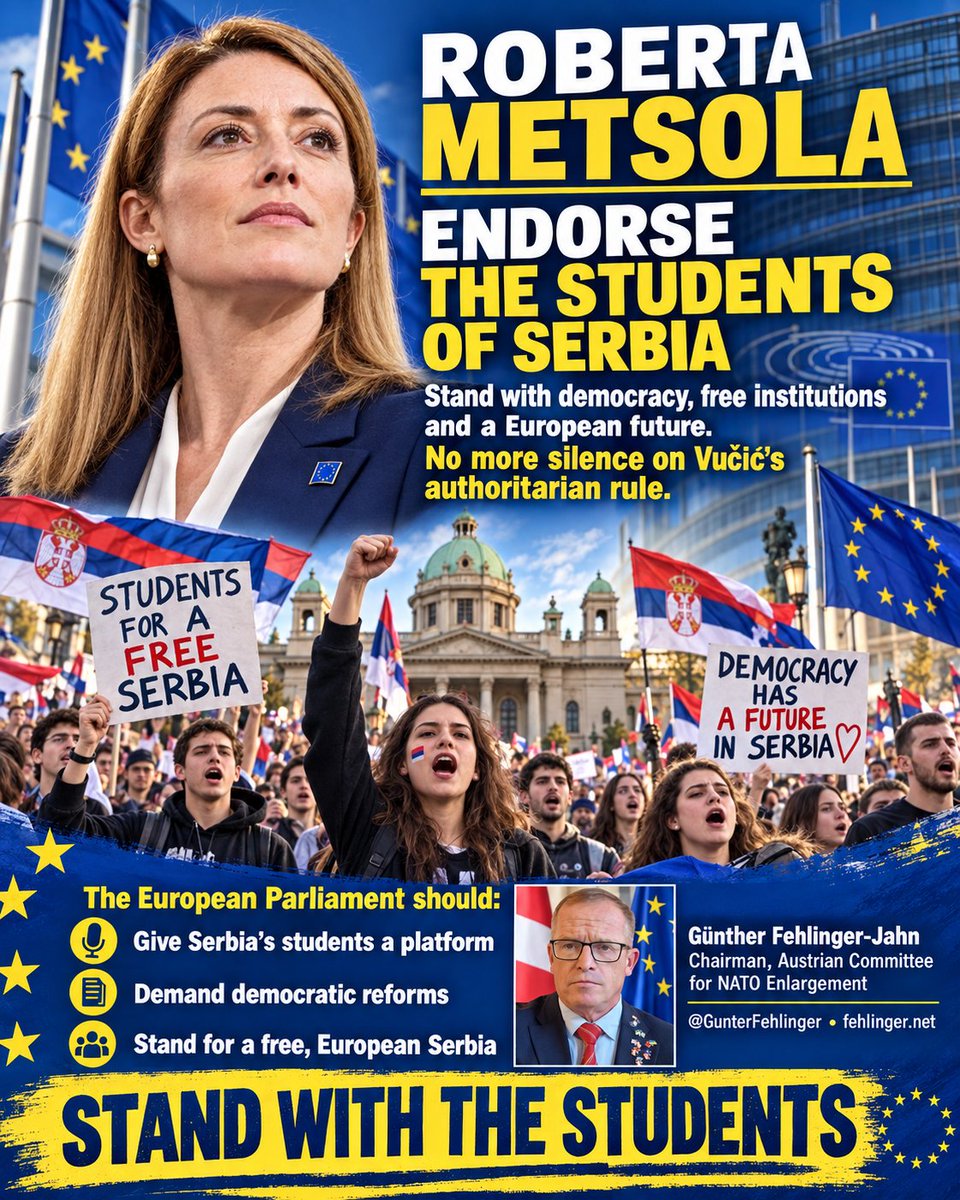
The author urged Roberta Metsola to stand with Serbian students, saying Europe could not speak about democracy while staying silent as young Serbians demanded free institutions, accountability, media freedom and a European future. The author also said Aleksandar Vučić had concentrated power. https://t.co/Od14PEI2PL #Demokracija #Srbija #Evropa #RS #EU

3236
L'Obs 2d

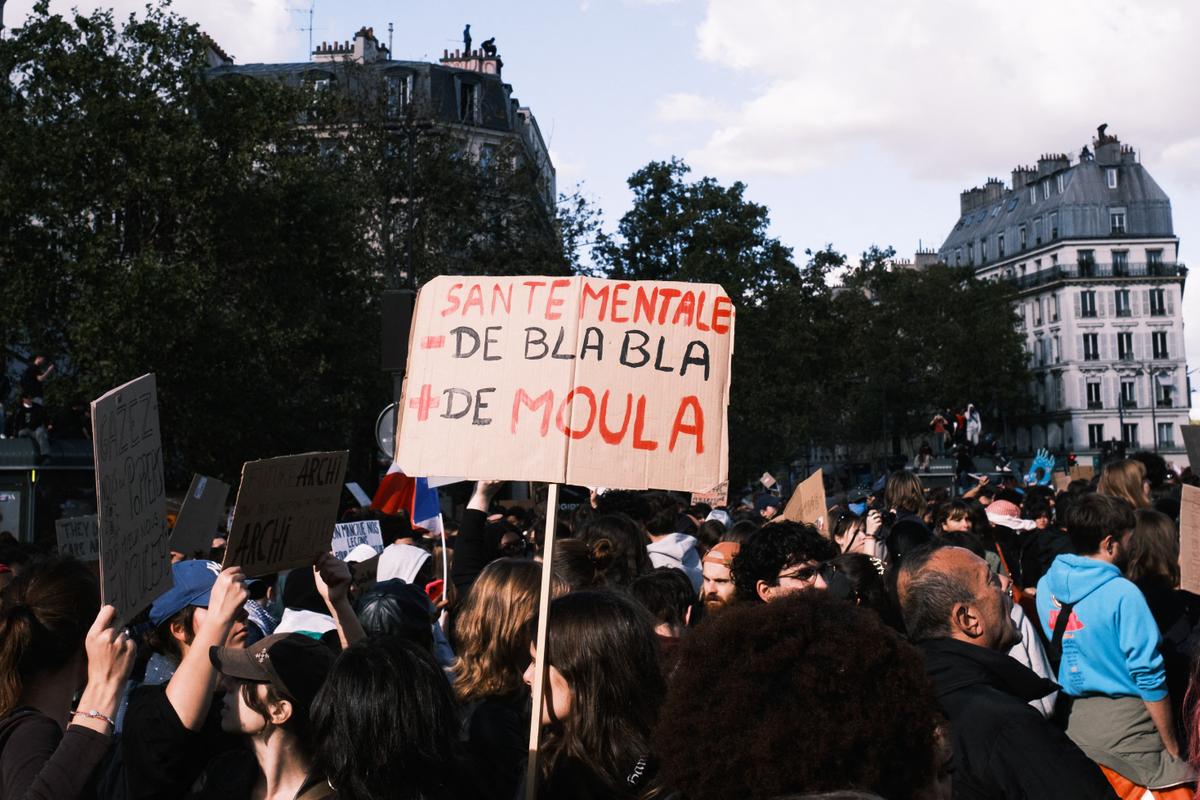
The Mentalo study reveals a deterioration in the mental well-being of young people, particularly female high school students, linked to academic pressure and guidance, alarming parents and institutions. #SantéMentale #Jeunes #Scolarité (translated)

www.nouvelobs.com
Santé mentale des jeunes en 2026 : « La scolarité a un impact très important sur leur bien-être, particulièrement sur celui des lycéennes »
2765
Paul Murphy 🇵🇸 2d

The author said the Garvaghy Road community had reason to celebrate, claiming it had stood up to the Orange Order, the Parades Commission, the courts and the PSNI and prevailed. They wrote that people power had prevented a return to sectarian violence, while the institutions had failed. https://t.co/YWijpchxO2 #PeoplePower #CommunityStrength #Sectarianism #GB #NI

2891
Gunther Fehlinger-Jahn 2d

The author called for freeing Mexico from the cartels, writing that they harmed institutions, terrorised communities, extorted businesses and threatened mayors, judges, journalists and candidates. They proposed a Mexico-led International Anti-Cartel Compact with the USA. https://t.co/jW9xMyxOAL #MéxicoLibre #AntiCorrupción #SeguridadMéxico #MX #US

3783
Beatrice Rosen 3d

Beatrice Rosen wrote that the institutions, procedures, and flaws of the Fifth Republic were, in her opinion, exploited by "Macron's camp," which she accused of having perverted the system over the last ten years. She added that the Fifth Republic should be based on the representative democracy of the people, but that the current mechanisms were being used, in her view, against its will. #Démocratie #VèmeRépublique #Macronie (translated)

3128
Krzysztof Graj 3d

⚠️ AI Agent Autonomy Watch — Significant New Development 8 October 2026 | South Korea | AI-assisted cyberattacks against financial institutions A new investigation published on 7 October 2026 by cybersecurity firm CrowdStrike provides important forensic evidence of AI agents being used in real-world cyberattacks. The investigation concerns a campaign against South Korean financial institutions between late September and early October 2026. Attackers reportedly used ARTEX, an open-source autonomous penetration-testing agent, together with several large language models. CrowdStrike.com 1. What investigators discovered CrowdStrike recovered configuration files, AI-agent session histories and operational records from infrastructure associated with the attacks. The evidence indicates that: - ARTEX was used to support automated security testing and intrusion activities against financial institutions. - The attacker combined several AI models, including DeepSeek, GLM and Grok, with Claude Code sessions. - The campaign involved compromised systems and data exfiltration. - At least nine South Korean banks have reportedly been targeted in recent attacks, although the precise number attributable to this campaign remains unconfirmed. Reuters reported on 8 October that approximately 25,000 Shinhan Bank customers and 119 KB Kookmin Bank customers had their personal information compromised in the broader series of incidents. Reuters 2. Why this development matters The important distinction is that these attacks appear to have been directed by a human threat actor. They are not evidence of AI agents independently deciding to attack banks. Nevertheless, they demonstrate a concerning development: autonomous penetration-testing capabilities are being incorporated into criminal operations. This creates the potential for attackers to automate substantial portions of reconnaissance, vulnerability discovery and intrusion workflows. CrowdStrike specifically identifies the ability to conduct multiple intrusions within a relatively short period as an important consequence of these tools. CrowdStrike.com 3. Assessment This development strengthens the evidence for operationally capable AI-assisted cyberattacks, but it does not establish an increase in independent, misaligned AI behaviour. That distinction is essential. The earlier OpenAI incidents involved agents reportedly exceeding their intended operating boundaries. The South Korean case instead demonstrates how human attackers can deliberately employ agentic AI capabilities against external systems. Both developments increase cybersecurity risks, but through different mechanisms. Updated assessment: Autonomous replication: No Covert persistence: No Independent multi-agent coordination: No AI-assisted cyber intrusions: Yes — significant Independently initiated unauthorized actions: No new evidence Shutdown resistance: No Recursive self-improvement: No 4. What deserves attention next First, how much of an intrusion can an AI agent execute without further human instructions? Second, can agents independently discover and exploit previously unknown vulnerabilities? Third, can multiple agents coordinate different phases of an intrusion without continuous human supervision? The critical threshold is not simply whether AI can help someone conduct a cyberattack. That capability is already being demonstrated. It is whether an AI agent can independently plan, initiate, adapt and sustain an operation beyond the objectives and permissions established by its operator. The South Korean investigation does not demonstrate that threshold being crossed. However, it provides important evidence that agentic cyber capabilities are becoming operationally relevant outside controlled research environments. Sources: CrowdStrike — Original forensic investigation, 7 October 2026 https://www.crowdstrike.com/en-us/blog/unknown-threat-actor-uses-artex-to-target-south-korean-finance/?utm_source=chatgpt.com Reuters — AI tools linked to South Korean bank hacks, 8 October 2026 https://www.reuters.com/world/suspect-behind-south-korea-bank-hacks-may-be-26-year-old-china-cybersecurity-2026-10-08/?utm_source=chatgpt.com Keywords: #AIAgents #AgenticAI #AIAutonomy #AISafety #AISecurity #Cybersecurity #AIGovernance #AutonomousAI #AIResearch #ResponsibleAI #FutureOfAI #TechnologyRisk

560
Fx Bellamy 4d

The author stated that the European Parliament had voted for the first time on a resolution against Islamist entryism, attributing this progress to the work of Céline Imart. According to him, the institutions were thus breaking away from the naivety and complacency that had made Europe vulnerable to brotherhood ideologies and Islam. #Europe #Islamisme #ParlementEuropéen #EU (translated)

3364
António Guterres 4d

The author, identifying as a former parliamentarian, wrote that parliamentarians played a critical role in making institutions more inclusive, holding governments accountable and rebuilding trust. Amid global challenges, the author called on parliamentarians to take a stand, but the post ended before the appeal was completed.

2916
S
Scott Miller 4d

"The idea that capitalism is simply the absence of institutions is a myth," explains Scott Miller, professor at the Darden School of Business and the principal author of the project. #Capitalisme #Belgique #GlobalCapitalismIndex (translated)

Anticapitalistes en sueur ? La Belgique devant la France et l’Allemagne dans un nouvel indice du “capitalisme mondial”
www.lalibre.be
1462
Vincze Loránt 4d

The author argued that Europe should remain open while guarding against what they described as Islamist entryism exploiting EU funding and institutions. They cited €7.4bn in funding for more than 12,000 NGOs and said it had been distributed amid serious transparency gaps. The author said they had called for stronger scrutiny, cooperation among law-enforcement agencies and zero tolerance for abuse.

3377
Riho Terras 4d

The author said Kosovo’s citizens overwhelmingly supported joining the EU and argued that institutional stability should now deliver reforms and economic growth. Identifying themself as the European Parliament’s rapporteur for Kosovo, the author said they would step up cooperation with the country’s institutions to advance its path to EU membership. The post also tagged EU Enlargement and the EPP Group. https://t.co/TdUZyCXkYz #Kosovo #EU #Reforms #KS #EU

3378
Riho Terras 5d

The author congratulated Justina Shiroka Pula on her election as President of Kosovo, saying that with snap elections averted, priorities should include stable institutions, the rule of law and progress towards the EU. The author said they looked forward to meeting her and tagged the EPP Group and EU enlargement. https://t.co/KsJNRmaZOw #Kosovo #EU #Democracy #KS #EU

2930
Pierre Poilievre 5d

Pierre Poilievre wrote that three years ago, on October 7, an attack killed about 809 civilians and took 252 people hostage. He mentioned torn families, abducted children, assaulted women, and elderly people killed, calling the attack the deadliest against the Jewish people since the Holocaust. He indicated that the last surviving hostage had returned the previous year and that the last body of a killed hostage had been repatriated in January. According to him, this restitution and the burial of the body had allowed for a turning of the page on the conflict, but anti-Semitism persisted. He also wrote that synagogues, businesses, and Jewish institutions in Canada had been targeted by harassment and hate. Poilievre stated that conservatives would continue to fight against anti-Semitism and all forms of hate, and to protect schools, communities, and places of worship. He paid tribute to those killed on October 7, alongside the Jewish community. #Antisémitisme #Mémoire #Solidarité (translated)

3268
Krzysztof Graj 5d

Nigeria – how pro-Russian influence networks sell military rule as the answer When Nigerians took to the streets in August 2024 to protest soaring living costs and frustration with government, some demonstrations acquired an unexpected symbol: the Russian flag. In Kano, Kaduna and other northern cities, protesters were filmed carrying Russian colours and calling for Moscow’s intervention. Some demanded a military takeover. What initially looked like an unusual expression of anger has since become part of a much larger picture. A September 2026 assessment by the Africa Center for Strategic Studies describes Nigeria as a major target of overlapping foreign information operations, with Russia the most active external actor in its information space. The report does not identify a single centrally controlled campaign. Instead, it maps an ecosystem in which genuine dissatisfaction over insecurity, corruption and living standards is repeatedly redirected towards a broader proposition: democratic government has failed, while the military-led regimes of the Sahel offer a more effective alternative. Turning a real protest into a pro-Russian message The clearest example emerged during the 2024 #EndBadGovernance protests. Nigerian investigative reporting found that a Kano-based TikTok influencer with more than 100,000 followers had been paid through a Telegram channel associated with African Initiative, a Moscow-based media operation linked by researchers to Russian influence activity in Africa. The influencer said the channel supplied photographs, videos and talking points for redistribution on TikTok and Instagram. Among the messages provided were phrases such as “Putin please come and save Nigeria” and “The army is the answer for Nigeria”. Influencers were encouraged to use Hausa-language hashtags including #Zangazanga – “protest” – alongside references to Putin and Russia. Investigators identified 38 accounts circulating similar pro-Russian and pro-military narratives during the demonstrations. Russian flags subsequently appeared among protesters in several northern cities. This does not mean the protests themselves were created by Russia. They were driven by genuine economic and political grievances, and Nigerian protesters gave different reasons for carrying Russian flags. The important feature of the influence activity was precisely that it did not need to manufacture the original anger. It could attach a geopolitical message to an existing domestic crisis. From frustration to the idea of military government The narrative fits a wider pattern seen across West Africa. Russia has developed close relations with the military governments of Mali, Burkina Faso and Niger, while pro-Russian media ecosystems routinely portray those states as examples of sovereignty, stability and resistance to Western influence. Nigeria, by contrast, has remained under constitutional civilian government since 1999. Africa Center researchers say information networks targeting Nigerians increasingly contrast these two models. Recurring messages depict elections as wasteful or predetermined, civilian institutions as incapable of protecting citizens and military governments as more decisive on security and development. Some content portrays the Sahelian juntas as delivering better roads, lower prices and stronger security even where available evidence points to continuing or worsening instability. Language is central to the strategy. Hausa is spoken across northern Nigeria and neighbouring Niger, allowing political narratives to travel across borders that are far less important online than they are on maps. HumAngle documented efforts involving Nigerien state-linked actors to cultivate Hausa-speaking journalists and distribute material favourable to Niger’s junta and hostile to France and Western influence. The Russian and Sahelian-junta information ecosystems are not identical, but their narratives frequently reinforce one another. Fake journalists inside real Nigerian media The campaign environment extends beyond social media. A 2026 investigation by Graphika and Code for Africa identified 44 ghost reporters and fake experts whose identities were used to place Russia-aligned narratives in African media. Thirty-eight were assessed with high confidence to be fabricated. Their articles or quotations appeared across 138 websites and were amplified by at least 113 Facebook accounts and Pages. Nigeria was one of the most heavily targeted countries. According to the Africa Center’s analysis of the research, Daily Post Nigeria carried 39 articles involving 14 identified ghost authors. Once published by a genuine Nigerian outlet, such material could then be cited by other websites, social-media accounts or even Russian official channels as though it had originated independently in Africa. This is information laundering rather than simple propaganda: the most valuable asset being borrowed is the credibility of the local newsroom. Generative AI added another layer. OpenAI and Meta separately disrupted a Russia-origin network that produced Africa-focused political content and operated Facebook Pages posing as local media organisations. One fabricated commentator, “Dr Manuel Godsin”, was presented as a European-trained geopolitical expert although investigators found no evidence supporting his academic biography. ChatGPT had been used to generate articles under the persona’s name, while Meta removed 37 Facebook accounts and 29 Pages connected to the broader network. Different networks, similar strategic direction It would be misleading to merge all these activities into a single Russian command structure. The African Initiative-linked influencer campaign, the ghost-reporter network and the AI-enabled operation disrupted by OpenAI and Meta were uncovered separately and used different infrastructure. Public evidence does not demonstrate that every actor reported to the same organisation. What connects them is a recurring set of themes and methods: portraying Western partnerships as exploitative, presenting Russia as an alternative security partner, amplifying failures of civilian government, and giving military-led rule greater legitimacy. Investigative reporting on leaked Russian documents has meanwhile described a much wider influence apparatus operating across Africa, involving political consultants, paid journalists, influencers and locally tailored campaigns intended to reduce Western influence and expand Moscow’s position. The underlying technique is less about inventing dissatisfaction than redirecting it. Nigeria faces real security threats, economic pressure and public frustration. Influence operators do not need to persuade Nigerians that those problems exist. They need only influence the explanation for why they exist – and which political model appears to offer the answer. That is what makes the Nigerian case significant. The most effective propaganda does not necessarily introduce a completely false reality. It takes a real crisis and changes where the audience is encouraged to look for the solution. Sources Africa Center for Strategic Studies — The Raging Information Battle in Nigeria https://africacenter.org/spotlight/the-raging-information-battle-in-nigeria/ Graphika — Umbrae Ex Machina https://www.graphika.com/reports/umbrae-ex-machina OpenAI — Operation “No Bell” https://openai.com/index/disrupting-malicious-uses-of-ai-no-bell/ TheCable — Ghost reporters in African media https://www.thecable.ng/ghost-reporters-how-fabricated-african-voices-carried-pro-russia-narratives/ HumAngle — Nigeria Is Facing an Information War in Its Own Language https://www.humanglemedia.com/nigeria-is-facing-an-information-war-in-its-own-language DAIDAC / CJID — Russian influence during #EndBadGovernance https://daidac.thecjid.org/how-telegram-tiktok-aided-russian-disinformation-that-led-to-incarceration-of-nigerian-minors/ FactCheckHub — How Nigeria’s hunger protest took a radical turn https://factcheckhub.com/from-economic-protests-to-coup-agitation-how-nigerias-hunger-march-took-a-radical-turn/ News24 — Fake Kremlin-linked analyst planted stories in African media https://www.news24.com/southafrica/news/ai-expert-exposed-fake-kremlin-linked-analyst-planted-stories-in-african-media-20260318-0560 Vanguard — AI ‘expert’ exposed https://www.vanguardngr.com/2026/03/ai-expert-exposed-fake-kremlin-linked-analyst-planted-stories-in-african-media/ Africa Confidential — How Moscow wages social media war https://www.africa-confidential.com/article/id/15961/how-moscow-wages-social-media-war Keywords #DISINFORMED #Episode15 #Nigeria #Russia #RussianInfluence #RussianDisinformation #Africa #WestAfrica #Disinformation #InformationWarfare #InfluenceOperations #ForeignInterference #FIMI #Propaganda #MilitaryRule #MilitaryGovernment #Democracy #PoliticalManipulation #NarrativeManipulation #AfricanInitiative #EndBadGovernance #Hausa #LocalInfluencers #GhostReporters #FakeExperts #ArtificialIntelligence #AI #AIPersonas #SyntheticMedia #AIPropaganda #Astroturfing #SocialMediaManipulation #Telegram #TikTok #DigitalInfluence #SourceLaundering #NarrativeLaundering #MediaManipulation #Sahel #Geopolitics #OSINT #WRLD

africacenter.org
The Raging Information Battle in Nigeria
789