WRLD

Search

#illustration
Elodie Dvt 2d

Elodie Dvt targeted Matthieu Valet, presenting him as the type of person the warning against drinking the contents of shampoo bottles was meant for. She added that he had been a commissioner, a position she described as supposed to represent the top of the line. #humour #société #fautes (translated)

2587
Mr. Numberwise 3d

Discover algebra through a coastal adventure on Vancouver Island. https://www.amazon.ca/dp/B0HM5FL7BD Chitakin aala nachual suwa! We are happy to see you! The Ants’ Treasure on Vancouver Island: Where the Paths Meet invites children and families in Nuu-chah-nulth communities to explore mathematics through story, pictures, and discovery. On a Pacific shoreline of pebbles, driftwood, and ocean waves, Mia and Alex follow two mysterious ant paths. With Mr. Numberwise as their guide, they discover how equations describe paths—and how their meeting point can reveal a treasure. Wooden staircases make slope visible. A treasure map introduces coordinates. Red and blue paths help children understand graphs and intersections. Young learners explore: • linear equations • slope and starting values • coordinates and graphing • intersections of straight lines The book combines colorful illustrations, step-by-step explanations, solved exercises, and practice worksheets. Its visual approach helps children connect mathematical symbols with ideas they can see. Designed mainly for ages 10–14, it can be enjoyed at home, in classrooms, or with an adult supporting a younger learner. An English-language mathematics adventure in a contemporary Nuu-chah-nulth setting. Follow the paths. Find their meeting point. Discover the mathematics behind the treasure. Chuu wey! Goodbye! #NuuChahNulth #NuuChahNulthLanguage #VancouverIsland #WestCoast #PacificCoast #BritishColumbia #Canada #CoastalLife #Ocean #Crabs #Octopus #Ants #TreasureHunt #Adventure #Kids #HappyKids #LearningThroughStories #VisualLearning #VisualAlgebra #MathMadeClear #Happy #HappyEdu #HappyKids #HappyMath #OceanFauna #MarineLife #VancouverFauna #PacificKids #MrNumberwise 20261007_0026_00(00)0 20261009_0834_70(17)1 20261012_0030_447(128)4

560
Mr. Numberwise 4d

Tanshi! Hello! Discover algebra through a treasure adventure at Batoche. https://www.amazon.ca/dp/B0H4SGZ6PL The Ants’ Treasure at Batoche: Where the Paths Meet invites children and families in Métis communities to explore mathematics through story, pictures, and discovery. Paywiichaywin! Come with me! Join Mia and Alex near the South Saskatchewan River, where two mysterious ant paths lead to a mathematical surprise. With Mr. Numberwise as their guide, they discover how equations describe paths—and how their meeting point can reveal a treasure. Aen pchi shmayn—a small path—becomes the starting point for a big discovery. This English-language adventure brings visual mathematics into a contemporary Métis setting, with family connections, fiddle music, and details inspired by Métis beadwork and woven sashes. Staircases make slope visible. A treasure map introduces coordinates. Red and blue paths help children understand graphs and intersections. Young learners explore: • linear equations • slope and starting values • coordinates and graphing • intersections of straight lines Memorable visual explanations turn an equation into the recipe for a path, coordinates into the address of a point, and an intersection into the place where two path-stories meet. The book combines colorful illustrations, step-by-step explanations, solved exercises, and practice worksheets. Designed mainly for ages 10–14, it can be enjoyed at home, in classrooms, or with an adult supporting a younger learner. Shipwayhtaytaak! Let’s go! Follow the paths. Find their meeting point. Discover the mathematics behind the treasure. Miina kawaapamitin! See you again! #Michif #MichifLanguage #Métis #MétisCulture #Batoche #SouthSaskatchewanRiver #Saskatchewan #Canada #CanadianKids #IndigenousEducation #FiddleMusic #Beadwork #MétisSash #Ants #TreasureHunt #Adventure #Kids #Happy #HappyEdu #HappyKids #HappyMath #LearningThroughStories #VisualLearning #VisualAlgebra #MathMadeClear #MrNumberwise 20261007_0050 20261007_2343 #0271 20261009_0827 197(122)2 20261009_1835_214(216)2 20261012_0032_674(341)6

788
Mr. Numberwise 5d

We are happy to see you! Discover algebra through a coastal adventure on Vancouver Island. The Ants’ Treasure on Vancouver Island: Where the Paths Meet invites children and families in Nuu-chah-nulth communities to explore mathematics through story, pictures, and discovery. On a Pacific shoreline of pebbles, driftwood, and ocean waves, Mia and Alex follow two mysterious ant paths. With Mr. Numberwise as their guide, they discover how equations describe paths—and how their meeting point can reveal a treasure. Wooden staircases make slope visible. A treasure map introduces coordinates. Red and blue paths help children understand graphs and intersections. Young learners explore: • linear equations • slope and starting values • coordinates and graphing • intersections of straight lines The book combines colorful illustrations, step-by-step explanations, solved exercises, and practice worksheets. Its visual approach helps children connect mathematical symbols with ideas they can see. Designed mainly for ages 10–14, it can be enjoyed at home, in classrooms, or with an adult supporting a younger learner. An English-language mathematics adventure in a contemporary Nuu-chah-nulth setting. Follow the paths. Find their meeting point. Discover the mathematics behind the treasure. Goodbye! (translated)

1130
S
Stig Colbjørn Nielsen 6d

Just published! New Scandinavian poems in English and fine art illustrations -

339
Linnéa 7d

Linnéa wrote that those who chose and approved the illustration likely wanted to be inclusive, but that Swedish schools should not contribute to normalizing sexism and the sexualization of children. She added that the presence of eight-year-old girls in veils did not mean that educational materials needed to depict them. (translated)

3403
France Galop 1w

France Galop indicated that the Qatar Prix de l'Arc de Triomphe was taking place that day at ParisLongchamp. To celebrate the event, the organization shared a special illustration of Umamusume and invited its subscribers to watch the race with it. #PrixdelArc #Coursehippique #Umamusume (translated)

34243
Ilan Gabet 1w

Ilan Gabet stated that Thaïs d’Escufon had expressed joy over the mutilation of a 16-year-old boy. He considered that it illustrated the system's failures in the face of online hate and criticized her for spreading hostile content on social media for years. He asked why she had not been condemned or banned from social media, a measure that he believed the law would allow, and why her posts had not been sanctioned by moderation. He finally asked when the authorities would put an end to the situation. #HaineEnLigne #LibertéDexpression #JusticeSociale (translated)

18105
Y
Yonathan Arfi 2w

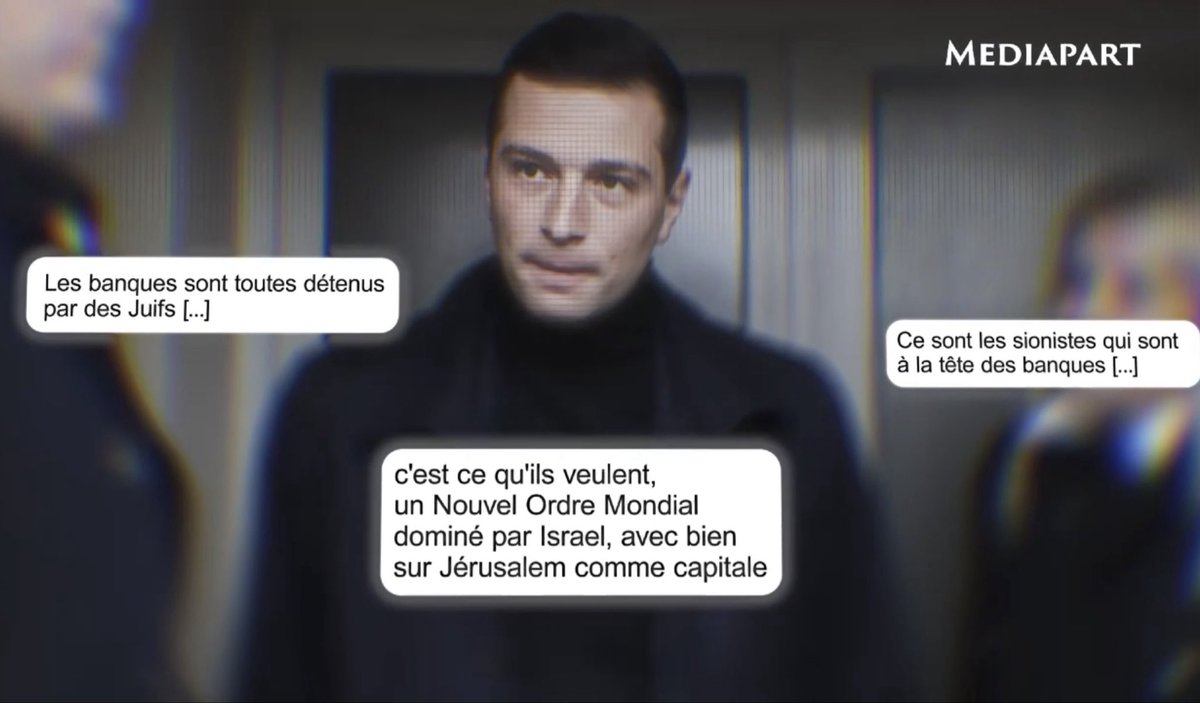
"C'est une illustration des limites de la dédiabolisation du Rassemblement national""C'est une illustration des limites de la dédiabolisation du Rassemblement national", a dénoncé à l'AFP Yonathan Arfi, président du Conseil représentatif des institutions juives de France. #Antisémitisme #RassemblementNational #JordanBardella

Propos antisémites attribués à Jordan Bardella : "On assiste à la machine à fabriquer des boules puantes", affirme le vice-président du groupe RN à l'Assemblée nationale
www.franceinfo.fr
1721
Y
Yonathan Arfi 2w

"C'est une illustration des limites de la dédiabolisation du Rassemblement national""C'est une illustration des limites de la dédiabolisation du Rassemblement national", a dénoncé le président du Conseil représentatif des institutions juives de France (Crif) auprès de l'AFP, Yonathan Arfi. #Antisémitisme #JordanBardella #RassemblementNational

Mediapart rapporte des écrits antisémites de Bardella datant de 2013 : le président du RN dément, Le Pen évoque "une barbouzerie"
www.lalibre.be
1722
Y
Yonathan Arfi 2w

« C’est une illustration des limites de la dédiabolisation du Rassemblement national »Des propos que le « premier ministrable » de Marine Le Pen dément « formellement » mais qui ont déjà fait réagir Yonathan Arfi, le président du Conseil représentatif des institutions juives de France (Crif) : « C’est une illustration des limites de la dédiabolisation du Rassemblement national ». #Antisémitisme #JordanBardella #RassemblementNational

D’anciens écrits antisémites de Jordan Bardella révélés par Mediapart
www.nouvelobs.com
1952
E
Emmanuel Macron 2w

Le régime de Vladimir Poutine a frappé la plus grande institution de recherche scientifique ukrainienne : l’Académie nationale des Sciences d’Ukraine.   Ces frappes sont une nouvelle illustration du mépris hostile du régime russe à l’égard de la science et de la vérité. #Ukraine #ScienceUnderAttack #PutinRegime #UA #RU

3445
Brèves de presse 2w

🔴🇫🇷FLASH - « C’est une illustration des limites de la dédiabolisation du Rassemblement national », réagit le président du #CRIF après les révélations de Mediapart sur les écrits #antisémites de Jordan #Bardella. Une déclaration lourde de sens après des années de rapprochement entre le #RN et la communauté juive, accompagné, consciemment ou non, par certains relais médiatiques. Un attelage contre nature que ces révélations viennent aujourd’hui percuter de plein fouet. #France #Politique #Antisémitisme

14238
AlertesInfos 2w

🇫🇷 FLASH - Le Crif estime que les écrits antisémites attribués à Jordan Bardella sont "une illustration des limites de la dédiabolisation du Rassemblement national". (AFP) https://t.co/eNV3enMiSf #Antisémitisme #RassemblementNational #Politique

35371
Daniel Schatz 2w

Bokmässan har yttrandefrihet som tema. Ändå kunde Palestinaaktivister störa ett samtal om Israel med Widar Andersson, kasta ketchup, hota samt skrämma deltagare och försöka tysta ett budskap de ogillade. Det är svårt att tänka sig en tydligare illustration av varför yttrandefriheten måste försvaras i praktiken – inte bara hyllas som tema. Jag utgår från att Bokmässans arrangörer fördömer detta angrepp på det fria ordet utan förbehåll. #yttrandefrihet #Bokmässan #demokrati

14389
S
Stig Colbjørn Nielsen 2w

Melody of Silence - Modern Scandinavian poetry in English by the author, Stig Colbjørn Nielsen, Denmark. Melody of Silence is a captivating collection of modern poems inspired by the tranquil beauty of a Danish island, yet its themes extend far beyond Nordic borders. Through powerful poetry and striking illustrations created by the author, this book delves into life’s deeper questions amidst a chaotic world. A poetic journey exploring silence, nature, and the search for meaning. This collection invites readers to pause and reflect on moments of stillness, beauty, and inner strength. Rooted in the quiet simplicity of island life, the poems touch on universal ideas like the mysteries of existence, the flow of time, and the ongoing quest for purpose. Each poem is accompanied by an original illustration, crafted by the author, which enhances the meditative experience and encourages thoughtful contemplation. Together, the words and images offer comfort and insight for anyone facing the uncertainties of modern life. Melody of Silence serves as a tribute to the quiet power of nature and acts as a thoughtful guide for those seeking clarity and wisdom on life’s complex path. Alltogether the most beautiful European book of the year!

922
Barry Malone 3w

This is a beautiful illustration of the extent to which Israel is a pariah across much of the world, something a lot of people in the West don’t realise because, for years, the mainstream media has done its bidding. #Israel #MainstreamMedia #Pariah #IL #US

5190

Sur LCI, Ségolène Royal explique l’explosion de l’antisémitisme en France par le fait que les juifs ne se désolidarisent pas de Benjamin Netanyahou…. Autre illustration d’une gauche à la dérive. #Antisémitisme #SégolèneRoyal #France

13160
Ivan Rioufol ن 3w

Quand #LéonXIV réveille la France catholique Les Français oubliés vont-ils écrire la nouvelle histoire ? Ils sont les dépositaires d’une possible révolution. Le réveil de la France catholique en offrira, dès vendredi, une illustration. Dès 10 heures, toutes les églises de France #LéonXIV #FranceCatholique #RéveilFrancais #FR

P
Patrice CUDICIO 3w

The Return to Feudalism in 21st Century Garb A simple observer's viewpoint, with no claim to hold any absolute truth. The Veneer Cracks There is something strangely archaic about the world unfolding before our eyes, despite its satellites, artificial intelligence, and promises of infinite progress. Here and there, we witness heads of state behaving like feudal lords of another age, patiently nibbling away at the neighboring territory, redrawing borders through force rather than law, as if governing a nation mattered less than expanding one's fiefdom. No names need be mentioned here: current events provide plenty of illustration, and each reader will recognize, according to their own geography and moment of reading, the faces that embody this observation. But this return to the archaic is not confined to grand geopolitical stages. It also permeates the most ordinary daily life—that of social media, where anyone can pour out venom against another without filter, without form, and often without the slightest argument. The verbal jousting of yesteryear, with its codes, its rhetoric, its tacit limits, has given way to raw invective, snap judgment, instant condemnation. We no longer debate: we execute, verbally—and sometimes it doesn't stop at words. The Vanished Inhibition What strikes one, in this dual observation—macro-political and micro-social—is the lifting of an inhibition we thought firmly anchored. Centuries of cultural construction, education, philosophy, sometimes religion, had patiently shaped mechanisms of restraint: politeness as social ritual, argumentation as a mode of resolving disagreement, respect for one's opponent as the very foundation of democratic debate. This civilizational veneer, however fragile it always was, seemed to hold. Today it is cracking, and the question—which for me remains a simple hypothesis, not a certainty—is why. A convenient explanation would blame social media: anonymity, the distance of the screen, the instantaneousness of publication would favor verbal acting-out without the usual mediation of reflection. This is probably true, but likely insufficient. For technology here is only an accelerant, an amplifier—not necessarily a root cause. A Poorly Formatted Neocortex? The more unsettling hypothesis—and I frame it explicitly as hypothesis, not scientifically established fact—is that of a failure in the formation of moral judgment and tolerance toward otherness. The human brain possesses the neural structures enabling empathy, the distancing of impulsive reaction, the acceptance of difference—but these capacities are not innate in their full exercise: they must be built, educated, cultivated, like a muscle that needs patient training from childhood onward. If this education in otherness, nuance, and tolerance of disagreement erodes—for multiple and undoubtedly complex reasons that are not mine to settle here—then older reflexes resurface: instinctive distrust of the stranger outside the clan, the law of the strongest, the logic of territorial or symbolic predation. The other ceases to be a possible interlocutor and becomes once again a potential threat, unless they belong to my tribe, my clan, my party, my digital bubble. Two Scales, One Logic What is striking, in this deliberately provocative reading, is the structural similarity between these two scales. The leader who invades a neighbor in the name of a rediscovered greatness or a reinvented historical right, and the anonymous internet user who insults a stranger in the name of an unnegotiable conviction, may obey the same underlying grammar: that of territory to defend, clan to protect, the other to subdue or exclude rather than understand. The form has changed—satellites instead of horses, tweets instead of heralds—but the substance, in this reading that remains mine alone and commits no one else, seems strangely identical to that of feudal rivalries: the absence of a recognized third party, of an accepted common rule, of a respected arbitrating authority. Everyone becomes judge and party, lord of their own digital or territorial fiefdom. A Civilization on a Knife's Edge Norbert Elias, in his Civilizing Process, showed how Western societies had historically built, with remarkable slowness, an increasing control over impulses and direct violence, in favor of more sublimated forms of social regulation. What we may be observing today—and I stress again the conditional—is a form of regression in this process, or at least a fragilization of the veneer it had patiently laid down. Should we see this as an effect of great technological accelerations, which shake up our cognitive rhythms without leaving education time to adapt? A deeper crisis of the institutions tasked with transmitting these values of tolerance—school, family, religion, the rule of law? Or simply a cyclical movement of human history, where phases of policed civilization alternate with darker backlashes? I have no certain answer, and I would be wary of anyone claiming to hold one. In Conclusion, a Shared Concern This text is only a viewpoint, necessarily partial and subjective, on a world that sometimes seems to replay ancient logics in new clothing. Perhaps I am wrong to perceive a continuity between the feudal lord and the contemporary dictator, between the anonymous online insult and the absence of education in nuance. Perhaps these phenomena are unrelated, or too complex to be thus summarized. But if this reading, even partially, hits the mark, then the question that arises is less one of technological regulation—though necessary—than the far more arduous question of how to rebuild, generation after generation, this capacity to accept the other in their difference, to debate without destroying, to coexist without necessarily dominating. This undertaking, if it exists, will not be resolved by an algorithm nor by an international treaty. It plays out, patiently, in the most elementary education—the one that teaches a child that the other is not a threat, but a possibility. Bibliography Elias, N. (1939). Über den Prozess der Zivilisation [The Civilizing Process]. Oxford: Blackwell (Eng. trans. 1978-1982). Lorenz, K. (1963). Das sogenannte Böse [On Aggression]. London: Methuen (Eng. trans. 1966). Arendt, H. (1970). On Violence. New York: Harcourt, Brace & World. Han, B.-C. (2013). Im Schwarm [In the Swarm: Digital Prospects]. Cambridge, MA: MIT Press (Eng. trans. 2017).

693