WRLD

Search

#neve
Jornal Expresso 5m

Internal letters expose high tension in the Ministry of Internal Administration, with the secretary-general warning about the lack of oversight in SIRESP, while Luís Neves refutes the allegations. #JavaScript #AdBlocker #WebDevelopment (translated)

expresso.pt
Cartas internas revelam tensão máxima no MAI: secretário-geral alertou para SIRESP sem fiscalização, Luís Neves nega
1032
Victor Ponta 9m

The author extended condolences to the families of victims of the attacks in Riyadh, Saudi Arabia, and condemned the violence as unacceptable and unjustifiable. They said their thoughts were with the victims, their loved ones and the people of Saudi Arabia. #Riyadh #Condolences #StopViolence #SA

1492
Anaelmarlon Luz - Général 4 ⭐ 9m

Anaelmarlon Luz reported a tense situation in Kanyaru, about 2 kilometers from Rubaya, in the Masisi territory of North Kivu. Citing information from the ground, he also reported movements of fleeing Rwandans accompanied by their herds and stated that reinforcements from the RDF/M23 coalition had been targeted by the FARDC and Wazalendo fighters. #RDC #Sécurité #Conflit (translated)

1145
Luciano Magaldi Sardella (PhD) 25m

LETTERE MERIDIANE — “TEATRO-EDICOLA” OF SAN SEVERO CONQUERS THE WORLD SOURCE: https://www.letteremeridiane.org/2026/10/il-teatro-edicola-di-san-severo-conquista-il-mondo/?fbclid=IwY2xjawU4oqFleHRuA2FlbQIxMQBwZG9mAXNydGMGYXBwX2lkEDIyMjAzOTE3ODgyMDA4OTIAAR5rVEwYs6UUXg7v-P0SyIQ_DRb_F6ZiY58OcseYoV4J7atcTiERnhWaqKM2pw_aem_Njle1jq1XLzHr93KLBUcVA After “Broadway World”, the “Los Angeles Journal”, “The Psychologist (British Psychological Association)” and Hollywood Beat Magazine, its “academic consecration” has now arrived courtesy of Stanford University. As I have already emphasised in my article on the revival of the GIO Festival in Foggia, celebrated by BroadwayWorld for the world stage premiere of the Giordano’s opera Marina (1888), the province of Foggia has long ceased to be peripheral. It happens when it finds an idea that shifts the coordinates: well, in San Severo, 40 kilometres from Foggia, it has happened again. Only this time an orchestra was not needed; six chairs were enough. The celebrated Teatro-Edicola of San Severo artistic director Francesco Gravino of the theatre company Foyer ’97 has been featured in the academic journal “Stanford Social Innovation Review (SSIR)” as an academic case study. The news, relayed on 19 September 2026 by ANSA Nazionale, looked like a misprint. Then it became clear that it was not. SSIR, an award-winning publication covering multisectoral solutions to global problems, included the project in its Dispatches section with the reportage “The Six-Seat Revolution”. It is the inverse trajectory to that of the GIO Festival: not a forgotten opera returning to a grand historic Italian horseshoe theatre, but an entire theatre reborn inside a disused place, forgotten by man. There are moments when past and future intertwine to create something visionary, innovative, artistically “revolutionary”: San Severo experienced one of those moments on the morning of 27 March 2026, during World Theatre Day, when the shutter of a newsstand closed for six years in Via Matteo Tondi was reopened “not to sell newspapers, but to offer stirring stories”, to quote Gravino’s motto. The idea of the visionary Francesco Gravino, artistic director, stage director and actor of the San Severo company Foyer ’97, active for at least 30 years in Capitanata, centred on the kiosk, hexagonal in metal and glass, granted free of charge by its owner Pino Frau, by now an urban relic created by the publishing crisis of the early 2000s: today in Italy active newsstands have fallen from about 35,000 in 2005 to about 20,000 in 2024, a decline of 42.8%. Gravino and eleven other actors restructured it in two weeks of work, without institutional funding, and transformed it into what is now under examination by the London commission of Guinness World Records as the “world’s smallest theatre”. The formula is deliberately austere: six spectators at a time outside, actors inside at less than a metre’s distance, 15-minute performances, continuous rotation from 11:00 to 20:45, texts ranging from Goldoni to Chekhov, from Ibsen to Dacia Maraini. On the door a QR code with an original theatrical warning: “Warning! This QR code transforms passers-by into actors. Scan only if ready.” The numbers immediately showed that it was no boutade: more than 60 people in a single afternoon, three inaugural days that sold out. But above all a positive echo that went beyond the borders of San Severo. “Broadway World” (just as in the previous case of the GIO Festival), the world’s most influential theatre criticism outlet with over 5.5 million monthly views, devoted exclusive coverage to it on 27 April 2026: “An Abandoned Italian Newsstand Just Became the World’s Smallest Theatre”. Not a mere listing, but an analysis: “There is no foyer, there is no balcony, there is no grid. There is barely a wing. What there is is something almost unrecognisable as an evening at the theatre, and for that very reason it is all the more powerful.” “Broadway World” captured Gravino’s manifesto idea: “This is a theatre of proximity. In an era of digital distance, we are putting human contact back at the centre,” framing it as “More than a clever exercise in site-specific theatre. It is a reappropriation.” All of this, in a Mezzogiorno of Italy often narrated only in terms of organised crime and marginalisation. To that seal of approval was added another, even more disorienting for a newsstand in San Severo: the “Los Angeles Journal”, one of the most influential publications on the West Coast for the performing arts. On 12 May 2026, it headlined thus: “San Severo’s Teatro-Edicola as an Innovative Model for Los Angeles Theaters?” opening as follows: “In a city in southern Italy that Hollywood has never heard of, a theatre director has just built the smallest stage in the world: six seats, fifteen minutes, zero distance. Los Angeles should pay attention.” The “Los Angeles Journal” does not indulge in folklore, but places the kiosk in Via Matteo Tondi alongside the prestigious 1,600-seat Ahmanson Theatre in Los Angeles, the Pantages of Broadway in Hollywood, the 99-seat plan of Rogue Machine, the Odyssey, the Victory Theatre and the Hollywood Fringe. It even recalls Ethan Marks’s Electrical Box Theatre, a veritable electrical box lined with red velvet in downtown Los Angeles, to argue that Gravino has taken to the extreme the question Los Angeles has been asking itself for decades: How small can a stage become before it ceases to be a stage? And it recognizes the San Severo urban model: almost zero cost, two weeks of work and six chairs, in return for immediate provincial, regional and national media coverage, recognition by the San Severo’s Municipal Administration, and a format exportable anywhere. Then, the third American piece came from “Hollywood Beat Magazine” on 20 April 2026: Six seats. Fifteen minutes. One actor. No stage. The magazine recounts the kiosk in Via Tondi left disused for almost six years, the contemporary six-seat cultural outpost, placing Francesco Gravino in a distinguished genealogy: Richard Schechner and environmental theatre, Jerzy Grotowski and poor theatre, Nicolas Bourriaud and relational aesthetics. But it closes with pragmatism: it is not a thesis, it is fixing a street corner, that is, repairing an urban street corner by asking not how large a theatre can become, but how small it must become again to recover its original power. And finally, the celebrated London-based “The Psychologist”, the journal of the “British Psychological Society (BPS)”, the oldest psychological society in the world, transformed the Teatro-Edicola into a scientific case study: on 30 July 2026 it published “The world’s smallest theatre — and Psychologists’ next act”, starting from the same detail, the morning of 27 March when the metal shutter of the hexagonal kiosk in Via Tondi reopened after six years, six people inside, an actor at less than a metre’s distance beginning Chekhov. It describes the formula: six spectators, 15 minutes, 11 actors over 10 hours, from Goldoni to Euripides, inside a kiosk where the fourth wall does not break because architecturally it never existed. But the BPS goes a step further: it cites the 2025 studies by Damien Gabriel in IBRO Neuroscience Reports, that live performance generates measurably stronger emotional and physiological activation than video, and introduces Edward Hall’s proxemics: below one metre is intimate space, reserved for doctors, close friends, lovers. In that one-square-metre space, the actor’s breath is audible, micro-expressions legible, the self-other boundary becomes permeable. The Teatro-Edicola “does not make theatre better, it makes it inevitable”. And it is here that one understands why Stanford is studying it as an academic case study in social innovation, not as a case of artistic originality. In Italy, meanwhile, the national media circuit had already picked up the phenomenon: RaiNews — TG2 Storie brought it to RaiDue at midnight on 19 April. RTL 102.5 devoted space to the format conceived by Gravino and developed by Foyer ’97 in the heart of San Severo in Via Tondi, defining it as a permanent micro-stage capable of bringing theatre into public space. ANSA.it, Gazzetta del Mezzogiorno, La Repubblica, TG2000, Radio Capital, Swiss RSI, ANSA Brazil and many others followed. And for the record: Fiorello praised it in La Pennicanza as an artistic case inspired by his Edicola Fiore, and Biagio Antonacci, on his tour in the Augustan amphitheatre of Lucera, made a “fact-finding” stop at the Teatro-Edicola singing the celebrated and nostalgic Iris in front of an audience certainly larger than the “six seats”. Francesco Gravino’s theatre company Foyer ’97 was not born yesterday: behind it lie the Teatro-Cantina of 2016, the underground theatre, and in 2011 a performance on the bell tower of a church in the centre of San Severo at 45 metres high. The Teatro-Edicola completes, in Gravino’s words, “the entire vertical extension of theatre: underground, street level, rooftop”. And it is preparing for its thirtieth anniversary in 2027 aiming to purchase the kiosk to make it permanent, exporting the “San Severo Model” to Rome, Lucca, and to the festivals of Santarcangelo and Todi. As with the GIO Festival, someone might dare to claim that it is merely a stunt, but when BroadwayWorld places you alongside the Los Angeles Opera House, the “Los Angeles Journa”l proposes you as a model for Hollywood, “Hollywood Beat Magazine” reads you through Grotowski and the “British Psychological Society” uses you to explain mirror neurones, it is no longer a stunt but an excellent artistic and academic positioning. To those who still whisper that Foggia and Capitanata are provincial, the answer is now written on two opposite and complementary fronts: on 5 June in Foggia a 138-year-old opera found the stage again at the Giordano ending up on BroadwayWorld; on 27 March in San Severo a 4-square-metre kiosk invented a stage that did not exist, ending up at Stanford, in Los Angeles, in Hollywood and in London. The periphery, when it has a precise idea, becomes the centre. Even with six chairs. Luciano Magaldi Sardella

www.letteremeridiane.org
Il teatro-edicola di San Severo conquista il mondo
47
Andreas Kling 59m

The author wrote that browser content renderers could never be made completely safe from malicious takeover. They said the main architectural priority should be to sandbox them aggressively and assume they were under hostile control.

1305
A
Andrej Babiš 1h

Even Babiš called the agreement between Trump and Putin shocking, while the Russians shot at Ukrainian civilians again, while the Ukrainians targeted one of Yandex's data centers. #szegénység #szerhasználat #mentálhigiénia (translated)

Gyilkos szerek és gyilkos szándékok
444.hu
1261
zdeněk šarapatka 2h

Zdeněk Šarapatka thanked his supporters and stated that their support helped him get back on his feet after the results of the Senate elections. According to him, the campaign in Prague 5 and 13 was not a fair competition about topics, but a contest over billboards. He claimed that one of the candidates was running a concurrent campaign for the Senate and the Prague City Hall, transferring funds between them, including money from a company building houses. According to Šarapatka, the state supervision office did not respond to the violations of the rules. The candidate, he claimed, received 14,606 votes out of a total of 45,782. Šarapatka also criticized the ODS, which, according to him, despite an agreement with his TOP 09, fielded its own candidate, thereby reducing the chances of defeating Václav Láska. He stated that their candidate hardly presented political positions during public appearances and instead relied on a romanticized story about the students' relationship with the school principal. He added that the students of the candidate's school, according to Šarapatka, got involved in the campaign, even though the principal was balancing on the edge of the education law. The candidate received 12,162 votes out of 45,782. As an earlier example of the split with ODS, Šarapatka mentioned its member Benda, who, according to him, appointed Matocha and Xaver Veselý to the Czech Television Council. He claimed that part of ODS contributed to his failure in the election despite the party agreements at that time. He also recalled that six years ago, at ODS's request, he supported its candidate in the second round of the Senate elections in Mělník, whom he claimed he had not seen publicly appear in the Senate since then. Šarapatka stated that he would not make the same mistake again. According to him, the result meant that there would be no amendment to the lustration law nor security clearances for government members and their deputies, and that there would be no qualified fight for a free Czech Radio and Czech Television. At the same time, he urged his supporters to keep going. #politika #volby #Senát (translated)

1627
L
Lee Jae-myung 3h

The president of North Korea, Kim Jong-un, described the test as an important step in strengthening the country's defense capabilities. #ÉszakKorea #ballisztikusrakéta #Japántenger (translated)

Észak-Korea újabb ballisztikus rakétákat lőtt ki a Japán-tenger irányába
telex.hu
1357
Yuriko Backes 11h

The author wrote that the history of the Second World War showed how valuable, and how vulnerable, freedom, democracy and human rights could be when intolerance and dictatorship prevailed. They said such horrors must never happen again and that everyone had a responsibility to prevent them. https://t.co/z89dRAMLdz #Liberté #Démocratie #DroitsHumains #LU (translated)

2218
David Rangl 12h

David Rangl, in an ironically toned post, claimed that the intervention of Russian data centers caused chaos in the Czech pro-Russian scene. According to him, disinformation websites and trolls stopped receiving instructions, so some people had to form their own opinions. Rangl described that the SPD convened a crisis staff, which, according to him, after several hours came up with several contradictory explanations: either the attack did not occur, Russia repelled it, or it could have been Brussels, NATO, migrants, and Petr Fiala to blame. He also mentioned a demand for the government's resignation without a clearly stated reason. According to him, on the alternative scene, one influencer condemned Russian aggression, another published photos of burning servers as evidence of Russian victory, and another began promoting Russia's accession to NATO. Jindřich Rajchl, according to Rangl, demanded a parliamentary investigative committee due to the decline in followers. The post further described the extinguished premises of the Stačilo! movement, non-functional stamp machines at the Václav Klaus Institute, and the vaccination of the Svatopluk association against rabies at a veterinary station. The situation was eventually calmed by a chain email that blamed events on Soros, Ukrainian pensioners, and a secret NATO lab in Uzhhorod. Rangl concluded that Russian servers were gradually returning to operation, while the damages to the Czech "patriotic scene" could be irreversible, as some people realized during the outage that they could think independently. #ČeskáRepublika #dezinformace #vlastenectví (translated)

2180

Zelensky said, however, that he was not aware of the ceasefire before Trump’s announcement. #RuskoUkrajina #příměří #Zelenskyj (translated)

Moskva zaútočila na ukrajinské energetické zařízení
www.novinky.cz
1806
Latvian public media 13h

After the failure in the Saeima elections, "New Unity" and the Union of Greens and Farmers (ZZS) plan to evaluate their future actions and political course, which raises questions about how to regain voter trust. #JaunāVienotība #ZZS #SaeimasVēlēšanas (translated)

www.lsm.lv
Pēc neveiksmes Saeimas vēlēšanās «Jaunā Vienotība» un ZZS izvērtēs tālāko darbību
2140
T
Turki Al-Maliki 13h

A military spokesman for the Saudi-led international coalition fighting against Yemeni Houthi rebels, Turki Al-Maliki, described the events as an open war crime. #Rijád #HúsziLázadók #Terrorizmus (translated)

Újabb fegyveres csapás érte a rijádi repteret
24.hu
1845

However, Ukrainian President Zelensky stated that he was not aware of the energy ceasefire announced by Trump. #Rusko #Ukrajina #energeticképříměří (translated)

Mezi Ukrajinou a Ruskem podle Trumpa začíná platit energetické příměří
www.seznamzpravy.cz
2285
Martina Navratilova 15h

The author wrote that Donald Trump may not have started the situation but had escalated it to unprecedented levels.

2060
T
Turki Al-Maliki 15h

The military spokesperson for the Saudi-led international coalition, Turki al-Maliki, called the attack on Riyadh airport on Sunday an open war crime. #Rijád #SzaúdÁria #Jemen (translated)

Lecsaptak a szaúdi fővárosra, a támadók jelezték, hogy „a legrosszabb még hátravan”
index.hu
1903
Iman Sefati 15h

Iman Sefati wrote that calls against Israel and Zionists at pro-Palestinian demonstrations with children, in his opinion, showed how early hatred of Jews is instilled in them. He compared this to being imprinted by mother's milk and stated that he knows this from Iran. Many Europeans underestimated the danger because they did not take such slogans seriously enough, he wrote. #Antisemitismus #Kindheit #Demonstrationen (translated)

2317
Bojkot Babišových výrobků 15h

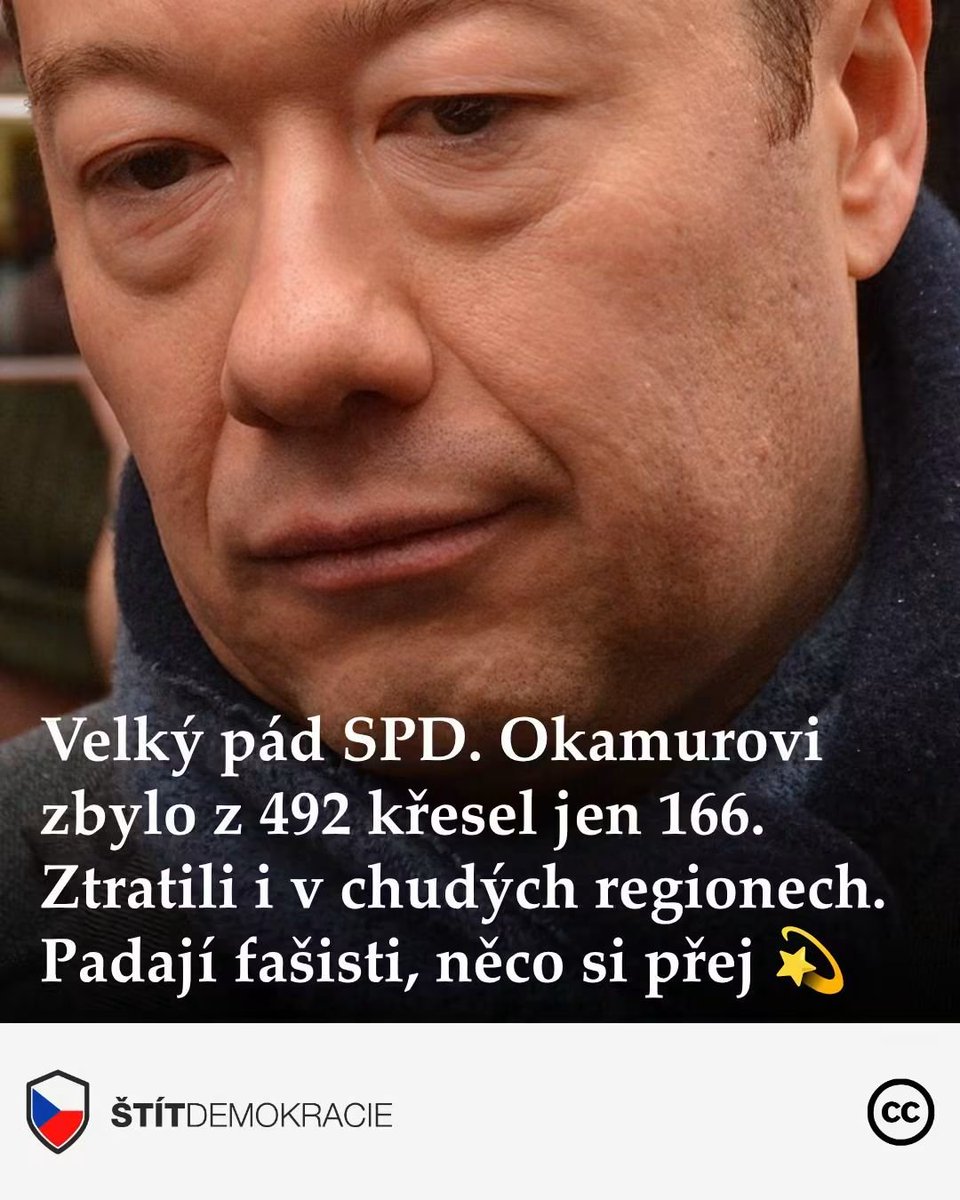
The boycott of Babiš's products stated that the election results confirmed the warnings of experts, analysts, and political scientists. He claimed that after entering the governing coalition, the preferences of SPD began to decline and that Tomio Okamura's party suffered a significant defeat. According to the author, no SPD candidate advanced to the second round of the senatorial elections. In the municipal elections, the party only defended 166 of the original 492 council seats, losing 326. He added that SPD was also losing support in poorer areas where it previously thrived, and he claimed that even Okamura's own voters were beginning to lose faith in him. He concluded the post with a wish for the downfall of political opponents, whom he derogatorily labeled. https://t.co/39epAeaGiZ #volby #politika #SPD (translated)

2327

The real reason for the war in Europe is Russia, and only that. It is already possible today to stop the attacks on the energy sector, but [Russian dictator Vladimir] Putin does not want to do that. Ukraine will be ready to stop attacks on Russian oil refineries if Russia stops attacking our energy infrastructure," Zelensky announced on the platform "X." #Ukraina #Krievija #dīzeļdegviela (translated)

Zelenskis gatavs apturēt triecienus Krievijas naftas rūpnīcām ar vienu nosacījumu
pmo.ee
2017

Jura Háček questioned the credibility of an unnamed man. He wrote that the man allegedly claimed that he did not run the campaign, but he supported candidates in Roudnice, met a known motorist there, and left with him to Černouček. What he learned there he was supposed to keep to himself. Háček also stated that the ministry was aware of Pavel's arrival, but supposedly did not inform the man. https://t.co/mgsktMhfPv #politika #kandidáti #Roudnice (translated)

2054