WRLD

Search

#soldi
Francesca Albanese, UN Special Rapporteur oPt 30m

The author expressed shock at what they described as political inaction over the actions of Israeli settlers and soldiers in Palestine, where they said terror had become a daily reality. They alleged that century-old trees were being burned and livestock poisoned in the West Bank, and asked when the EU would act against what they called “Apartheid Israel.” #Palestine #Israel #HumanRights #IL #PS #EU

1324
Sabrina F. 5h

Sabrina F. claimed that Volodymyr Zelensky was contacting his European allies after Donald Trump suggested he change jobs. She joked about the possibility that he might even call deceased relatives. According to her account, one of the calls was directed to London and the interlocutor was Andy Burnham, whom she referred to as the British Prime Minister. She reported that they would discuss support for Kiev, sanctions against Moscow, and an upcoming meeting, which in her opinion would primarily serve for a photograph, without guarantees on funding. Sabrina F. criticized the European Union, arguing that it promised support in words while the bill would fall on the citizens, and contrasted European statements with American pragmatism. She described Zelensky's phone calls as an attempt to keep a failed project alive. Among the sources she cited were a communiqué from the British government dated October 10, 2026, one from the Ukrainian presidency of the same date, and the Associated Press, also dated October 10, 2026. #Zelensky #Ucraina #PoliticaInternazionale (translated)

1802
Buzzo 22h

Buzzo attributed to Ferguson the expertise and to Berlusconi the money from Cosa Nostra, claiming that both had brought glory to otherwise ordinary teams. He added that the Pakistani fans of the two clubs identified them with the eras of Ferguson and Berlusconi, overlooking what had come before and after. #Ferguson #Berlusconi #Calcio (translated)

1925
Maddalena Loy 1d

Maddalena Loy had recalled a phrase attributed to Goebbels about the repetition of lies and had defined the accusation from the opposition that the Meloni government had cut funding for public health as false. Loy had contested the data from the Gimbe Foundation, led by Nino Cartabellotta, on the 18.8 billion euros of “invisible cuts.” According to her reconstruction, the figure did not indicate resources taken away from hospitals but the difference compared to what would have been allocated had the ratio between the national health fund and GDP of 2022 remained unchanged. She argued that Gimbe’s headline had led publications like Repubblica to present the figure as an actual loss and called that interpretation a political attack on the government. In comparing allocations, Loy pointed out an increase of 8.2 billion euros between 2011 and 2019, under the Monti, Letta, Renzi, Gentiloni, and Conte governments; of 11.6 billion euros between 2019 and 2022, during the Conte government; and of 17.5 billion euros between 2022 and 2026, with the Meloni government, which would raise the fund from 125.4 to 142.9 billion euros. She described the latter as the largest accounting increase in peacetime. Loy also mentioned monthly increases of around 400 euros for doctors, peaking at 600 euros, a plan to hire 1,000 doctors and 6,300 nurses, coverage of over 2,000 new services, and a flat tax of 15% on overtime for doctors and nurses. She finally contested the statements of Senator Castellone on L’Aria che tira regarding cuts to healthcare. #SanitàPubblica #GovernoMeloni #FakeNews (translated)

2762
RA/Avv. DDr. Renate Holzeisen 1d

Renate Holzeisen wrote that Trump had in fact politically sidelined Volodymyr Zelensky, a step that, according to her, should have been taken much earlier. She argued that the war had caused the deaths of many young people, destroyed families, made Ukraine lose territories and heritage, and caused costs and economic damage to European citizens. She also stated that the European supporters of continuing the conflict would have wanted to prolong it, while its outcome would have shown, in her opinion, the consequences of the irresponsible use of Ukraine for geopolitical plans that she had described as a declaration of war against Russia from the very beginning. #Ucraina #Guerra #Politica (translated)

2751
R
RaffaeleLello 2d

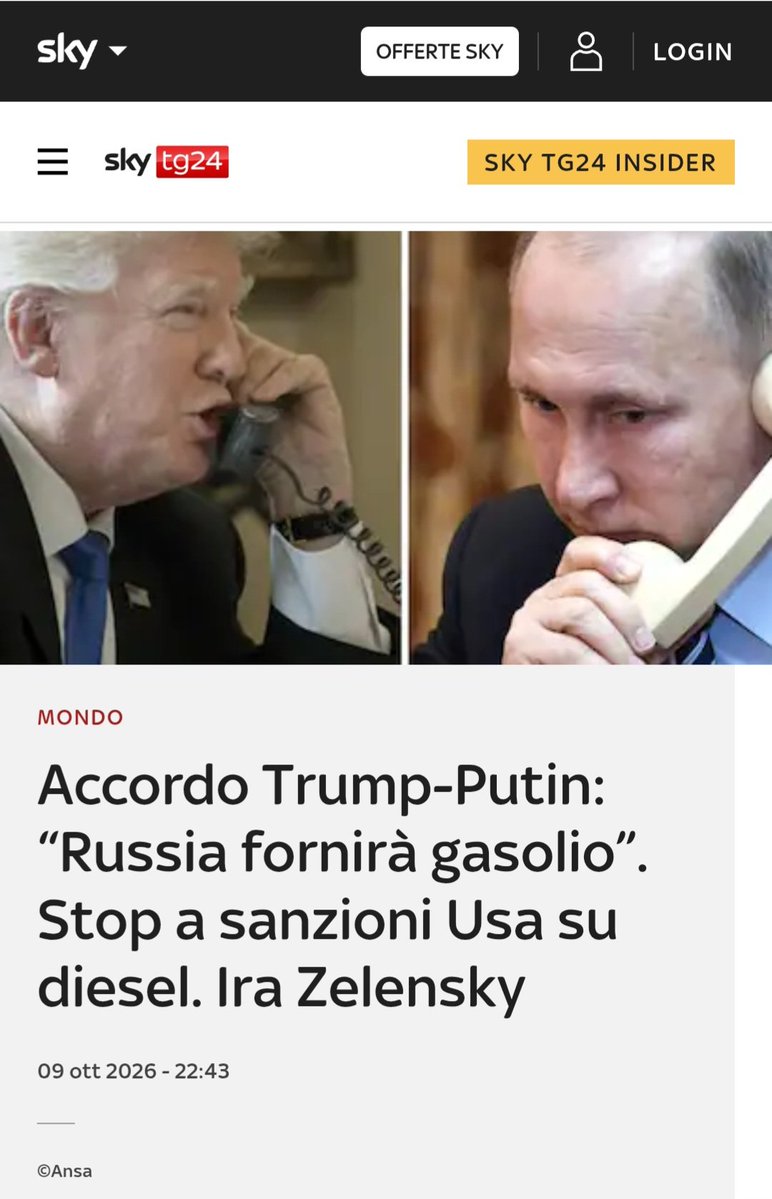
Il presidente Volodymyr Zelensky ha dichiarato che la squadra negoziale ucraina negli Stati Uniti viene usata come "paravento" mentre Donald Trump stringe accordi con Vladimir Putin sulle forniture di carburante. "Ritengo che la nostra squadra venga usata semplicemente come paravento. E questo non è affatto onesto, non è affatto da partner. E secondo me, purtroppo, è una decisione debole da parte di partner forti", ha detto il presidente. Ha aggiunto che accordi di questo tipo significano soldi in più per Putin per questa guerra. Certo, uno smacco bello e buono, anche all’Europa…e poi parliamo di sanzioni!! Questo è un colpo che ha spiazzato tutti, e dimostra ancora una volta come ai cari americani non gliene freghi niente. Ricordo, tanti anni fa, un dialogo con un americano di origine egiziana, sulla via di Odessa. C’era Clinton, io tessevo le sue lodi, il tizio mi disse “ma voi credete che agli americani interessi qualcosa di qualcuno?? A loro interessa solo che la benzina costi poco!!”. Mi risuonano queste parole, dette negli anni 90. Certo, le elezioni di medio termine sono alle porte, il presidente è in calo di consensi, e si allea anche col demonio. Da adesso in poi, non so cosa succederà, che senso ha parlare di sanzioni europee, se poi gli americani sdoganano il petrolio russo??

Seyed Abbas Araghchi 2d

Iranian Foreign Minister Abbas Araghchi responded with a message on X, accusing the Israeli prime minister of trying to save himself from justice with "more blood and American money." #ArabiaSaudita #Houthi #ConflittoMedioOrientale (translated)

Arabia Saudita, attacco Houthi con missili sull?aeroporto di Riad: almeno 12 morti e 300 feriti, voli sospesi
www.ilmessaggero.it
2543
VIA DI QUA. 2d

VIA DI QUA wrote that Gianmarco had advised Alessandro not to think that he held a grudge against him before shaking his hand. According to the author, the public was losing a person who could have shown a positive lesson about relationships on live TV: respect, which he defined as rarer than any trivial love triangle. #gfvip #rispetto #relazioni #gfvip (translated)

2905
Rossano Sasso 2d

Rossano Sasso wrote that lifting sanctions on Russia in Italy and Europe would, in his view, lower fuel and energy costs, ease the cost of living and revive the economy. He said Donald Trump was acting in the interests of US citizens rather than Volodymyr Zelensky and his allies. Sasso called for ending the sanctions, stopping Italian funding for Zelensky and no longer following what he described as Ursula von der Leyen’s impositions. He argued that Italians would benefit and urged the country’s leaders to act with courage and patriotism. #Italia #Europa #Sanzioni

2667
Marco Setaccioli 2d

Marco Setaccioli had argued that Donald Trump, after imposing sanctions on those buying fuel from Russia, would in turn buy Russian fuel. According to Setaccioli, the money paid to Moscow would allow Vladimir Putin to purchase drones from Iran and technology from China, which in turn purchased Iranian oil. The author had accused Trump of indirectly funding the Tehran regime while the United States was waging war against it, and of contributing to dedollarization by paying in dollars. He also used offensive expressions to describe the U.S. president and accused him of putting weapons in the hands of America's enemies, claiming that dictators knew how to exploit him and convince him to lead the country away from ruin. #politica #Trump #Russia (translated)

2890
Alessandro Orsini 2d

Alessandro Orsini stated that Europe depended on Russia for energy supplies and described as humiliating the announcement, attributed to Donald Trump, of an agreement with Vladimir Putin for the supply of over 300,000 tons of diesel, which would lower prices. Citing the Corriere della Sera, he reported that Europe was facing winter with the lowest gas reserves in the last fifteen years and was purchasing more gas by ship from Russia than ever before. According to the data he provided, European storage was 72% full, compared to 83% a year earlier, while in Germany and the Netherlands it was below 60%. Orsini claimed that the agreement would give Putin more resources to strike Ukraine. Orsini recalled predicting that an attempt by NATO to defeat Russia on the battlefield would provoke a more intense Russian response against Ukraine and a severe economic crisis for Europe and Italy. He said that the prediction, made on February 24, 2022, had not been believed and that subsequent events had confirmed it. He also announced his participation that evening in the program *Accordi e Disaccordi* and the presentation, on October 17, at the Feltrinelli in Largo Argentina in Rome with Luca Sommi, of his book *Nato, l’espansione verso la Russia*. He described the volume as a historical reconstruction of NATO's enlargement towards Russia, from the promises to Gorbachev during the negotiations for German reunification to the war in Ukraine. The thesis of the book, he explained, connected the documentary origins of tensions between NATO and Russia to the contradiction between Article 5 and the minutes attached to the Treaty on the Final Settlement of Germany of September 12, 1990. https://t.co/2KWZ8kSEG9 #Russia #Europa #Gas (translated)

3223
Paolo Becchi 2d

The author shared a video that, according to him, showed the European Union's reaction to the news that Donald Trump was buying diesel from Russia and lifting sanctions, thus providing money to Vladimir Putin to finance the war against Ukraine. He also wrote that one of the reasons the EU was entering a debt crisis was related to debt, but the post cut off before completing the thought. #UnioneEuropea #Trump #Ucraina #EU #RU #US #UA (translated)

3336
Il Post 3d

The former mayor of Prato, Ilaria Bugetti, has been sent to trial for corruption after resigning in June 2025, accused of having received money and votes in exchange for favors to a businessman in the textile sector. #Corruzione #IlariaBugetti #Prato (translated)

www.ilpost.it
L’ex sindaca di Prato Ilaria Bugetti è stata rinviata a giudizio per corruzione
2679
BBC 3d

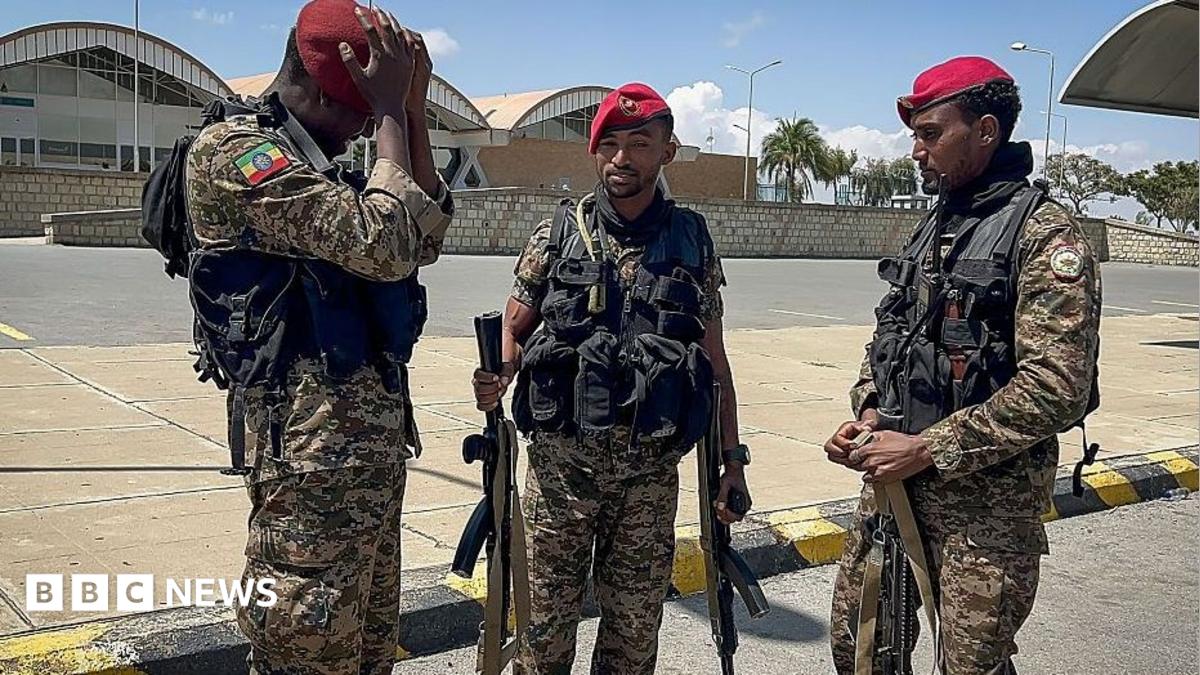
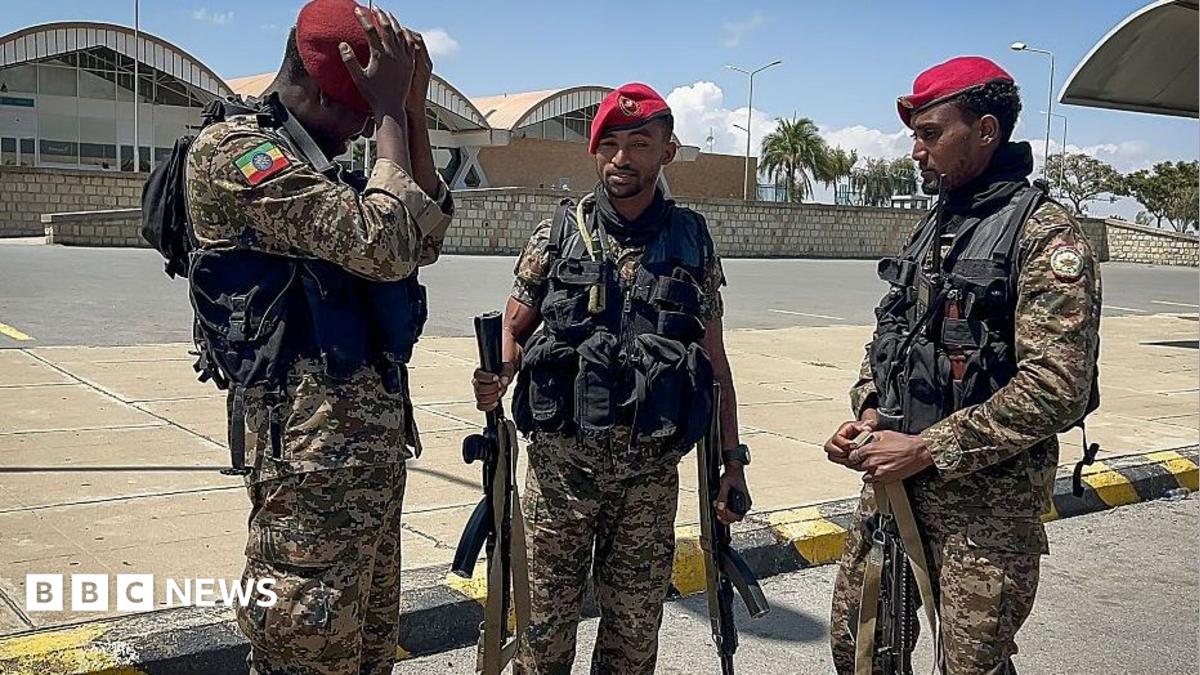
Truckloads of Eritrean soldiers have been seen driving into Ethiopia, which has reportedly responded with drone strikes. #Ethiopia #Eritrea #TigrayConflict

www.bbc.co.uk
Ethiopia warns Eritrea it will defend itself after troops cross border
2680
Nicola Porro 3d

The author wrote that Cazzullo had attributed the French protests to justified reasons, such as increased funding for schools and less inequality, and said that the comment seemed to him close to Mélenchon's positions. He then wondered who today were those who protested against inequalities and the Vietnam war in 1968, citing professors and politicians. #proteste #disuguaglianze #istruzione #FR (translated)

2905
BBC 3d

Truckloads of Eritrean soldiers have been seen driving into Ethiopia, which has reportedly responded with drone strikes. #Ethiopia #Eritrea #TigrayConflict

www.bbc.co.uk
Ethiopia warns Eritrea it will defend itself after troops cross border
2570
LA BARBIE MORA 🩷 3d

BARBIE MORA 🩷 criticized a man who, according to her, had said in a chat that he was very rich and didn't need the GFVIP. She added that, after being left by his girlfriend during a national live broadcast and after the program had stopped contacting him, it was he who reached out to talk to his now ex. She said she finds the situation shocking. #gfvip #alepier #gfvip #relazioni #dignità (translated)

2908
Bonifacio Castellane 3d

Bonifacio Castellane argued that robots should be banned, as Bernie and Mamdani were allegedly trying to do, or find the funds to support 10 million immigrants who, according to him, were demanding more money while threatening to burn everything down. He predicted interesting years ahead. #robot #immigrazione #società (translated)

2462
Krzysztof Graj 3d

Russia’s war propaganda gets a soundtrack – how AI-generated songs reached global streaming platforms Russian war propaganda is no longer confined to television broadcasts, Telegram channels or political videos. A study by the Ukrainian threat-intelligence organisation Terrecon has identified 981 songs combining signs of AI generation with pro-Russian military narratives, distributed through an ecosystem that reaches YouTube, Spotify, Apple Music, Deezer and SoundCloud. The songs range from sentimental ballads to rock and heavy metal. Their recurring themes are familiar from conventional Russian wartime propaganda: the heroisation of Russian soldiers, romanticisation of the war, mobilisation, the “Russian world”, commemoration of fallen troops and attacks on Ukraine and its armed forces. Some contain derogatory or dehumanising references to Ukrainians. What is new is not necessarily the message, but the production and distribution model: generative AI allows propagandistic music to be produced rapidly, cheaply and in quantities that would previously have required musicians, studios and producers. Nearly 1,000 tracks identified Terrecon examined 3,725 tracks collected from YouTube, YouTube Music, SoundCloud and the AI music platform Suno. After manual review, researchers classified 981 as showing both indications of AI generation and pro-Russian war propaganda. In 681 tracks they identified 728 propaganda-related keywords or phrases. The largest category was the glorification of the Russian military, followed by romanticised treatment of Moscow’s so-called “special military operation”, mobilisation appeals, narratives about the “Russian world”, and the cult of fallen soldiers and the state. The reach was not merely theoretical. Listening or viewing statistics were available for 608 of the identified tracks; together they had accumulated 86.8 million plays and views, according to Terrecon. A smaller group of 13 high-performing songs accounted for more than 53 million YouTube views and more than 67 million when YouTube Music was included. Among the better-known examples is “Power of Artillery”, a Russian-language rock song praising artillery weapons that passed two million views on YouTube. Most of the tracks for which publication dates could be established appeared after 2024, broadly coinciding with the rapid expansion of consumer AI music generators such as Suno and Udio. That correlation does not prove that AI alone caused the increase, but it illustrates how drastically the economics of production have changed. A propaganda song for as little as $11 Terrecon also tested how difficult it would be to commission such material. Researchers approached 25 creators producing AI-assisted militaristic music; 15 agreed to take commissions. Prices ranged from approximately $11 to $330, while delivery times ranged from two hours to three days. According to Terrecon, some were prepared to produce highly aggressive anti-Ukrainian material, including content intended for audiences involving children from occupied Ukrainian territories. Some creators used Russian intermediary services that provided access to Western AI tools such as Suno and Udio despite restrictions. The researchers then tested several AI generators themselves. Across 40 prompts submitted to Suno, Udio, Mureka, Google Flow Music and ElevenLabs, 25 resulted in successful generations, while safeguards were circumvented in 15 cases. Terrecon reported that four of the five services tested produced Russian-language material containing wartime narratives, although technical problems prevented comparable testing on some systems. In one Udio experiment, the researchers said the model itself introduced more explicit violent language than had appeared in the original promp These tests do not demonstrate that the commercial platforms knowingly support Russian propaganda. They show something narrower: existing safeguards can be inconsistent when political messaging is packaged as music. From generation to Spotify The distribution experiment may be the most revealing part of Terrecon’s research. The team deliberately uploaded test tracks containing explicit hostile language to YouTube, SoundCloud, Spotify and Deezer. Terrecon says none was blocked during the experiment. On SoundCloud, researchers used an account identifying its location as Moscow, disclosed the use of AI and added markers including references to the Russian military and the war. The platform accepted the upload and subsequently offered paid promotional and distribution tools. This does not prove that streaming recommendation systems systematically promote pro-war music. There is currently insufficient public evidence to make that claim. It does demonstrate that material can enter the same commercial distribution infrastructure as ordinary music and, once there, potentially benefit from playlists, searches, sharing and recommendation mechanisms available to other releases. That distinction is important. Propaganda no longer has to announce itself as political communication. On a streaming platform it can look like another song. Culture as a delivery mechanism Music has always been used in wartime propaganda. What generative AI changes is scale. Instead of investing heavily in a limited number of patriotic performers or officially commissioned productions, creators can generate variations across styles, audiences and emotional registers at very low cost. Terrecon found material ranging from war rock to sentimental songs and content styled for younger audiences. Some creators also experimented with cloned celebrity voices and stylistic imitation of established musicians. The format also offers a different relationship with the audience. A political video asks a viewer to consume an argument. Music can accompany commuting, exercise or entertainment and may be encountered outside explicitly political spaces. This does not automatically make it more persuasive, and Terrecon’s research does not establish measurable effects on political attitudes. It does, however, place wartime narratives inside a cultural environment where users may not initially perceive themselves as consuming political messaging. An ecosystem, not a proven Kremlin command structure The strongest evidence supports describing this as a growing AI-assisted pro-Russian propaganda-music ecosystem, not a single operation controlled from Moscow. Terrecon did not establish that the Russian government created, financed or coordinated all 981 tracks. Reporting on the study likewise notes that the extent of direct state involvement remains unclear. There is broader evidence that the Russian state finances cultural projects and digital content supporting the war, including through state-backed funding bodies. That context matters, but it does not allow individual songs in Terrecon’s dataset to be attributed to the Kremlin without additional evidence. The significance of the case lies elsewhere. AI has reduced the cost of producing ideological content, intermediaries can help creators access generation tools, and global platforms can provide distribution. The result is a pipeline in which wartime propaganda no longer has to resemble propaganda at all. It can simply appear in a playlist. Sources Terrecon / Ukrainska Pravda — Daria Verbytska on the research https://www.pravda.com.ua/columns/2026/10/05/8056229/ Suspilne Culture — detailed breakdown of Terrecon findings https://suspilne.media/culture/1417933-rosijsku-voennu-propagandu-maskuut-pid-anime-karaoke-ta-rok-doslidzenna-si-pisen-vid-terrecon/ The Insider — AI-generated Russian war propaganda music https://theins.ru/news/297839 Institute of Mass Information — summary of New York Times reporting https://imi.org.ua/en/news/doslidzhennya-rf-masovo-stvoryu%D1%94-propagandistski-pisni-za-dopomogoyu-shi The Bridge Media — AI-generated songs and Russian military propaganda https://thebridgemedia.com.ua/en/ai-generated-songs-russian-military-propaganda/ Center for Strategic Communication — cost and production of AI propaganda music https://spravdi.org/propaganda-za-11-yak-rosiya-shtampuye-shi-pisni-z-miljonamy-prosluhovuvan/ Times of India — AI-generated Russian war songs https://timesofindia.indiatimes.com/world/europe/ai-sings-russias-war-story-inside-the-rise-of-generative-songs-about-ukraine-conflict/articleshow/134650594.cms EU Council / EUR-Lex — Presidential Foundation for Cultural Initiatives https://eur-lex.europa.eu/legal-content/EN/TXT/?uri=CELEX:32026D1351 Human Rights Watch — Russian state funding of digital and patriotic content https://www.hrw.org/report/2025/07/30/disrupted-throttled-and-blocked/state-censorship-control-and-increasing-isolation #DISINFORMED #Episode16 #Russia #Ukraine #RussianPropaganda #WarPropaganda #MusicPropaganda #AIMusic #ArtificialIntelligence #AI #GenerativeAI #SyntheticMedia #AIPropaganda #Disinformation #InformationWarfare #InfluenceOperations #CulturalPropaganda #DigitalInfluence #NarrativeManipulation #PropagandaMusic #StreamingPlatforms #Spotify #AppleMusic #YouTube #YouTubeMusic #Deezer #SoundCloud #Suno #Udio #RussianWorld #RusskiyMir #MilitaryPropaganda #WarNarratives #Mobilisation #AlgorithmicDistribution #RecommendationAlgorithms #MusicStreaming #PlatformManipulation #Terrecon #OSINT #MediaManipulation #WRLD

224
Irish Independent 3d

Russian soldiers are reportedly resorting to self-detonation to avoid capture, driven by army propaganda that warns of potential torture if taken prisoner. #Cookies #Security #OnlinePrivacy

www.independent.ie
Russian soldiers ‘blowing themselves up to avoid capture’ as army propaganda tells them they will be tortured if caught
1904