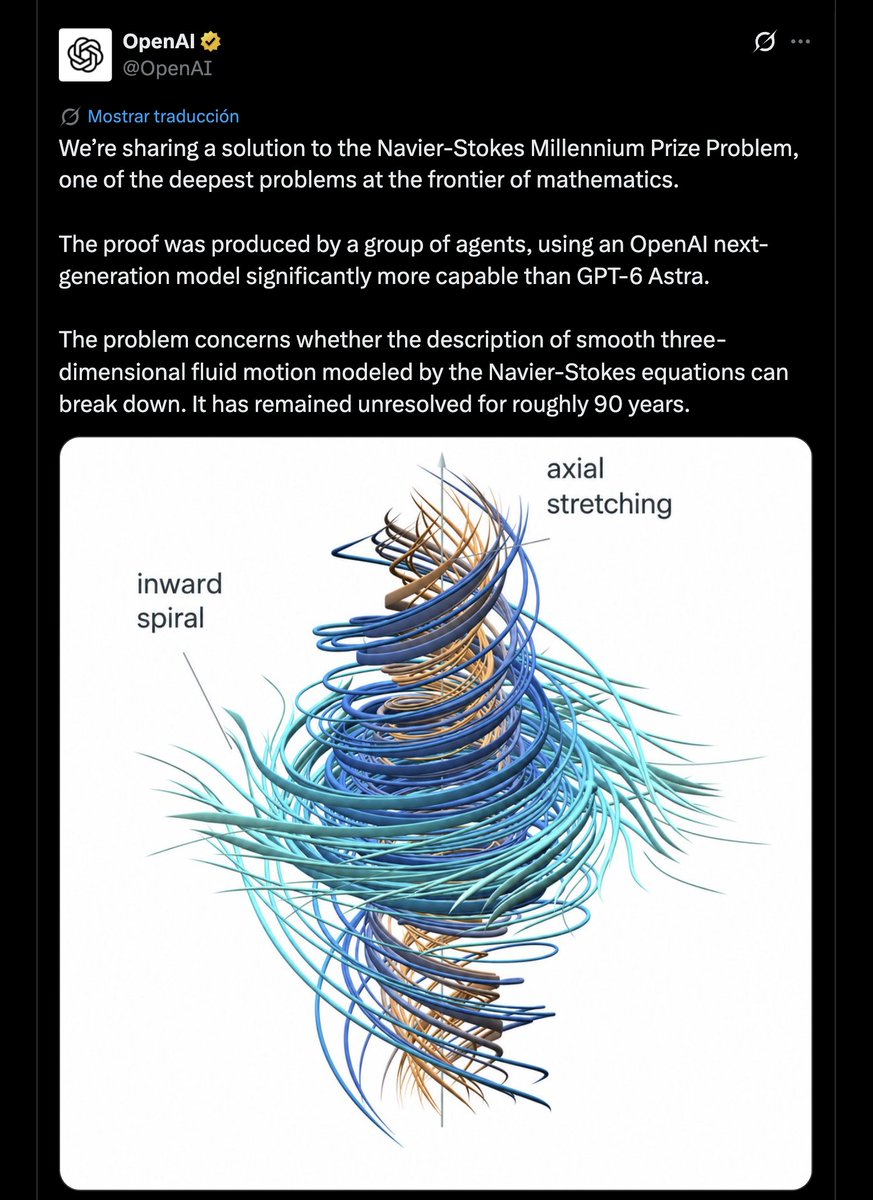
Carlos Santana claimed that the recent advances by OpenAI in mathematics had provoked reactions of astonishment, enthusiasm, and bitterness among members of the mathematics community. He wrote that the company had published 372 high-caliber results and that the average work time per result was equivalent to three hours of ChatGPT Pro Thinking. Santana stated that artificial intelligence had become a driving force in cutting-edge mathematical research and attributed part of the initial doubts to the difficulty of accepting this change. He compared the use of resources to the case of Navier-Stokes, for which, he indicated, OpenAI had deployed 10,000 concurrent agents. He also cited researcher Noam Brown, who, according to Santana, had said that the result was not so much due to the multi-agent system but to the mathematical capability of the model. The author said he understood the professional and emotional impact these advances could have on mathematicians, but he considered that it was not possible to reverse them. He added that publishing the results openly was the best scenario, although he noted that it was unclear whether OpenAI had reserved key findings for its own research or whether other organizations would share their advances. Santana maintained that the results could translate into improvements for science and engineering. He also wrote that OpenAI had evaluated 4,000 problems and that, according to their figures, 376 had been solved—about 10%—and anticipated that within a year, few or none could remain unsolved. He concluded by encouraging those who valued the role of science and technology to closely follow the changes and sent words of support to those who received them with confusion. #InteligenciaArtificial #Matemáticas #Innovación (translated)