WRLD

Search

#Surveys
wiadomosci.wp.pl 16h

Most Poles, according to a United Surveys poll, do not believe that Marcin Romanowski will appear before the court or prosecutor, with 60.3% of respondents skeptically assessing his possible return to the country. #MarcinRomanowski #Sondaż #Polska (translated)

wiadomosci.wp.pl
Romanowski wróci do kraju? Jest sondaż, jasne wskazanie

2027
wiadomosci.wp.pl 7d

Most Poles, especially opposition voters, believe in Donald Trump's promises regarding the establishment of a permanent US military base in Poland, while supporters of the ruling coalition express skepticism towards them, according to a survey conducted by United Surveys for Wirtualna Polska. #Trump #bazaWojskowa #Polska (translated)

wiadomosci.wp.pl
Trump obiecuje stałą bazę wojskową. Czy Polacy mu wierzą? Jest sondaż
1363
wiadomosci.wp.pl 1w

As many as 60.3% of Poles believe that schools in Poland are not prepared for a potential air attack, according to research conducted by United Surveys for Wirtualna Polska. #bezpieczeństwo #szkoły #sondaż (translated)

wiadomosci.wp.pl
Szkoły gotowe na atak z powietrza? Polacy wydali jednoznaczny werdykt
1478
wiadomosci.wp.pl 1w

Almost half of Poles believe that Jarosław Kaczyński does not currently control the situation in Law and Justice, according to the latest survey by United Surveys by IBRiS. #JarosławKaczyński #PrawoiSprawiedliwość #sondaż (translated)

wiadomosci.wp.pl
Czy Jarosław Kaczyński panuje nad sytuacją w partii? Polacy odpowiedzieli
1480
Rzeczpospolita 1w

A study conducted by United Surveys shows that 86.5% of Poles consider the conflict between the president and the government to be a threat to the country's security, and both sides of the political dispute agree on its negative consequences. #Polityka #Bezpieczeństwo #Kraj (translated)

www.rp.pl
Sondaż. Polacy o konflikcie prezydenta z rządem. Wyjątkowa zgodność elektoratów
1709
Christophe Barraud🛢🐳 1w

The post said proxy data and regional surveys suggested eurozone producer price inflation would exceed expectations in August, with the Bloomberg consensus at +7.9% year on year, compared with +5.8% previously. #Eurozona #PPI #economía #EU

114
Christophe Barraud🛢🐳 1w

The author wrote that proxies and regional surveys pointed to a possible upside surprise in September’s year-on-year Eurozone CPI, citing a Bloomberg consensus estimate of 3.7% versus 3.2% previously. #Eurozona #CPI #Economía #EU

457
231elections 2w

Czy prezydent Nawrocki powinien podpisać ustawę o podatku od nadzwyczajnych zysków koncernów paliwowych, z którego rząd chce finansować obniżki cen paliw? 🟢Tak: 51,7% 🔴Nie: 31,1% ⚪️Nie wiem: 17,2% United Surveys dla „WP” 18-20.09 | n=1000 | CATI/CAWI https://t.co/SIz56D8bbl #Polityka #Podatek #Paliwa

12649
wiadomosci.wp.pl 3w

W najnowszym sondażu United Surveys, Koalicja Obywatelska osiąga 31,5% poparcia, co daje jej przewagę nad PiS, które spada do 17,2%, a Konfederacja Korony Polskiej zyskuje 4,1 pkt proc., co może prowadzić do stworzenia minimalnej większości w Sejmie przez KO i Lewicę. #KoalicjaObywatelska #PiS #sondaż

wiadomosci.wp.pl
Duży wzrost partii Brauna, spadek PiS. Kto miałby większość w Sejmie?
7514
wiadomosci.wp.pl 3w

Według najnowszego sondażu United Surveys dla Wirtualnej Polski, Mateusz Morawiecki cieszy się zdecydowaną przewagą nad Jarosławem Kaczyńskim, zdobywając aprobatę 37,5% badanych, podczas gdy Kaczyńskiego popiera zaledwie 9,5%. #Morawiecki #Kaczyński #sondaż

wiadomosci.wp.pl
Kaczyński czy Morawiecki. Kto z nich ma rację?
7524
wiadomosci.wp.pl 3w

Większość Polaków, według sondażu United Surveys by IBRiS dla Wirtualnej Polski, ocenia Donalda Tuska jako premiera negatywnie, z ponad połową badanych wyrażających niezadowolenie z jego działań. #DonaldTusk #sondaż #Polska

wiadomosci.wp.pl
Polacy ocenili Donalda Tuska. Większość niezadowolona z szefa rządu
7525
O
Oberlé Daniel 3w

🚨 Un·e étudiant·e sur trois en détresse : ce que révèle enfin l’enquête nationale sur leur santé 📒 Santé et bien-être des étudiants : les enseignements des enquêtes de l'OVE ✍️ Observatoire national de la vie étudiante (OVE), copublication avec la DGESIP (sous-direction A2-2, vie étudiante et réussite). Coordinateur : Malo Mofakhami. Juin 2026 Capsules Audio de Pratiques en Santé 🎙️🎥 https://www.youtube.com/watch?v=Cy_ejSwU_wk 🔍📊 Santé étudiante 2026 : 40 % de détresse psychologique, un tiers en insécurité alimentaire, et un recours aux soins qui reste faible même chez les plus fragiles. 🧭 Des profils de recours et des inégalités de genre et de sexualité qui appellent des réponses différenciées — pas des moyennes. Analyse de Pratiques en Santé et lien vers la source ℹ️➕ https://www.pratiquesensante.com/blog/pratiques-15/sante-et-bien-etre-des-etudiants-les-enseignements-des-enquetes-de-l-ove-6205 📌 Ce rapport objective, à l’échelle nationale et sur données comparables, ce que le terrain observe depuis la sortie du Covid : une santé psychologique durablement dégradée et un renoncement aux soins à deux visages. Il ne se contente pas de moyennes : il cartographie des profils de recours (non-recourant·es, inséré·es, en besoin de soins), croise santé, genre, orientation sexuelle, bourse et littératie, et documente l’insécurité alimentaire de près d’un tiers des étudiant·es. Utile pour cibler une action, argumenter un projet de campus promoteur de santé, ou repérer les publics à double vulnérabilité qu’un dispositif généraliste laisse de côté. 🇬🇧: Student Health and Well-being: Lessons from the OVE Surveys - https://www.pratiquesensante.com/en/blog/practices-15/sante-et-bien-etre-des-etudiants-les-enseignements-des-enquetes-de-l-ove-6205 #️⃣ #pratiquesensante #SantéÉtudiante #SantéMentale #InégalitésDeSanté #LittératieSanté #RenoncementAuxSoins #PrécaritéAlimentaire #CampusPromoteurDeSanté

www.youtube.com
Santé Étudiante La Réalité
695
Balázs Orbán 4w

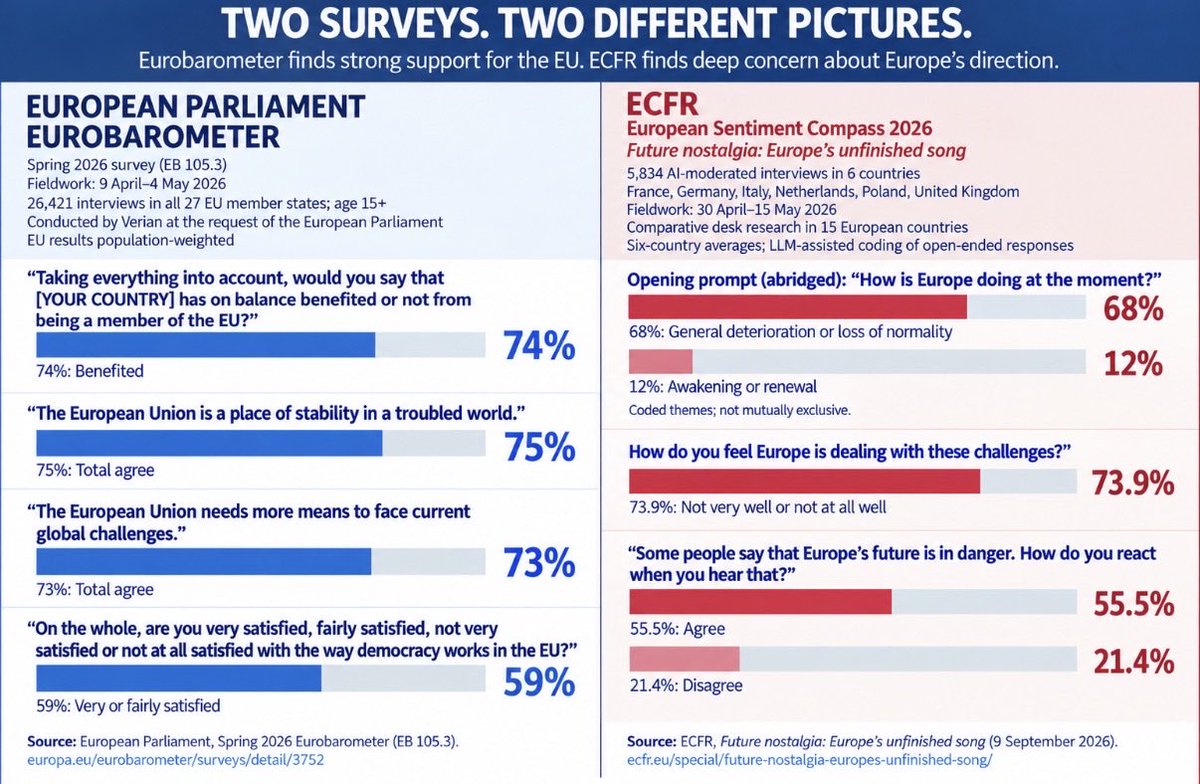
Look at these two surveys. I know the methodology and the questions are not identical. But I’m not going to sugarcoat it: if one of these pictures is true, the other one cannot be. And that immediately raises a serious question: are European taxpayers financing European https://t.co/h6IcgKW3kb #EU #Taxpayers #Surveys #EU #BE #FR #DE

116
Rzeczpospolita 4w

78 proc. Polaków popiera militarną pomoc w obronie Litwy, Łotwy i Estonii w ramach NATO w przypadku zbrojnej agresji na te państwa, co pokazuje najnowszy sondaż przeprowadzony przez United Surveys. #NATO #Polska #ObronaBałtyków

www.rp.pl
Obrona Litwy, Łotwy i Estonii. 78 proc. Polaków za pomocą wojskową w ramach NATO
16878
wiadomosci.wp.pl Sep 10

Najnowszy sondaż United Surveys by IBRiS dla Wirtualnej Polski wskazuje, że Koalicja Obywatelska zdobywa 30,2% poparcia, ale wciąż nie jest w stanie obalić obecnego rządu PiS, który może stracić większość w Sejmie, a opozycyjne partie zyskują znaczną przewagę. #sondaż #KoalicjaObywatelska #PrawoiSprawiedliwość

wiadomosci.wp.pl
Najnowszy sondaż partyjny. Tusk bez szans ponowną władzę
12237
wiadomosci.wp.pl Sep 6

Ponad połowa Polaków negatywnie ocenia wpływ prezydentury Donalda Trumpa na bezpieczeństwo i interesy Polski, a różnice w opiniach występują pomiędzy sympatykami obozu rządzącego a opozycją, wynika z sondażu United Surveys by IBRiS dla Wirtualnej Polski. #Trump #Polska #Bezpieczeństwo

wiadomosci.wp.pl
Wpływ Trumpa na Polskę. Polacy ocenili
9925
Luciano Magaldi Sardella (PhD) Sep 5

"RadioText-RadioSoftware (1983–1989)": The First (Forgotten) Radio Programme of Computer Science Dissemination in Italy SOURCE: https://www.linkedin.com/pulse/radiotext-radiosoftware-19831989-first-forgotten-sardella-ph-d--eqief/ Radiosoftware represents Italy's absolute pioneer in broadcasting digital literacy education over the airwaves in the Belpaese. Abstract This paper reconstructs the history of Radiosoftware, the first Italian radio programme which anticipated by over a decade the dissemination of microtelematics, computing, and digital technology, as well as modern methods of digital software distribution. Established in 1983 at Radio Popolare and subsequently developed as a national initiative on Rai Radio 3 from 1984 to 1989, Radiosoftware represents the first Italian radio programme to broadcast educational content and transmit executable software for home computers over the airwaves. Through analysis of its technical evolution, educational content, and cultural impact, this article demonstrates how the initiative constituted a significant precedent in national computer literacy, the democratisation of access to software, and the development of amateur programming communities, establishing itself as the progenitor of a media ecosystem dedicated to technological dissemination that has extended into the contemporary era. Keywords: history of Italian computing, technological dissemination, digital broadcasting, computer literacy, Radio Popolare Introduction: The Dawn of Computing Dissemination in Italy In the landscape of Italian digital media history, a fundamental chapter remains little explored in academic literature: that of computing dissemination through radio broadcasting in the 1980s. In an era characterised by the absence of network connectivity and economic and geographical barriers to accessing computer technologies, radio configured itself as a democratic instrument for the diffusion of nascent digital culture. Radiosoftware emerges in this context as an absolutely pioneering initiative in Italy, anticipating not only analogous Italian experiences but also positioning itself amongst the first European experiments in software transmission over the airwaves. Its genesis at Radio Popolare in 1983 and subsequent evolution as a national programme on Rai Radio 3 bear witness to a trajectory of technical and pedagogical innovation that merits in-depth analysis. Contenuto dell’articolo The Original Phase: Radio Popolare (1983) The birth of Radiosoftware at Radio Popolare in 1983 constitutes the foundational moment of radio-based computing dissemination in Italy. In a period when personal computers still represented niche objects, the programme set out to systematically explore programming languages, hardware architectures, and practical applications of home computing, addressing a heterogeneous audience composed of students, teachers, hobbyists, and professionals. This first incarnation established the conceptual paradigms that would characterise the entire subsequent tradition: linguistic accessibility, pedagogical vocation, attention to the social and cultural dimensions of technology, and promotion of active listener participation. Contenuto dell’articolo The National Evolution: From Radiotext to Radiosoftware (1984–1989) The experience gained at Radio Popolare found systematic development in the national initiative coordinated by Rai Radio 3. The pilot phase, denominated Radiotext, commenced on 11 May 1984 as an experimental segment within the current affairs programme Un certo discorso, presented by Pasquale Santoli. Eight 30-minute episodes, broadcast on Fridays at 16:00 with Sunday repeats, tested the technical feasibility and public interest in the transmission of executable software through audio signals. Curated by Luigi Grimaldi and Giovanni Sighele of the Lega Informatica of Florence, in collaboration with Arci Media, the pilot phase demonstrated the viability of the concept. In autumn 1984, the format consolidated with the definitive denomination Radiosoftware, expanding to one-hour episodes and maintaining its placement within Un certo discorso. Contenuto dell’articolo The third season, inaugurated on 7 February 1986, introduced a thematic structuring articulated in three distinctive segments: "Hard & soft news" (updates and reviews), "Studiare con il computer" (educational applications), and "Radio + informatica" (experimental intersections between broadcasting and computing). This phase evidenced a growing pedagogical sophistication and greater attention to formal educational applications. In late 1986, the programme acquired editorial autonomy, transforming into an independent transmission with nocturnal weekend scheduling. 1987 marked a significant technical innovation with the introduction of the 4800 bit/s hardware interface developed by the RAI Research Centre in Turin, which enabled direct connection to the RS-232 serial port, overcoming the limitations of the audio-cassette method. The concluding phase, from February to June 1989, adopted a brief daily format (10 minutes, Monday to Friday at 19:45), concentrating on MS-DOS-compatible software. Despite the announcement of a cycle for 1990, no national transmission is documented beyond June 1989. Contenuto dell’articolo The Audio-Cassette Method (1984–1987) The initial methodology replicated the cassette loading mechanisms typical of 1980s home computers. Programmes were encoded as sequences of audio impulses—electronic noises incomprehensible to the human ear—which listeners recorded onto blank audiocassettes by connecting a tape recorder to the radio's audio output. The recorded cassette was subsequently played through the computer's cassette interface, which decoded the signals, loading the software into memory. This approach, based on modulation techniques similar to frequency-shift keying (FSK), guaranteed compatibility with heterogeneous platforms such as the ZX Spectrum 48K, Commodore 64, Olivetti M10, subsequently extended to the Apple II, MSX, BBC Micro, Olivetti M24 and M28. Each episode transmitted sequentially platform-specific versions for each system. Whilst accessible and revolutionary for mass distribution in pre-Internet Italy, this method presented significant limitations: low transmission speed, susceptibility to errors induced by radio interference or ambient noise, and the necessity for precise volume and timing adjustments. Contenuto dell’articolo The RAI-Radiosoftware Hardware Interface (1987) In 1987, the RAI Research Centre in Turin developed an advanced interface documented in CCIR reports as the RAI-Radiosoftware system. The principal innovation consisted of direct transmission at 4800 bits/s utilising biphase modulation organised in packets, enabling connection to the computer's RS-232 serial port without cassette intermediation. The interface was designed for operating system independence, with management software adaptable for MS-DOS, CP/M, and potential future extensions to Macintosh. For Olivetti M24 and M28 computers, a version with an internal card was available. The Research Centre additionally developed management software, test cassettes, and manuals, considering initial commercialisation at approximately 90,000 lire. This technical evolution represented a significant advancement in terms of speed, reliability, and usability, whilst maintaining the audio-cassette method in parallel to guarantee universal access. Contenuto dell’articolo Types of Software Transmitted The catalogue of software distributed through Radiosoftware reflected a broad range of applications: practical utilities (thematic databases on fashion, music, itineraries, and personalised diets), educational tools (didactic programmes for secondary schools, upper secondary schools, and conservatoires), recreational software (games such as the Olympic pentathlon for the Commodore 64), graphic demonstrations, and creative tools (bases for musical composition and digital comics). Particularly significant was the introduction, from the third season onwards, of educational software developed in collaboration with the Ministry of Public Education, designed specifically for scholastic use across various disciplines, not limited to computing. Contenuto dell’articolo Community Participation: The ORSA Section The Osservatorio Radiofonico del Software Autoprodotto (ORSA) [Radio Observatory of Self-Produced Software], reintroduced in the third season from February 1986, constituted a space dedicated to the transmission of programmes created by listeners. This feature transformed Radiosoftware into a bidirectional platform, anticipating collaborative logics that would characterise, decades later, open-source communities and participatory digital cultures. The "listeners' post" section within "Hard & soft news" additionally facilitated continuous dialogue with the public, integrating feedback, questions, and suggestions into the programming. Questionnaires distributed at the end of cycles and surveys conducted by specialist magazines such as Sperimentare con l'elettronica e il computer provided further mechanisms for evaluation and editorial orientation. Contenuto dell’articolo Institutional Collaborations and School Experiments In 1987, Radiosoftware collaborated with the ITIS Enrico Fermi in Rome to produce a series of transmissions dedicated to the development and application of educational software in scholastic contexts. The initiative involved experimental reception centres in 60 Italian schools, where students and teachers utilised the specialised interfaces developed by the RAI Research Centre to capture and load directly the transmitted software. These experiments positioned Radiosoftware as an operational instrument of pedagogical innovation, extending its impact beyond the hobbyist user base towards formal integration within the national education system. Contenuto dell’articolo Comparison with European Experiences Although Radiosoftware represents the first Italian national initiative, it was not the first European experiment in radio transmission of software. In the Netherlands, the programme Hobbyscoop on the public broadcaster NOS began transmitting computer programmes via radio around 1979–1980, subsequently developing the Basicode standard (from 1982). This standardised format utilised a restricted subset of BASIC commands and platform-specific translation routines, guaranteeing portability across heterogeneous architectures through FSK modulation at 1200 bps. Contenuto dell’articolo In the United Kingdom, The Chip Shop on BBC Radio 4, presented by Barry Norman and launched in 1984, included a "takeaway" service that transmitted Basicode programmes during nocturnal hours on VHF. Contenuto dell’articolo Technical and Cultural Differentiation Unlike approaches based on Basicode, which privileged portability at the interpreted language level, Radiosoftware transmitted platform-specific executable files, often in machine code, encoded as audio tones analogous to cassette loading signals. This choice reflected different priorities: maximising performance and the specific capabilities of each architecture rather than guaranteeing universal compatibility through a standardised language. The subsequent introduction of the 4800 bit/s interface with RS-232 connection represented a further differentiation, bypassing cassette recording entirely. These technical specificities bear witness to an autonomous development pathway, oriented towards the characteristics of the Italian computing market and ecosystem. Contenuto dell’articolo Transition towards Telesoftware Between 1988 and 1989, Radiosoftware was progressively accompanied and superseded by telesoftware transmitted through Televideo, RAI's teletext system. Technically defined by the RAI Research Centre in collaboration with Olivetti, the system became operational in 1989 following scholastic experiments coordinated with the Ministry of Public Education and Seleco in 1988. Telesoftware represented a natural evolution that shifted distribution from radio to television, offering advantages in terms of bandwidth capacity and already widespread reception infrastructure. This transition reflected broader trends in media convergence and the evolution of digital broadcasting technologies. Contenuto dell’articolo Obsolescence and the Rise of the Internet The emergence of the Internet in the 1990s rendered obsolete both radio-based and teletext-based methods of software distribution. Bidirectional digital networks offered incomparable speed, scalability, and interactivity, radically transforming the paradigms of software access and distribution. However, the conceptual legacy of Radiosoftware persists: the idea of mass distribution of executable digital content through broadcasting channels anticipated logics that re-emerge in modern over-the-air distributions of firmware and software updates for mobile devices and IoT. Contenuto dell’articolo The Ecosystem of Italian Radio-Based Computing Dissemination COMPLETE TIMELINE From the birth of computing dissemination on radio to the contemporary digital ecosystem 🟦 1983 — THE ORIGIN Radiosoftware – Radio Popolare (1983) The first Italian programme entirely dedicated to computing, programming languages, and personal computers. The absolute progenitor of the Italian tradition of radio-based technological dissemination. 🟦 THE 1980s — THE FIRST HEIRS 1984–1989 — Bit, Byte & Musica – Radio Popolare Technology, electronics, early networks, hacker culture. Continues the pioneering spirit of Radiosoftware, exploring the countercultural and communal dimensions of nascent computing. 1987–1990 — Decoder / Cyberpunk – Radio Popolare First systematic discussions of BBS, cryptography, alternative telematics, anticipating themes that would become central in the Internet era. 🟩 THE 1990s — THE INTERNET ERA 1993 — Golem – Radio3 Critical reflection on media and digital technologies, situating technological transformation within a broader cultural and philosophical framework. 1994 — Eta Beta – Radio1 Innovation, information society, digital transformation. Technological dissemination for a general audience in the phase of initial digital literacy. 1995 — Internetworkcity – Radio Deejay Presented by Claudio Cecchetto and Marco Camisani Calzolari, represents the first pop-commercial programme dedicated to the Internet, introducing email, websites, chat, and cyber culture to the mass public with accessible language and a massified educational approach. 1996–1999 — Mediamente (radio version) – RAI Dissemination on the Internet, networks, digital culture, with particular attention to the social and cognitive implications of emerging technologies. 1997–2000 — Cybernet / Tecnologie e Libertà – Radio Sherwood Free software, digital rights, civic networks. Continuation of the critical and communal tradition inaugurated by Radio Popolare, with focus on the political and libertarian dimensions of technology. This timeline evidences how Radiosoftware does not represent an isolated phenomenon, but rather the point of origin of a continuous tradition that has traversed over four decades. From the programming languages and over-the-air software transmission of the 1980s, through explorations of BBS and alternative telematics, to mass literacy on the Internet in the 1990s and critical reflections on free software and digital rights, a connecting thread emerges that testifies to the role of radio as a privileged space for the cultural mediation of emerging technologies. Contenuto dell’articolo Contemporary Recognition and Archival Preservation In recent years, Radiosoftware has acquired renewed attention as a pioneering initiative in the history of Italian computing. In 2024, contributions by scholars such as Andrea Fortuna have described the programme as a fascinating chapter in the diffusion of personal computing in Italy, underscoring its innovative approach to the distribution of executable software in the pre-Internet era. RAI has preserved selections from the initial phase of the programme through digital platforms such as RaiPlay Sound, where a dedicated playlist in the "Via Asiago 10" series includes several pilot episodes from 1984, originally broadcast on Rai Radio 3. Preservation efforts by enthusiasts have further contributed to maintaining accessible portions of the programme's legacy, with partial audio recordings and listener interviews available on dedicated websites. Radiosoftware constitutes a significant case study from multiple disciplinary perspectives. From the standpoint of media history, it represents an innovation in the utilisation of radio broadcasting, extending its functionalities beyond the transmission of audio content towards the distribution of executable code. In computing history, it testifies to strategies of democratisation of software access in contexts characterised by scarcity of resources and infrastructure. From a pedagogical standpoint, it anticipates models of distributed and community learning that re-emerge in modern online educational platforms. The participatory dimension embodied by the ORSA section prefigures collaborative dynamics that would characterise open-source cultures. Its position as progenitor of a continuous media ecosystem dedicated to technological dissemination—from Radio Popolare through national public broadcasters to the experiences of the 1990s—underscores the role of radio broadcasting as essential cultural infrastructure in the processes of national digital literacy. In an era when over-the-air distribution of software updates has become ordinary practice for billions of connected devices, Radiosoftware emerges not as an antiquarian curiosity, but as a conceptual antecedent that illuminates often-neglected technological genealogies. Its rediscovery and archival preservation constitute essential operations for a complete understanding of the roots of Italian digital culture.

www.linkedin.com
"RadioText-RadioSoftware (1983–1989)": The First (Forgotten) Radio Programme of Computer Science Dissemination in Italy
584
Rzeczpospolita Aug 31

Mniej niż połowa Polaków uważa, że prezydent Karol Nawrocki powinien podpisać proponowane przez rząd Donalda Tuska zmiany podatkowe, według sondażu przeprowadzonego przez United Surveys dla Wirtualnej Polski. #Polska #podatki #Polityka

www.rp.pl
Rząd proponuje zmiany podatkowe. Polacy w sondażu ocenili, co powinien zrobić prezydent
11122
wiadomosci.wp.pl Aug 28

Ucieczka byłego wiceministra sprawiedliwości Marcina Romanowskiego do Naddniestrza w opinii większości Polaków negatywnie wpływa na wizerunek Prawa i Sprawiedliwości (PiS), według sondażu United Surveys by IBRiS. #MarcinRomanowski #PrawoiSprawiedliwość #Naddniestrze

wiadomosci.wp.pl
Ucieczka Marcina Romanowskiego obciąża PiS? Polacy wydali werdykt
12307
Kazimierz Smoliński Aug 25

Najnowszy sondaż United Surveys dla Wirtualnej Polski pokazuje dwie rzeczy: 1. Pomimo odejścia premiera Morawieckiego poparcie dla PiS rośnie (+2,8 pp.) i dystans do KO szybko spada (20,6 do 27,3) 2. Za rok Tusk oddaje władzę, bo z Lewicą będzie miał tylko 198 posłów. #Polska #Sondaż #PiS #PL

117