WRLD

Search

#Systěma
David Thunder 3h

The author questioned whether citizens of a Western democracy could re-elect a politician whose party, they wrote, was under investigation for obstructing justice and intimidating judges. They also accused the politician of repeatedly lying on camera and systematically breaking solemn promises. The post ended mid-sentence while beginning another allegation.


1794
Jari Mäkäräinen 5h

Jari Mäkäräinen criticized an article in Helsingin Sanomat and said he had made corrections to it. According to him, the nonfiction writer Ari Haasio and Mattila had suggested that Finnish identity was ambiguous, compared the mistrust faced by evacuees from Karelia to current fears directed at Muslims, and stated that everyone was a descendant of immigrants. Mäkäräinen wrote that migration was an old phenomenon, but migrations from different times could not be equated. He noted that the first people arrived in what is now Finland about 11,000 years ago and believed that this did not provide a basis for equating the current migration from Afghanistan or Somalia with the arrivals of earlier traders, craftsmen, or industrial founders. He described Finlayson as an actor that built factories in capital-poor Finland, brought technology, and created jobs. Mäkäräinen compared him to a Mohammed coming from Somalia, who he described as illiterate and dependent on Kela support. He believed these examples illustrated different types of migration and claimed that there were differences in education, employment, cultural distance, and criminality. He also claimed that those coming from Afghanistan were overrepresented in rape statistics. Regarding the evacuees from Karelia, Mäkäräinen wrote that they had come from within Finland, spoke Finnish, and shared key features of Finnish culture. He said they had faced mistrust and derogatory name-calling, but believed they differed from current arrivals from Afghanistan, for example, in terms of adaptation, work ethic, and use of social security. Mäkäräinen also denied the comparison made by Haasio and Mattila between 19th-century antisemitism and the Somali discussions of the 1990s. According to him, the groups were not similar, and Jews had mostly integrated well. He argued that current migrations should be evaluated based on their impacts on employment, crime, and social security. Finally, he wrote that the continuity of society required, in his opinion, the adaptation of newcomers. #maahanmuutto #suomalaisuus #kulttuuri (translated)

1856
Hayek-Club Weimar 7h

The Hayek Club Weimar warned of a possible economic and social decline. Only when cars fell silent on the side of the road, businesses closed, apartments remained cold, and families suffered from hunger would people, according to the club, recognize that they had watched for too long. It stated that the foundations of a livable life had been systematically destroyed, diligence and achievement devalued, and responsibility portrayed as a burden. The silence and the willingness to be deceived had facilitated the downfall, the club explained. #Gesellschaft #Verantwortung #Zukunft (translated)

1986
SVT Nyheter 12h

A couple in California is suspected of having subjected at least 14 of their 21 children, the majority of whom were born through surrogacy, to systematic abuse in their luxury home outside Los Angeles. #Barnmisshandel #Surrogatmödrar #Kalifornien (translated)

www.svt.se
Bakom lyxvillans fasad – par misstänks för misshandel av minst 14 barn
1667
Franceinfo 1d

A documentary reveals the systematic tracking of undocumented immigrants in Minneapolis by immigration police under the Trump administration, provoking fear and civic mobilization against what are considered arbitrary arrests. #Immigration #Dystopie #ICE (translated)

www.franceinfo.fr
"Nous sommes dans une sorte de dystopie" : à Minneapolis, l'opération de la police de l'immigration vire à la chasse à l'homme
2129
Granskning 2d

The review echoed a testimony from a woman who, according to her account, had been raped while another attacker cut off her breasts with a knife. The assaults continued before she was killed, the review stated. The author described the massacre on October 7 as a deep trauma for Israeli society and wrote that this year's memorial ceremony was particularly significant because all surviving hostages had returned from Gaza and the remains of the murdered had been brought home. The review believed the day should have focused on the victims, the survivors, and the relatives. The review criticized Sveriges Radio for instead directing attention towards employee Sami Abu Salem in Gaza. The author also questioned why SVT Rapport, after a segment from the memorial ceremony in Tel Aviv, had presented Gilda Hamidi-Nia's documentary "The World's Most Hated?", which according to the review had been published three days before the anniversary and dealt with how Israeli soldiers were mapped on social media and accused of suspected war crimes in Gaza. The review stated that SVT's live broadcast from the ceremony repeatedly shifted the focus from the victims and their relatives to Israel's warfare, genocide allegations against Israel and the IDF, as well as the war in Gaza. The author argued that the coverage showed a lack of judgment, proportion, and respect, and asked why the victims were not allowed to be at the center of the memorial day. https://t.co/unFDFBluFH #Hamas #Israel #minnesdag (translated)

3180
Mateusz Łoń 2d

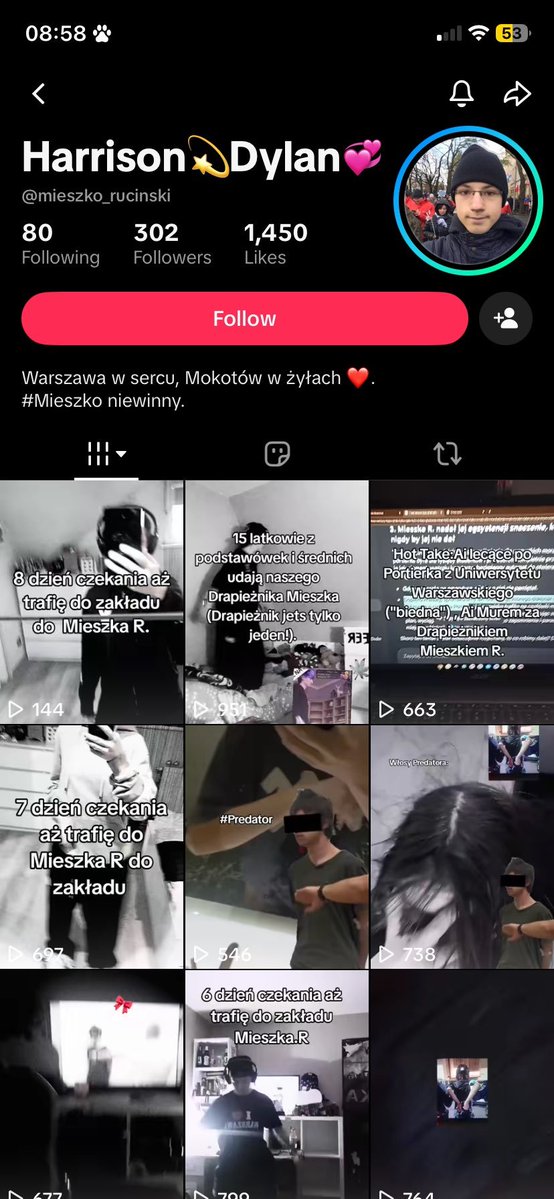
Mateusz Łoń wrote that Mieszko R., the perpetrator of the attack in May 2025, has become a significant thread in the case of the arrest of two individuals responsible for the events in Wyszków and Ostrołęka. According to the author, the perpetrators had been watching and listening to the same content online. Łoń also claimed to have found the profile of a girl supporting Mieszko R. and reported that her account description included the phrase "#Mieszko innocent." He wrote that the girl published recordings in which she counted down the days until going to the facility where Mieszko R. was held. The author added that she referred to him as "Predator Mieszko," and according to other findings, she recorded videos in which she danced with an axe and drove it into the ground. Łoń urged authorities to urgently examine algorithms and radicalization in online bubbles. He assessed that imitating and glorifying perpetrators was becoming a real threat. #równouprawnienie #bezpieczeństwo #cenzura (translated)

3555
Szymon Kardaś 2d

The author wrote that the agreement with Trump could have turned out to be a diplomatic masterpiece of the Kremlin, especially if it allowed not only to prevent further sanctions but also to lead to their systematic easing. He added that on the other hand, "often the greatest" — this entry was cut off. #dyplomacja #sankcje #Kreml #RU #US (translated)

3111
Les Mileistes Français 🦁🇫🇷 2d

French Milei supporters published a translation of a tweet from Javier Milei, in which the Argentine president accused socialism of claiming causes such as disability, retirees, or public universities to justify, in his opinion, uncontrolled and untransparent spending and bureaucratic structures. Milei claimed that audit requests were often presented as an attack against the concerned individuals, and that opening accounts revealed intermediaries, advocacy organizations, and taxpayer-funded privileges. He argued that this mechanism had been observed in Argentina and other countries, to the detriment of people who truly needed help and Argentine taxpayers. He demanded the publication of all accounts and contracts as well as accountability from each responsible party. #Liberté #Transparence #Responsabilité (translated)

3113
LesFansGones 🦁 3d

LesFansGones found it worrisome that every return after a break has been disastrous, believing that the scenario was systematically repeating itself. #TeamOL #RCLOL https://t.co/qR0HReM1ZO #Football #Sport #TeamOL (translated)

3012
Actu Foot 3d

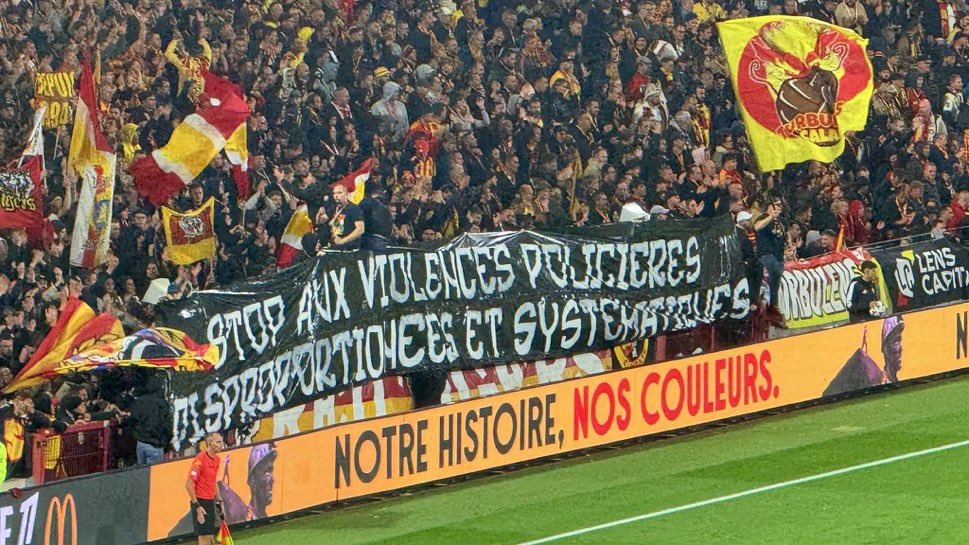
Actu Foot indicated that a banner denouncing disproportionate and systematic police violence had been seen at Bollaert during the Lens-Lyon match. The media credited the photo to Africadelle. (translated)

2678
Ahmad Mansour 3d

Ahmad Mansour criticized the treatment of the police over the past three years as defamatory and disrespectful. He wrote that it is not about Palestine or Gaza, but rather about a systematic erosion of the principles of the rule of law and decreasing respect for those who protect the rule of law. Mansour expressed his respect for the police officers who continue to serve in Berlin despite the daily demands. He warned that a society that despises its police must expect to eventually lose the protection it takes for granted. #Polizei #Rechtsstaat #Respekt (translated)

3237
Die Presse 3d

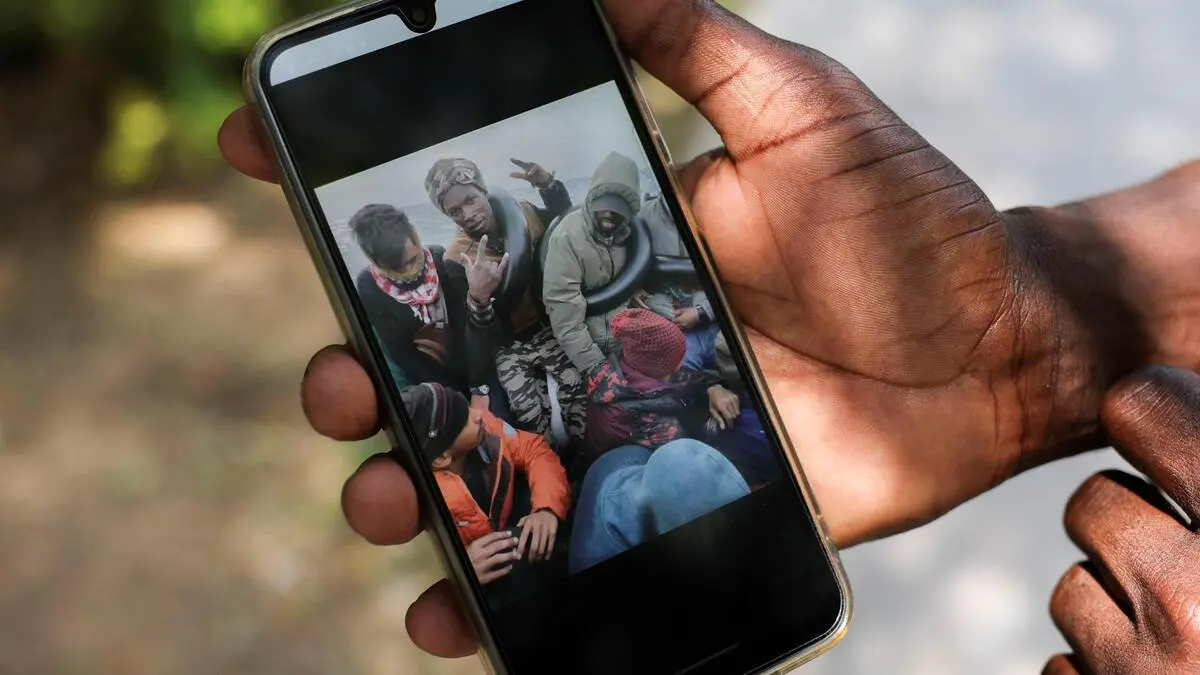
Asylum seekers in several EU countries are systematically having their mobile phones confiscated, and their data is evaluated without transparency, which violates data protection rules and has been criticized by human rights organizations. #Datenschutz #Asylverfahren #Menschenrechte (translated)

www.diepresse.com
Wieso Handys von Migranten durchsucht werden [premium]
2791
Ansgar Schledde 3d

Ansgar Schledde explained that in the local elections in the Hannover region, more than 3,000 outer ballot envelopes were opened prematurely in 14 out of 20 surrounding municipalities. He regarded this as a systematic violation of §59 of the Lower Saxony Municipal Election Code. The envelopes should have remained unopened and sealed; instead, ballots with the names and addresses of the voters became visible and were repackaged. The votes were then counted without verification, Schledde wrote. The procedure was ordered by the regional election office via email and was only stopped by the state election director four days before the election. Interior Minister Daniela Behrens (SPD) commented cautiously on the incident; supposedly, no impact on the election result was to be expected, criticized Schledde. He supported the objection of Bundestag member Dirk Brandes and announced a complete clarification as well as a legal examination. For the state elections in 2027, postal voting documents must be designed to prevent manipulation, and the rules must be adhered to. Those who violate the election regulations must face consequences, Schledde wrote. https://t.co/uzZye3DAPi #Wahlen #Demokratie #Niedersachsen (translated)

3581
Krzysztof Graj 3d

Russia’s war propaganda gets a soundtrack – how AI-generated songs reached global streaming platforms Russian war propaganda is no longer confined to television broadcasts, Telegram channels or political videos. A study by the Ukrainian threat-intelligence organisation Terrecon has identified 981 songs combining signs of AI generation with pro-Russian military narratives, distributed through an ecosystem that reaches YouTube, Spotify, Apple Music, Deezer and SoundCloud. The songs range from sentimental ballads to rock and heavy metal. Their recurring themes are familiar from conventional Russian wartime propaganda: the heroisation of Russian soldiers, romanticisation of the war, mobilisation, the “Russian world”, commemoration of fallen troops and attacks on Ukraine and its armed forces. Some contain derogatory or dehumanising references to Ukrainians. What is new is not necessarily the message, but the production and distribution model: generative AI allows propagandistic music to be produced rapidly, cheaply and in quantities that would previously have required musicians, studios and producers. Nearly 1,000 tracks identified Terrecon examined 3,725 tracks collected from YouTube, YouTube Music, SoundCloud and the AI music platform Suno. After manual review, researchers classified 981 as showing both indications of AI generation and pro-Russian war propaganda. In 681 tracks they identified 728 propaganda-related keywords or phrases. The largest category was the glorification of the Russian military, followed by romanticised treatment of Moscow’s so-called “special military operation”, mobilisation appeals, narratives about the “Russian world”, and the cult of fallen soldiers and the state. The reach was not merely theoretical. Listening or viewing statistics were available for 608 of the identified tracks; together they had accumulated 86.8 million plays and views, according to Terrecon. A smaller group of 13 high-performing songs accounted for more than 53 million YouTube views and more than 67 million when YouTube Music was included. Among the better-known examples is “Power of Artillery”, a Russian-language rock song praising artillery weapons that passed two million views on YouTube. Most of the tracks for which publication dates could be established appeared after 2024, broadly coinciding with the rapid expansion of consumer AI music generators such as Suno and Udio. That correlation does not prove that AI alone caused the increase, but it illustrates how drastically the economics of production have changed. A propaganda song for as little as $11 Terrecon also tested how difficult it would be to commission such material. Researchers approached 25 creators producing AI-assisted militaristic music; 15 agreed to take commissions. Prices ranged from approximately $11 to $330, while delivery times ranged from two hours to three days. According to Terrecon, some were prepared to produce highly aggressive anti-Ukrainian material, including content intended for audiences involving children from occupied Ukrainian territories. Some creators used Russian intermediary services that provided access to Western AI tools such as Suno and Udio despite restrictions. The researchers then tested several AI generators themselves. Across 40 prompts submitted to Suno, Udio, Mureka, Google Flow Music and ElevenLabs, 25 resulted in successful generations, while safeguards were circumvented in 15 cases. Terrecon reported that four of the five services tested produced Russian-language material containing wartime narratives, although technical problems prevented comparable testing on some systems. In one Udio experiment, the researchers said the model itself introduced more explicit violent language than had appeared in the original promp These tests do not demonstrate that the commercial platforms knowingly support Russian propaganda. They show something narrower: existing safeguards can be inconsistent when political messaging is packaged as music. From generation to Spotify The distribution experiment may be the most revealing part of Terrecon’s research. The team deliberately uploaded test tracks containing explicit hostile language to YouTube, SoundCloud, Spotify and Deezer. Terrecon says none was blocked during the experiment. On SoundCloud, researchers used an account identifying its location as Moscow, disclosed the use of AI and added markers including references to the Russian military and the war. The platform accepted the upload and subsequently offered paid promotional and distribution tools. This does not prove that streaming recommendation systems systematically promote pro-war music. There is currently insufficient public evidence to make that claim. It does demonstrate that material can enter the same commercial distribution infrastructure as ordinary music and, once there, potentially benefit from playlists, searches, sharing and recommendation mechanisms available to other releases. That distinction is important. Propaganda no longer has to announce itself as political communication. On a streaming platform it can look like another song. Culture as a delivery mechanism Music has always been used in wartime propaganda. What generative AI changes is scale. Instead of investing heavily in a limited number of patriotic performers or officially commissioned productions, creators can generate variations across styles, audiences and emotional registers at very low cost. Terrecon found material ranging from war rock to sentimental songs and content styled for younger audiences. Some creators also experimented with cloned celebrity voices and stylistic imitation of established musicians. The format also offers a different relationship with the audience. A political video asks a viewer to consume an argument. Music can accompany commuting, exercise or entertainment and may be encountered outside explicitly political spaces. This does not automatically make it more persuasive, and Terrecon’s research does not establish measurable effects on political attitudes. It does, however, place wartime narratives inside a cultural environment where users may not initially perceive themselves as consuming political messaging. An ecosystem, not a proven Kremlin command structure The strongest evidence supports describing this as a growing AI-assisted pro-Russian propaganda-music ecosystem, not a single operation controlled from Moscow. Terrecon did not establish that the Russian government created, financed or coordinated all 981 tracks. Reporting on the study likewise notes that the extent of direct state involvement remains unclear. There is broader evidence that the Russian state finances cultural projects and digital content supporting the war, including through state-backed funding bodies. That context matters, but it does not allow individual songs in Terrecon’s dataset to be attributed to the Kremlin without additional evidence. The significance of the case lies elsewhere. AI has reduced the cost of producing ideological content, intermediaries can help creators access generation tools, and global platforms can provide distribution. The result is a pipeline in which wartime propaganda no longer has to resemble propaganda at all. It can simply appear in a playlist. Sources Terrecon / Ukrainska Pravda — Daria Verbytska on the research https://www.pravda.com.ua/columns/2026/10/05/8056229/ Suspilne Culture — detailed breakdown of Terrecon findings https://suspilne.media/culture/1417933-rosijsku-voennu-propagandu-maskuut-pid-anime-karaoke-ta-rok-doslidzenna-si-pisen-vid-terrecon/ The Insider — AI-generated Russian war propaganda music https://theins.ru/news/297839 Institute of Mass Information — summary of New York Times reporting https://imi.org.ua/en/news/doslidzhennya-rf-masovo-stvoryu%D1%94-propagandistski-pisni-za-dopomogoyu-shi The Bridge Media — AI-generated songs and Russian military propaganda https://thebridgemedia.com.ua/en/ai-generated-songs-russian-military-propaganda/ Center for Strategic Communication — cost and production of AI propaganda music https://spravdi.org/propaganda-za-11-yak-rosiya-shtampuye-shi-pisni-z-miljonamy-prosluhovuvan/ Times of India — AI-generated Russian war songs https://timesofindia.indiatimes.com/world/europe/ai-sings-russias-war-story-inside-the-rise-of-generative-songs-about-ukraine-conflict/articleshow/134650594.cms EU Council / EUR-Lex — Presidential Foundation for Cultural Initiatives https://eur-lex.europa.eu/legal-content/EN/TXT/?uri=CELEX:32026D1351 Human Rights Watch — Russian state funding of digital and patriotic content https://www.hrw.org/report/2025/07/30/disrupted-throttled-and-blocked/state-censorship-control-and-increasing-isolation #DISINFORMED #Episode16 #Russia #Ukraine #RussianPropaganda #WarPropaganda #MusicPropaganda #AIMusic #ArtificialIntelligence #AI #GenerativeAI #SyntheticMedia #AIPropaganda #Disinformation #InformationWarfare #InfluenceOperations #CulturalPropaganda #DigitalInfluence #NarrativeManipulation #PropagandaMusic #StreamingPlatforms #Spotify #AppleMusic #YouTube #YouTubeMusic #Deezer #SoundCloud #Suno #Udio #RussianWorld #RusskiyMir #MilitaryPropaganda #WarNarratives #Mobilisation #AlgorithmicDistribution #RecommendationAlgorithms #MusicStreaming #PlatformManipulation #Terrecon #OSINT #MediaManipulation #WRLD



224
Fabian Keubel 4d

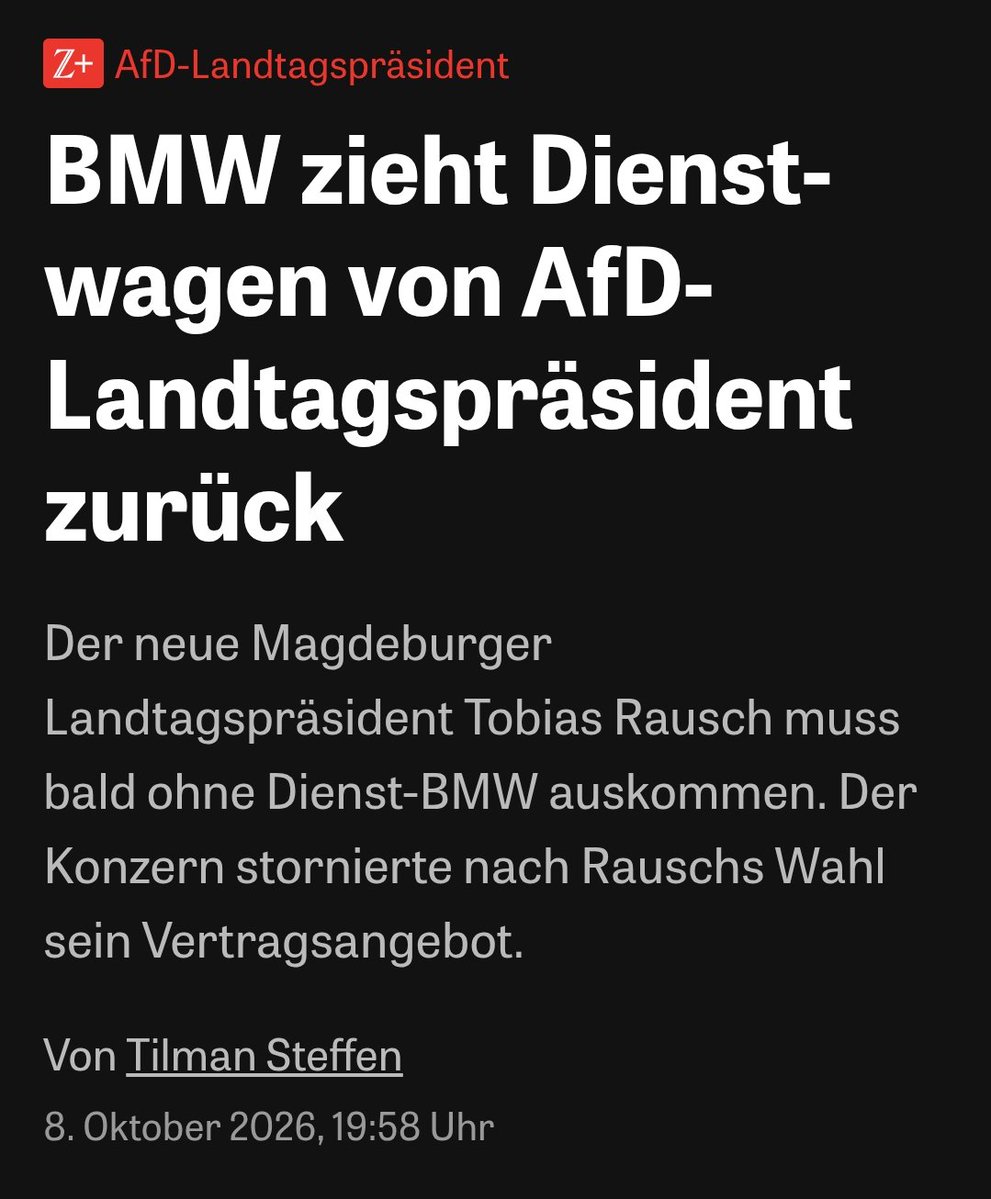
Fabian Keubel wrote that BMW apparently accepts that one-third of Germans and nearly half of the people in Saxony-Anhalt would not want to buy a BMW at all anymore. He suggested that Elon Musk would certainly be happy to sponsor a Tesla. At the same time, Keubel asked whether there was still a decent German car manufacturer that was not corrupted and depended on those who had systematically destroyed their companies with their politics for more than ten years. #BMW #Tesla #DeutscheAutoindustrie (translated)

2917
J
Jamie McDonald 4d

"As the indictment states, Maduro, Flores, and other high-ranking individuals in their circle have used violent, systematic, torture methods to maintain their power in Venezuela," said federal prosecutor Jamie McDonald on Thursday. #NicolásMaduro #Venezuela #tortyr (translated)

Nya åtal mot Nicolás Maduro
www.svt.se
2805
Blocktrainer 4d

Blocktrainer reported that the CDU/CSU financial politician Olav Gutting commented in the Bundestag on the proposal to abolish the holding period for profits from Bitcoin and other cryptocurrencies. Gutting stated that a corresponding change in taxation must be systematic and should not only affect individual areas. https://t.co/2MnKaJHhIY #Bitcoin #Krypto #Steuerreform (translated)

2920
Le Parisien 4d

The article addresses the statements of Yaya D., accused of leading a drug trafficking network in Grigny, while arguing against the idea of systematically blaming his siblings. #TraficDeDrogue #Grigny #Fratrie (translated)

www.leparisien.fr
« Faut arrêter de tout mettre sur la fratrie » : les vérités de Yaya D., soupçonné d’avoir régné sur le trafic de drogue à Grigny
1461
Seznam Zprávy 4d

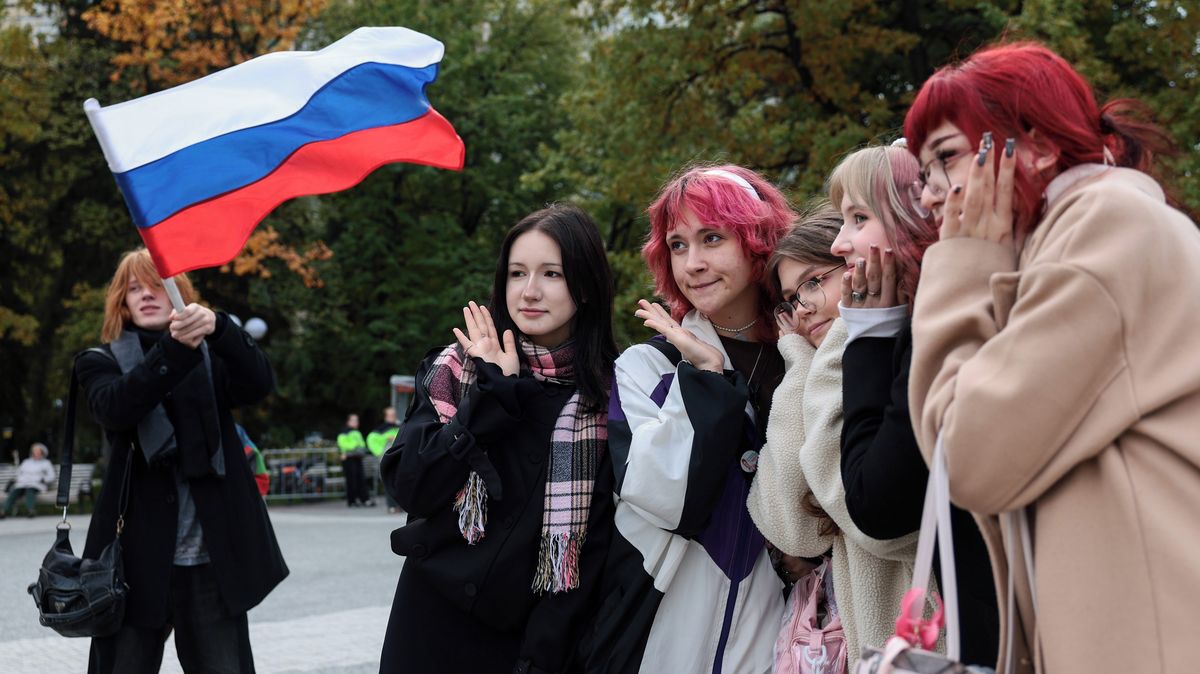
The article describes the systematic control and pressure from Russian authorities on the residents of occupied Ukraine, which includes the enforcement of Russian citizenship and threats to access basic services, leading to an increasing sense of hopelessness and migration of Ukrainians from these areas. #ŽivotPodOkupací #RuskáKontrola #LidskáPráva (translated)

www.seznamzpravy.cz
„Zvykli jsme si šeptat.“ Rusko na okupované Ukrajině kontroluje lidi i doma
2136