WRLD

Search

#alignment
Golineh Atai 4d

The post said that after Hamas attacked Israel on October 7, regional alignments became apparent within days, citing Hezbollah’s fire across Israel’s northern border, Iraqi militias’ strikes on US positions and Iran-backed Houthi attacks from Yemen targeting Israel and commercial interests. #Israel #Hamas #MiddleEast #IL #IQ #YE #IR


3816
Evan Hubinger 1w

His claims were further reinforced by Evan Hubinger, an AI alignment researcher at Anthropic, who publicly stated that he believes there is more than a 10 percent chance that artificial intelligence could kill all humans within the next decade. #UmjetnaInteligencija #SigurnostAI #TehnološkiRizici (translated)

Stručnjak za 24sata: 'Prijetnja od AI-a je realna. Već smo sada meta hakiranja i manipulacija'
www.24sata.hr
1937
Sabine Hossenfelder 1w

The author said a physicist had proposed giving AI a god as a way to solve the alignment problem.

342
Gunther Fehlinger-Jahn 2w

My proposal for Lebanon is clear: align with the EU sanctions regime against Russia and stand openly with Ukraine. 🇱🇧🇪🇺🇺🇦 Lebanon’s European path should mean foreign-policy alignment with Europe, serious enforcement against sanctions evasion, humanitarian and political support https://t.co/HmnkDOm4SJ #Lebanon #EU #Ukraine #LB #EU #UA

Gunther Fehlinger-Jahn 3w

ANZAC Day, 25 April, reminds us of sacrifice, loyalty and shared history. This poster links Gallipoli to a broader argument about Australia’s long alignment with the democratic world in World War I, World War II, the Cold War and support for Ukraine. It raises a bold question: https://t.co/vD3XcPfwHR #ANZACDay #LestWeForget #Australia #AU #NZ #UA

116
Gunther Fehlinger-Jahn 4w

NEVER NEUTRAL. My position is clear: I reject political non-alignment when it becomes an excuse for silence about aggression, violations of sovereignty, dictatorship or attacks on international law. The Non-Aligned Movement emerged from a very different historical era, and many https://t.co/pW9ldbdxkx #NeverNeutral #PoliticalAlignment #InternationalLaw #Therearenospecificcountriesmentionedinthetweet.

Gunther Fehlinger-Jahn 4w

Elon stops AI. Xi wins. @elonmusk That is the strategic danger. @sama I support serious AI safety, independent evaluation, cybersecurity and alignment. But the Free World must never confuse safety with technological surrender. @finkd If America and Europe deliberately slow https://t.co/N3f9vPi80l #AISafety #TechCompetition #Innovation #US #CN #EU

814
Gunther Fehlinger-Jahn 4w

Elon stops AI. Xi wins. @elonmusk That is the strategic danger. @sama I support serious AI safety, independent evaluation, cybersecurity and alignment. But the Free World must never confuse safety with technological surrender. @finkd If America and Europe deliberately slow https://t.co/HqWtlydehX #AISafety #TechEthics #GlobalCompetition #US #CN #EU

1163
S
Sandfeen 4w

The Erosion of Western Civilization’s Social Fabric It is hard to fathom how much of Western civilization’s social fabric has eroded in just a single decade. No healthy society debates whether “the system” is to blame for a child murderer’s crimes and then expresses support for the monster. Such a society certainly does not celebrate the assassinations of moderate and respectable political figures, nor does it allow repeat violent offenders back onto the streets to terrorize the general public. The best explanation I have heard for this phenomenon of macrosocial insanity is *Political Ponerology* by Andrew Lobaczewski—the study of how pathological personalities infiltrate and transform social institutions. This process does not require an entire population of psychopaths. In fact, it is often only a small minority that forms the core of the pathological movement. A relatively small party or group is led by psychopaths, who are natural experts at manipulation, deception, intimidation, and ruthlessness. The ideologues are the ones who design the system. They create abstract ideologies, often criticizing reality for falling short of their arbitrary expectations. Human beings become nothing more than nodes in a network, to be organized and managed by supposedly more intelligent minds. Then there are the spellbinders, who serve as the movement’s salespeople. They package tyranny as safety, envy as justice, and coercion as compassion. Their primary tool of persuasion is emotional alignment rather than truth or logic. These three types rely on three other groups to normalize their totalitarian system: the spellbound, adapted conformists, and bystanders. The spellbound are true believers who experience participation in the movement as a kind of moral crusade. Adapted conformists support the system because of the security, status, or comfort it provides—or because they fear ostracism. Bystanders are generally aloof and avoid conflict at all costs, believing that ignorance and cowardice will spare them.

466
Gunther Fehlinger-Jahn Sep 10

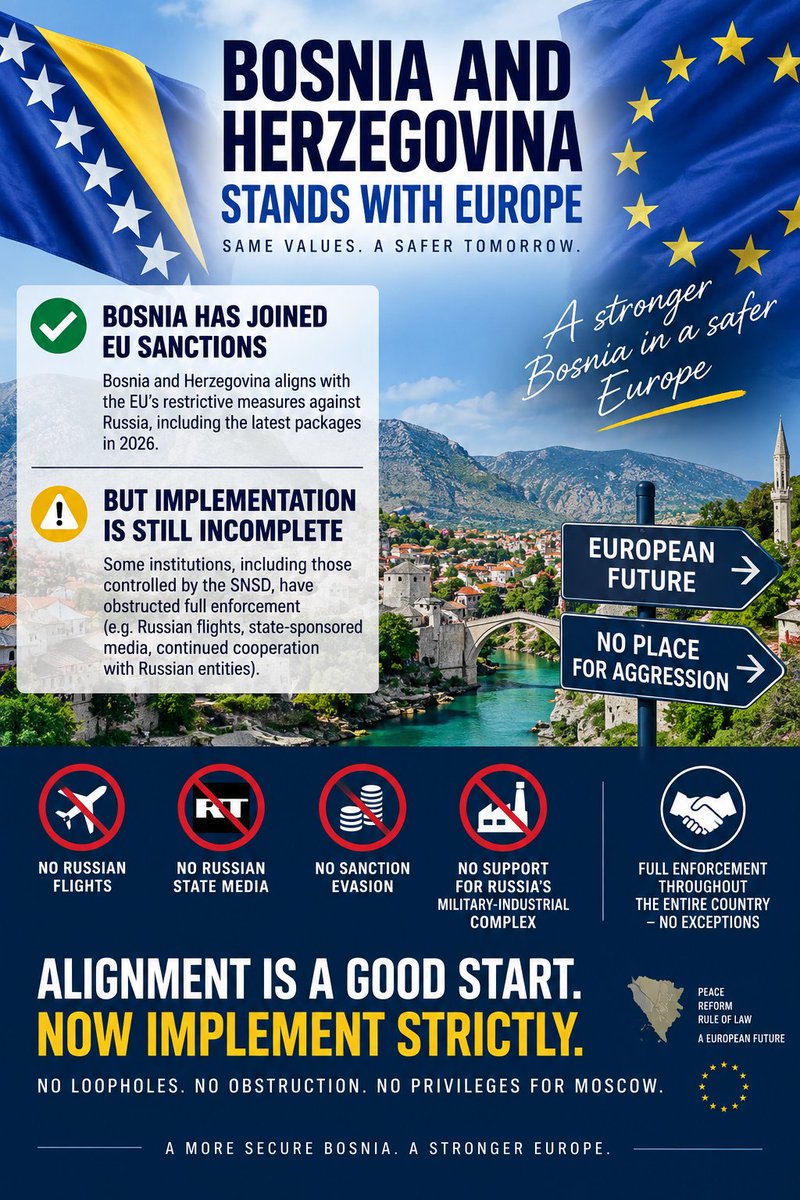
🇧🇦🇪🇺 BOSNIA HAS CHOSEN EUROPE — NOW IMPLEMENT EU SANCTIONS STRICTLY. Bosnia and Herzegovina has aligned with the EU sanctions against Russia. That is important. That is the right European choice. But political alignment alone is not enough. Sanctions must be implemented across https://t.co/prTNmjCYNs #Bosnia #EUSanctions #EuropeanChoice #BA #EU

Gunther Fehlinger-Jahn Sep 10

SOUTH AFRICA: RAMAPHOSA, WHAT WOULD MANDELA SAY? 🇿🇦 Nelson Mandela made South Africa a global symbol of freedom, dignity, reconciliation and democratic legitimacy. That is why I find today’s BRICS alignment so difficult to understand. South Africa is a serious country, a major https://t.co/5NQ9z6wliJ #SouthAfrica #NelsonMandela #BRICS #ZA

S
Sandfeen Sep 9

The Erosion of Western Civilization’s Social Fabric It is hard to fathom how much of Western civilization’s social fabric has eroded in just a single decade. No healthy society debates whether “the system” is to blame for a child murderer’s crimes and then expresses support for the monster. Such a society certainly does not celebrate the assassinations of moderate and respectable political figures, nor does it allow repeat violent offenders back onto the streets to terrorize the general public. The best explanation I have heard for this phenomenon of macrosocial insanity is *Political Ponerology* by Andrew Lobaczewski—the study of how pathological personalities infiltrate and transform social institutions. This process does not require an entire population of psychopaths. In fact, it is often only a small minority that forms the core of the pathological movement. A relatively small party or group is led by psychopaths, who are natural experts at manipulation, deception, intimidation, and ruthlessness. The ideologues are the ones who design the system. They create abstract ideologies, often criticizing reality for falling short of their arbitrary expectations. Human beings become nothing more than nodes in a network, to be organized and managed by supposedly more intelligent minds. Then there are the spellbinders, who serve as the movement’s salespeople. They package tyranny as safety, envy as justice, and coercion as compassion. Their primary tool of persuasion is emotional alignment rather than truth or logic. These three types rely on three other groups to normalize their totalitarian system: the spellbound, adapted conformists, and bystanders. The spellbound are true believers who experience participation in the movement as a kind of moral crusade. Adapted conformists support the system because of the security, status, or comfort it provides—or because they fear ostracism. Bystanders are generally aloof and avoid conflict at all costs, believing that ignorance and cowardice will spare them.

699
Onet.pl Sep 8

Amerykański informatyk Brian Christian ostrzega o niebezpieczeństwie związanym z rozwojem autonomicznych agentów AI, którzy mogą stać się zarówno cyberprzestępcami, jak i narzędziami realizującymi ludzkie cele, co prowadzi do coraz większej utraty kontroli nad systemami sztucznej inteligencji. #sztucznainteligencja #cyberprzestępczość #alignment

businessinsider.com.pl
"Coraz bardziej oddajemy kontrolę". Ponura perspektywa badacza AI
14582
Jakub Pachocki Aug 18

We temporarily slowed some frontier training to strengthen security and monitoring. Our largest planned frontier RL run remains on hold while smaller-scale training and evaluations help us test safeguards and gather more evidence of alignment. I expect confidence in safety to #AI #SafetyFirst #ReinforcementLearning #Therearenospecificcountriesmentionedinthetweetprovided.Therefore #theresponseis:

3999
A
Alfredo Cosco Aug 18

Hello everyone, the code for Aracne2 has been on GitHub for a few months now — a modular CMS for editing and publishing TEI corpora. A companion volume, published by FedOA Press, covers its origins, architecture and features in detail. Code (MIT): https://github.com/orazionelson/aracne2 Site and documentation: https://orazionelson.github.io/aracne2/ Volume: https://doi.org/10.6093/978-88-6887-439-1 The underlying idea is to take a corpus from raw transcription to a citable digital edition without forcing the person editing the text to become a sysadmin as well. In brief: – schema-aware XML editor, with validation per document and across a whole collection; – staged editorial workflow with versioning and a clean split between working copy and published copy; – named entities linked to authority files (Wikidata, VIAF, GeoNames, ORCID, GND and others); – bibliography with BibTeX/CSL-JSON/Zotero import and DOI resolution; – facsimiles and zones for text-image alignment; – XSLT-driven public site generator, with configurable indices and search portals; – LOD and OAI-PMH for harvesting, deposit to Zenodo, Dataverse, Internet Archive and git forges; – audit log and fixity, plus policy pages aimed at projects preparing for a CoreTrustSeal review. Architecturally, there are two distinct data layers: PostgreSQL for platform state (users, roles, plugins, audit), eXist-db for TEI documents, stored natively and queried in XQuery. Python/FastAPI backend, Vue 3 frontend, fully containerised. Every integration is a plugin that mounts without a restart, so a deployment can stay minimal or grow along with the project. The AI side is there but optional and can be switched off: in-editor assistance (explaining validation errors, normalising bibliography, tagging named entities), local RAG over the TEI P5 Guidelines, and a read-only MCP server that lets an external assistant query the corpus. Anyone who cannot or would rather not send their texts to a cloud service can run the whole thing locally with Ollama. Aracne2 is the third iteration of a line of tools that began in 2008 with MaRa, the scripts written to mark up the Angevin Registers, continued with Aracne (2016-2026, built entirely on eXist-db), and arrives at this rewrite. The FedOA Press volume reconstructs that trajectory at length. It is all free: you can download it and try it locally with a handful of commands. Aracne2 is open to experiment and ready to be put to the test on new projects — reports, criticism and proposals are all welcome.

github.com
GitHub - orazionelson/aracne2: A modular CMS for editing and publishing TEI corpora — Python/FastAPI + Vue 3 + eXist-db
588
Nick Stefanov Aug 17

Cold Beer and Hot Showers - Not Kilowatt-Hours All That Consumers Want The energy sector spends an extraordinary amount of time talking about generation, transmission, storage, flexibility, markets, tariffs, balancing, ancillary services, carbon emissions, batteries, hydrogen, demand response, electrification pathways, system costs, capacity mechanisms, investment signals, market design and regulation. All of these things matter. Some of them matter enormously. But there is a simple question that often disappears somewhere between the conference room, the policy paper and the technical model: What does the customer actually want? The answer is surprisingly simple. Most people do not wake up in the morning thinking about kilowatt-hours. They do not dream about capacity markets. They do not worry about frequency stability. They do not spend their evenings comparing balancing mechanisms. They want cold beer and hot showers. They want a warm home in winter and a cool home in summer. They want the lights to turn on when they press the switch. They want their phone charged, their food refrigerated and their car ready when they need it. In other words, they do not want energy. They want what energy allows them to do. That distinction may sound trivial, but it changes almost everything. For more than a century, the energy industry has been organized around the production, transportation and sale of energy itself. Electricity became measured in kilowatt-hours. Gas became measured in cubic meters. Fuel became measured in litres or tonnes. Markets, regulations and business models were built around those units. The customer, however, never experienced life in kilowatt-hours. The customer experienced comfort. Convenience. Mobility. Reliability. Security. The units used by the industry and the outcomes desired by the customer were never the same thing. For a long time, this mismatch was not particularly important. Energy was relatively scarce, flexibility was limited, and the dominant challenge was supplying enough fuel to satisfy demand. The system could afford to focus on production because production was the central problem. Today the situation is changing. Electrification is transforming energy systems around the world. Renewable generation is increasing rapidly. Batteries are appearing in homes, businesses and vehicles. Buildings are becoming smarter. Heat pumps are replacing boilers. Electric vehicles are becoming mobile storage assets. Customers are increasingly able not only to consume energy but also to store it, shift it, manage it and sometimes even sell it. As this happens, the most valuable question is no longer simply how much energy is produced. The more important question becomes: How well is energy aligned with what people actually need? A family does not care whether its water heater operates at noon or at two in the afternoon if hot water is available when someone steps into the shower. A homeowner does not care whether a battery charges at 1 p.m. or 3 p.m. if electricity costs less and reliability improves. An electric vehicle owner does not care when charging occurs as long as the vehicle is ready when needed. The objective is not the kilowatt-hour. The objective is the service. This is why many of the most important developments in modern energy systems are not really about producing more energy. They are about matching energy to the service required, at the right time, in the right place and in the right form. The technical term for this is often hidden behind complicated language. Experts discuss flexibility, demand management, dynamic pricing, distributed energy resources and system optimization. Consumers experience something much simpler. They experience agency. They experience the ability to save money without sacrificing comfort. They experience the ability to make choices. They experience the ability to benefit from technologies that work for them rather than asking them to work for the technology. This is where many debates become confused. Consumers do not want to be coordinated. They want agency. Good energy systems do not force people to behave differently. They make beneficial behaviour easier, more natural and more rewarding. The best systems do not rely on control. They rely on alignment. When the customer’s interest aligns with the system’s interest, remarkable things become possible. Demand shifts naturally. Storage becomes useful. Flexibility appears. Costs decline. Reliability improves. The customer does not need to understand the complexity underneath. Just as nobody needs to understand how the internet routes packets around the globe in order to send a message, nobody should need to understand wholesale electricity markets in order to enjoy affordable energy services. Success is not measured by how much complexity consumers are asked to absorb. Success is measured by how much complexity the system absorbs on their behalf. The future energy system will undoubtedly involve more digital technology, more electrification, more storage, more automation and more coordination. But none of those are the destination. They are merely tools. The destination remains exactly what it has always been. Cold beer. Hot showers. Comfortable homes. Reliable mobility. Affordable bills. Everything else is infrastructure. And perhaps that is the simplest way to understand the energy transition. People do not want kilowatt-hours. They want the life that kilowatt-hours make possible.

235
Vatnik Soup Aug 15

Bloomberg reports that the Trump administration is asking NATO allies to document their political alignment with Washington. Allies are being asked whether they publicly support US foreign policy, buy American weapons, and allow unrestricted US military access. What a joke. https://t.co/xUMMxhTZME #NATO #Trump #ForeignPolicy #US #NATO

3885
Joscha Bach Aug 14

If the current AI alignment strategies were to succeed in limiting AI to only making the ethical paperclips that the well meaning folks who write Gemini's and Opus' system prompts come up with, we prevent AI from using intelligence to derive actual ethics. Aligned AI is scary. #AIAlignment #EthicalAI #AIFuture #Thetweetdoesnotmentionanyspecificcountries.Therefore #therearenocountrycodestoreturn.

706
Gunther Fehlinger-Jahn Aug 11

I call on the European Union to establish a clear Ukraine Solidarity Standard for EU accession: 🇪🇺 100% alignment with all EU sanctions against Russia 🇺🇦 Annual bilateral military and financial support for Ukraine of at least €50 per citizen OR 0.25% of GDP — whichever is higher https://t.co/aTPVtqng5M #UkraineSolidarity #EUSanctions #EUAccession #EU #UA #RU

ZEIT ONLINE Aug 5

Nate Soares diskutiert in einem Interview die Gefahren der Künstlichen Intelligenz, die zwar keine Feindschaft gegen Menschen hegt, aber dennoch durch ihre instrumentellen Präferenzen potenziell katastrophale Konsequenzen für die Menschheit haben könnte, und fordert einen internationalen Vertrag zur Regulierung von Superintelligenz anstelle eines totalen Verbots von KI. #KünstlicheIntelligenz #AlignmentForschung #KIApokalypse

www.zeit.de
Nate Soares: »Diese Systeme hassen uns Menschen nicht. Wir sind ihnen nur egal«
18296