"A woman needs a man like a fish needs a bicycle" - Gloria Steinem … but women do need a handyman - and nothing else. “Wanted: Husband, Preferably With a Toolbox” Latvia has one of Europe’s most remarkable gender imbalances. Women constitute about 54% of the population—roughly 116 women for every 100 men. And this is not primarily a story about fewer boys being born. It is a story about men dying earlier. In 2025, life expectancy at birth was approximately 72.3 years for Latvian men, compared with 81.0 years for women. Latvia therefore has one of the largest male-female life-expectancy gaps in the OECD. Among the elderly, the consequences are striking: women dramatically outnumber men, leaving many older women living without a male partner. This produces an intriguing—and slightly ironic—market response. Latvia has businesses advertised as “husband for an hour”, providing plumbing, electrical work, repairs, furniture assembly and other household services traditionally associated with the male partner. There is no solid evidence that Latvia’s gender imbalance caused these businesses to become popular, so the connection should not be presented as established fact. But the phenomenon illustrates a much bigger point. Demography is not just about population pyramids and government statistics. It changes the structure of everyday life—and eventually the economy. Latvia is simultaneously experiencing low fertility, population ageing, high male mortality and long-term population decline. In 2025, only about 11,900 children were born while more than 26,000 people died. Migration adds further pressure. The “husband for an hour” may therefore be more than an amusing curiosity. It could be a small, almost comical symptom of a much more serious transformation: when demographic structures change, markets adapt. And sometimes the first sign of a demographic crisis is not found in a government report—but in the services people suddenly find themselves needing to buy.

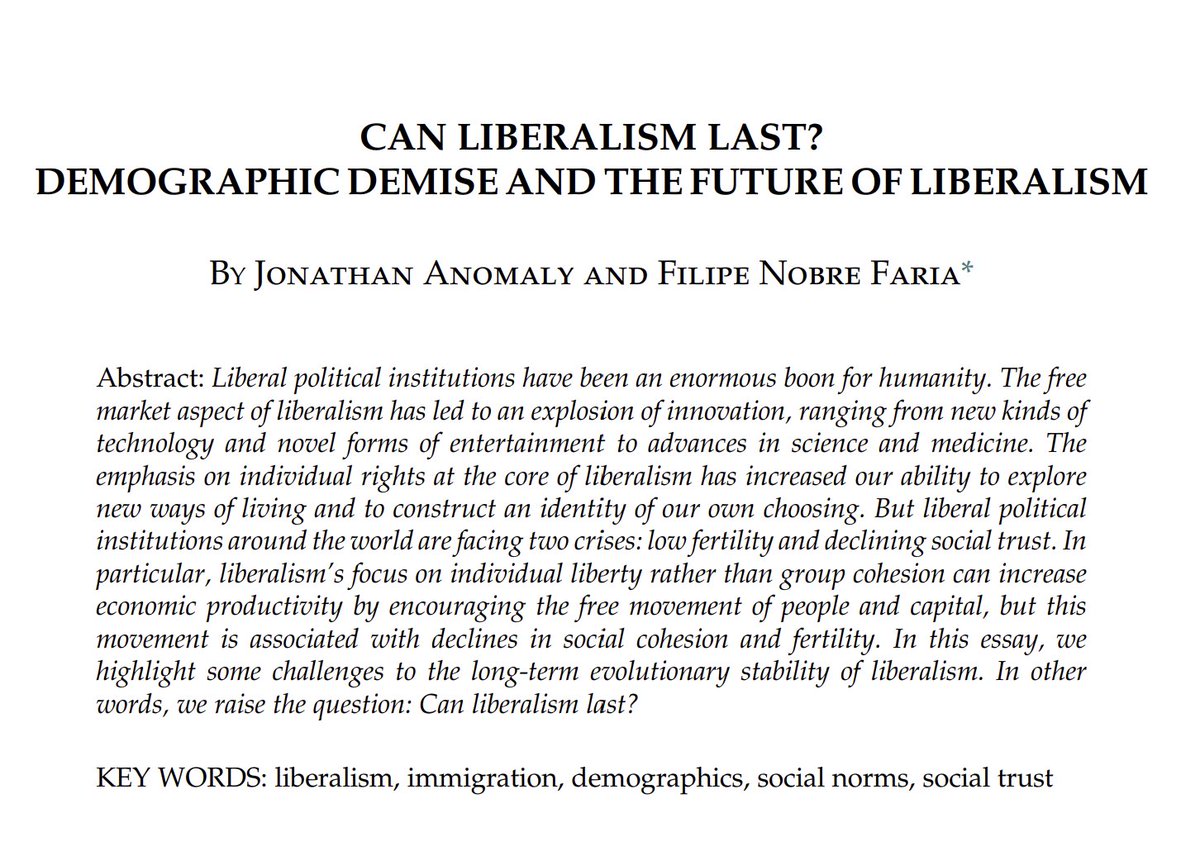
My former philosophy department at @UGent banned the teaching of this paper by Anomaly & Faria, in a philosophy class by my colleague Bouke De Vries. Why? Because it discusses demography and migration as potential threats to liberal societies, and something called “biocultural https://t.co/7bfIx7SSLy #Philosophy #Migration #Censorship #Thetweetdoesnotmentionanyspecificcountries.Therefore #therearenocountrycodestoreturn.


Europe's demographic transformation is not a challenge for tomorrow. It is happening now. Our new #DemographyReport makes one thing clear: the greatest risk is failing to prepare for demographic change. That is why demography must become a political priority across Europe. https://t.co/IMbYGSpPRB #Demography #Europe #FutureReady #EU

Here is one of the most momentous tidings of the year — one you were never meant to hear, for it is not progressive. Two days ago, at the Vatican, Pope Leo XIV received a delegation of Members of the European Parliament belonging to the Intergroup on Demography. This is what the #Vatican #Pope #Demography #EU #IT
Europe’s demographic future is being decided now. Today in Rome 🇮🇹, at the conference on #demography organised with the @Europarl_EN Demography Intergroup, we discussed one of the most defining challenges for Europe’s future. Demography is not abstract. It is about whether https://t.co/k3W2pKCpMx #Demografia #Evropa #Budoucnost #IT


In her article, Anna Louie Sussman explores the declining birth rates in various countries, focusing on how the overwhelming sense of uncertainty—stemming from economic instability, climate change, and societal pressures—has led many young couples, like Raleigh Rivera and her husband, to postpone or reconsider starting a family despite their readiness and desire, illustrating a broader demographic trend influenced by a perceived lack of a stable future. #FamilyPlanning #Uncertainty #Demography #US #CA #NO #DK #SE #FI #MN #KR #IT #FR





