WRLD

Search

#Expectations
Olivia Rodrigo ITALIA🇮🇹 2h

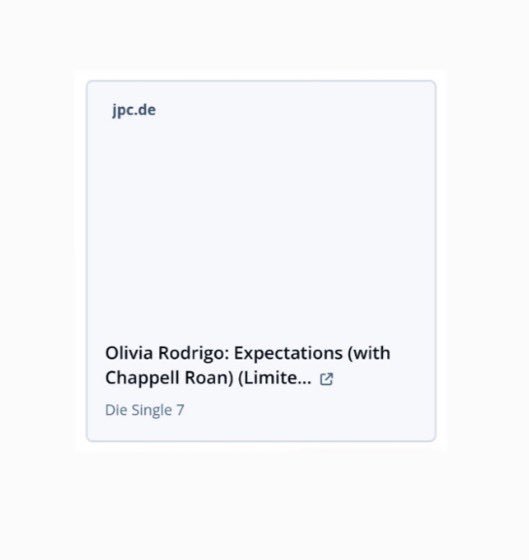
Olivia Rodrigo ITALIA reported that a German music store had announced a limited edition vinyl of "expectations," a track featuring Olivia and Chappell Roan, which is set to be released on October 16. https://t.co/OHjC56N2cM #vinile #musica #OliviaRodrigo (translated)
1418
Update Olivia Brasil 3h

Update Olivia Brasil reported that, according to rumors on ATRL, "expectations" by Olivia Rodrigo should receive a remix version featuring Chappell Roan. https://t.co/KxK6z7L66F #OliviaRodrigo #ChappellRoan #Remix (translated)

1397
Christophe Barraud🛢🐳 7d

The author’s Monday brief said the G7 had agreed to release 100 million barrels of diesel and crude, that allies of Jair Bolsonaro had gained strength in the Senate, and that the euro had fallen to a 17-month low. The author also forecast that eurozone producer price inflation would exceed expectations. https://t.co/tBcPVAHckP #G7 #Economie #Marché #BR #EU

114
Christophe Barraud🛢🐳 1w

The author’s Friday brief highlighted the U.S. employment report, described the global credit market as starting to sputter, and noted accelerating inflation in Tokyo and eurozone CPI that exceeded expectations. https://t.co/nZI2TpoWzz #Employment #MarketNews #Inflation #US #JP #EU

Christophe Barraud🛢🐳 2w

⚠ Wednesday Brief⚠️ 🇺🇸 U.S. Consumer Confidence Plunges 🇨🇳 #China’s Economic Activity Rebounds 🇨🇳 China’s Stimulus Push Falls Flat With Markets 🇫🇷 French CPI Came Above Expectations ... https://t.co/LZd65RmZLH #Economy #ConsumerConfidence #MarketTrends #US #CN #FR

115
Christophe Barraud🛢🐳 2w

🇺🇲 US Sept. Consumer Confidence Falls to 81.9, Below All Estimates - Bloomberg - Prior month revised to 88.6 from 89.4 - Present situation confidence fell to 109.3 from 117.2 - Consumer confidence expectations fell to 63.6 from 69.5 #ConsumerConfidence #USEconomy #Bloomberg #US

344
Christophe Barraud🛢🐳 2w

⚠ Tuesday Brief ⚠️ 🇨🇳 #China Launched Targeted Stimulus 🇦🇺 #RBA Raised Rates 🇪🇦 Spanish CPI Beat Expectations ... https://t.co/CaTNPsa9TT #China #RBA #CPI #CN #AU #ES

115
Access Olivia Rodrigo 2w

🚨 FOMO! Simplesmente a plateia fazendo o desafio de “expectations”, em que as meninas cantam a parte de Olivia Rodrigo e os meninos, a de Dan Nigro. https://t.co/wtkv2UJxij #FOMO #OliviaRodrigo #Música

25228
Lesbocine 3w

O PÚBLICO PEDIU E ELA ATENDEU! Lauren Jauregui colocou oficialmente “Expectations” na setlist da sua turnê pelo Brasil! https://t.co/dSJWCNvO2D #LaurenJauregui #Expectations #TurnêBrasil

12721
S
Sandfeen 4w

The Erosion of Western Civilization’s Social Fabric It is hard to fathom how much of Western civilization’s social fabric has eroded in just a single decade. No healthy society debates whether “the system” is to blame for a child murderer’s crimes and then expresses support for the monster. Such a society certainly does not celebrate the assassinations of moderate and respectable political figures, nor does it allow repeat violent offenders back onto the streets to terrorize the general public. The best explanation I have heard for this phenomenon of macrosocial insanity is *Political Ponerology* by Andrew Lobaczewski—the study of how pathological personalities infiltrate and transform social institutions. This process does not require an entire population of psychopaths. In fact, it is often only a small minority that forms the core of the pathological movement. A relatively small party or group is led by psychopaths, who are natural experts at manipulation, deception, intimidation, and ruthlessness. The ideologues are the ones who design the system. They create abstract ideologies, often criticizing reality for falling short of their arbitrary expectations. Human beings become nothing more than nodes in a network, to be organized and managed by supposedly more intelligent minds. Then there are the spellbinders, who serve as the movement’s salespeople. They package tyranny as safety, envy as justice, and coercion as compassion. Their primary tool of persuasion is emotional alignment rather than truth or logic. These three types rely on three other groups to normalize their totalitarian system: the spellbound, adapted conformists, and bystanders. The spellbound are true believers who experience participation in the movement as a kind of moral crusade. Adapted conformists support the system because of the security, status, or comfort it provides—or because they fear ostracism. Bystanders are generally aloof and avoid conflict at all costs, believing that ignorance and cowardice will spare them.

466
S
Sandfeen Sep 9

The Erosion of Western Civilization’s Social Fabric It is hard to fathom how much of Western civilization’s social fabric has eroded in just a single decade. No healthy society debates whether “the system” is to blame for a child murderer’s crimes and then expresses support for the monster. Such a society certainly does not celebrate the assassinations of moderate and respectable political figures, nor does it allow repeat violent offenders back onto the streets to terrorize the general public. The best explanation I have heard for this phenomenon of macrosocial insanity is *Political Ponerology* by Andrew Lobaczewski—the study of how pathological personalities infiltrate and transform social institutions. This process does not require an entire population of psychopaths. In fact, it is often only a small minority that forms the core of the pathological movement. A relatively small party or group is led by psychopaths, who are natural experts at manipulation, deception, intimidation, and ruthlessness. The ideologues are the ones who design the system. They create abstract ideologies, often criticizing reality for falling short of their arbitrary expectations. Human beings become nothing more than nodes in a network, to be organized and managed by supposedly more intelligent minds. Then there are the spellbinders, who serve as the movement’s salespeople. They package tyranny as safety, envy as justice, and coercion as compassion. Their primary tool of persuasion is emotional alignment rather than truth or logic. These three types rely on three other groups to normalize their totalitarian system: the spellbound, adapted conformists, and bystanders. The spellbound are true believers who experience participation in the movement as a kind of moral crusade. Adapted conformists support the system because of the security, status, or comfort it provides—or because they fear ostracism. Bystanders are generally aloof and avoid conflict at all costs, believing that ignorance and cowardice will spare them.

699
Christophe Barraud🛢🐳 Sep 7

⚠ Monday Brief ⚠ 🇮🇷 🇺🇸 Iran, U.S. Trade Tanker Attacks 🇨🇳 #China Injects $45 Billion in Banks, Insurers 🇯🇵 🇺🇸 Japan Likely Sold #Treasuries 🇩🇪 German Far Right Scores Best Result Ever 🇪🇺 #Eurozone Q2 GDP to Beat Expectations ... https://t.co/N6Eq5srNGj #Iran #China #Eurozone #IR #US #CN #JP #DE #EU

350
Christophe Barraud🛢🐳 Sep 7

🇪🇺 Regional figures confirm that #Eurozone Q2 GDP is set to be revised upward, comfortably beating expectations. ➡ Bloomberg consensus (QoQ): +0.4%e v +0.4% latest estimate (v 0.0% in Q1). ⚠ Note 1: Distortion caused by Ireland will be even more significant, with GDP growth #Eurozone #GDP #Bloomberg #EU #IE

117
Christophe Barraud🛢🐳 Sep 6

🇩🇪 German Far-Right AfD Set to Win State Vote, Short of Majority - Bloomberg *The AfD secured 44.5% of the vote on Sunday in the eastern state (above expectations). https://t.co/S1pGFUJrRK #AfD #Německo #Volby #DE

117
Luciano Magaldi Sardella (PhD) Sep 5

The Vindication of the “GIO Festival”: “BroadwayWorld” Celebrates Marina and the Umberto Giordano Theatre of Foggia SOURCE: https://www.linkedin.com/pulse/vindication-gio-festival-broadwayworld-celebrates-sardella-ph-d--8zzce/ SOURCE: https://www.letteremeridiane.org/2026/08/la-rivincita-del-gio-festival-broadwayworld-celebra-marina-e-foggia/ The GIO Festival has been, to put it mildly, overlooked by Rai3 Puglia and several regional outlets. Yet the festival dedicated to Umberto Giordano — promoted by the Chamber of Commerce of Foggia together with the Municipality and the Province, and supported by the Apulia Region and the Fondazione Monti Uniti — has achieved a remarkable vindication, landing on the homepage of BroadwayWorld thanks to the world première of the opera Marina, staged on 5 June at the Umberto Giordano Theatre in Foggia. This is no small feat, considering that BroadwayWorld is among the most influential American platforms devoted to theatre and the performing arts. The transatlantic debut of the opera by Foggia’s great composer did not escape the attention of Luciano Magaldi Sardella, who submitted to the editorial board of Lettere Meridiane an in‑depth and compelling contribution, reproduced below. In the article, the author masterfully reconstructs the extraordinary story of Giordano’s first opera, composed in 1888 and left without a staged production for 138 years, until its historic performance on 5 June at the Giordano Theatre. Above all, he recounts how the inaugural edition of the GIO Festival has restored Foggia to the centre of the international operatic stage, through the rediscovery and valorisation of Marina, the involvement of major musical institutions, and the attention of the American press. It is a stimulating reflection on the cultural and identity‑driven renaissance of a city that, for far too long, bore Giordano’s name on the façade of its theatre without managing to turn it into a lever of international visibility. (g.i.) + + + + + There are moments in the life of a city when past and future clasp hands upon the stage of the present. Foggia experienced one of these moments on the evening of 5 June 2026, when the curtain of the Umberto Giordano Theatre rose upon Marina, an opera composed in 1888 by a young man of twenty‑one — Umberto Giordano — then a student at the San Pietro a Majella Conservatoire in Naples. After one hundred and thirty‑eight years of silence, that score finally found its first scenic breath in the world. “It is not an ordinary event. It is a turning point. A void filled. A story rewritten.” Umberto Giordano, one of the most celebrated verismo composers of the fin‑de‑siècle — born in Foggia, author of masterpieces such as Andrea Chénier, Fedora, Siberia — had remained, until now, the only great Italian opera composer without a festival entirely dedicated to his oeuvre. A paradox that weighed like a historical injustice upon a city that bears his name engraved on the pediment of its most beautiful theatre. This is the extraordinary journey of Marina, Giordano’s first opera, which after 138 years of oblivion received its world première in scenic form on 5 June 2026 at the Umberto Giordano Theatre in Foggia, as the opening event of the GIO Festival — the inaugural edition of the Giordano International Opera Festival. The manuscript, preserved in the Frederick R. Koch Collection at Yale University’s Beinecke Rare Book and Manuscript Library, has travelled an astonishing path: from the elite libraries of America’s East Coast to the beating heart of the Daunia. On the night of 5 June 2026, at the Umberto Giordano Theatre, that silence was finally broken. The GIO Festival was conceived in Foggia as an ambitious cultural project promoted by the Chamber of Commerce, the Municipality, and the Province, with the support of the Apulia Region, aiming to transform the artistic legacy of the verismo composer into a driver of territorial development and cultural tourism. Under the artistic direction of conductor Gianna Fratta and violinist Dino De Palma, the event at last fills a historical void. Its model is explicit and ambitious: a project inspired by the great festivals dedicated to Italian composers — such as the Verdi Festival, the Puccini Festival, the Rossini Opera Festival — while maintaining a strong territorial and participatory dimension. In other words, Foggia formally claims its seat at the table of the greats. And it does so with the credentials required: an unrepeatable world scenic première (parallel to the concert première at Milan’s Teatro Dal Verme, recorded by the prestigious opera label Decca Classics), a high‑quality operatic production, and the support of leading cultural institutions (Teatro dell’Opera di Milano, Fondazione Teatro Petruzzelli of Bari). The festival benefitted from the collaboration of the Orchestra of the Conservatoire and the Chorus of the Fondazione Teatro Petruzzelli of Bari, the Umberto Giordano Conservatoire of Foggia, the Fondazione Monti Uniti, and the Fondazione Apulia Felix. A network of excellence that lent the event national resonance and stature. The Umberto Giordano Theatre is a nineteenth‑century jewel of rare beauty — the oldest functioning horseshoe‑shaped historic theatre in Apulia. Yet for decades it lived in a state of semi‑clandestine cultural marginality, relegated to the periphery of the operatic routes that matter, hindered by long interruptions in its use from 2007 to 2014, including recent fire‑safety compliance requirements. Some referred to it, with a mixture of condescension and provincial resignation, as a “provincial theatre”, destined merely to bear Giordano’s name. That label is now destined to fall. It is precisely in Foggia that this youthful gem received its first scenic staging, placing the city on the international map of opera. A positioning without precedent in the city’s recent history. The Giordano Theatre recorded a full house for the historic première of Marina, welcoming hundreds of spectators, while many more followed the performance from outside via a large screen installed for the occasion. The production met expectations with full artistic dignity: the staging transposed the narrative to the First World War, heightening the opera’s dramatic and realist character. On the podium, the Symphony Orchestra of the Umberto Giordano Conservatoire conducted by Matteo Dal Maso. Sets and costumes by Alfredo Troisi; lighting by Massimo Russo. An ensemble of talents worthy of the name the theatre proudly bears. The definitive seal of this moment’s historical significance arrived from across the Atlantic. BroadwayWorld, the world’s most influential outlet for live performance criticism and reporting — with over 5.5 million monthly views — dedicated exclusive coverage to the event, publishing a complete photographic gallery of the world scenic première curated by Chloe Rabinowitz and a substantial critical review by Rachel Stone. The American article emphasised the historical value of the undertaking and the bond between the composer and his native city, highlighting the musical quality of the score, deemed surprisingly mature for the composer’s age. For the first time, the Umberto Giordano Theatre appeared on the New York‑based site alongside institutions such as the Los Angeles Opera House, Houston Opera, and BBC Classical Music at the Royal Opera House. It is its natural place. It should have been there decades ago. Until now, the world knew Giordano through his Milanese triumphs, not through the youthful opera written between Foggia and the Naples Conservatoire — the lost (and later rediscovered) Marina of 1888. Let us be clear: this is no minor detail. BroadwayWorld does not grant exclusive galleries to provincial theatres. It does so for events that shift the coordinates of musical and theatrical history within the circuits that matter. This time, those coordinates shifted to Foggia thanks to the GIO Festival, in the name of Umberto Giordano. For the record — and for those who may not yet know — the GIO Festival is a new and ambitious biennial event conceived by the Chamber of Commerce of Foggia, with the aim of celebrating the genius of Umberto Giordano and transforming it into a powerful engine of development for the entire Capitanata. Biennial means continuity, planning, vision. It means that Foggia does not intend to be a meteor in the operatic firmament, but a stable and recognisable presence within the international festival circuit. Andrea Chénier, Siberia, and Fedora had already carried Giordano’s name to the Metropolitan Opera House in New York for more than a century, where his works are still performed to great acclaim. Now Foggia itself — not merely its scattered operatic legacy — claims its rightful “place in the sun”. The composer whom his city struggled to recognise in life, and whose name it preserves on its theatre, its square, and its conservatoire, may finally become the lever of an unprecedented cultural, economic, and identity‑driven renaissance. The GIO Festival 2026 is not, one hopes, a point of arrival. It should be the first chapter of a new story for Foggia, for the Capitanata, and for the cultural South of Italy. The Umberto Giordano Theatre is no longer merely an architectural jewel to be preserved: it has now become a place of creation and inspiration, capable of attracting international press attention and hosting events that enter the annals of world opera. To those who still whisper that Foggia is a provincial city, the answer is now written upon the world’s stages: on the evening of 5 June 2026, the periphery became the centre.

www.linkedin.com
The Vindication of the “GIO Festival”: “BroadwayWorld” Celebrates Marina and the Umberto Giordano Theatre of Foggia
818
Christophe Barraud🛢🐳 Sep 4

⚠ Friday Brief ⚠ 🇺🇸 Focus on U.S. Employment Report; 🇳🇴🌎 Norway Wealth Fund Proposes Lower Bond Holdings 🇩🇪 German Factory Orders Beat Expectations 🇩🇪 Focus on German State Election ... https://t.co/NgQ4ogGMRp #USEmployment #NorwayWealthFund #GermanFactoryOrders #US #NO #DE

234
Christophe Barraud🛢🐳 Sep 4

⚠ Friday Brief ⚠ Focus on U.S. Employment Report; Norway Wealth Fund Proposes Lower Bond Holdings German Factory Orders Beat Expectations Focus on German State Election ... https://t.co/NgQ4ogGMRp #USEmployment #NorwayWealthFund #GermanEconomy #US #NO #DE

Christophe Barraud🛢🐳 Sep 2

🇪🇺 *MAKHLOUF SAYS #ECB MUST BE PREPARED TO LIFT INTEREST RATES: FT *MAKHLOUF `UNEASY' OVER EUROZONE INFLATION, HE TELLS FT *MAKHLOUF TELLS FT ECB DECISION NEXT WEEK WON'T BE A SURPRISE *MAKHLOUF SAYS INFLATION EXPECTATIONS ARE 'IN GOOD PLACE': FT *MAKHLOUF EXPECTS ECB TO SLIGHTLY #ECB #Inflation #InterestRates #EU

117
Olivia Rodrigo Brasil | Fã-site Aug 30

Olivia Rodrigo fazendo com que os homens e as mulheres cantassem o coro da ponte em “expectations”, no Daisy Chain Fields. 🌼 “Cantem essa parte comigo, esse é nosso mantra, porque nós merecemos o mundo, certo?” https://t.co/nXbic8woNu #OliviaRodrigo #Expectations #Música

17803
S
Sandfeen Aug 28

The Austrian Critique of Marx followed a line from value theory to economic coordination. 1) **Menger:** Value is **subjective**. People value goods because they think they satisfy wants; water in a desert can be far more valuable than water at home, with production labor unchanged. 2) **Böhm-Bawerk:** Marx’s surplus value is flawed. **Time and capital** matter: wages and costs are advanced before revenue arrives, so interest/profit reflect time preference, risk, and production structure—not unpaid labor. 3) **Transformation problem:** Marx’s labor-values should imply different surplus values by industry, but competition pushes toward equal profit rates. Marx tried to convert values into **prices of production**, yet the inconsistency with his earlier theory remains debated. 4) **Mises:** The key issue is whether socialism can **calculate**. Rational planning needs prices for **capital goods**, which only markets under **private ownership** can generate. 5) **Hayek:** Knowledge is **dispersed** and local. **Prices** transmit that information so coordination can occur without everyone knowing the full cause. 6) **Rothbard:** Profit isn’t necessarily exploitation. Capitalists bear uncertainty, organize production, and pay wages upfront; workers get an agreed wage, while profit is what remains if the venture succeeds. So the deepest split is not only about profit source, but about coordination: Marx asks who appropriates value; Austrians increasingly ask how millions coordinate exchange, knowledge, and expectations at all.

586