WRLD

Search

#Hayek
Les Mileistes Français 🦁🇫🇷 1w

The account Les Mileistes Français reported that Javier Milei had received the award for the best economist of the year the day before, presented by the Paris Economic Forum. According to the account, he explained that his concern for the mechanisms of growth led him to study economics. In his speech, Milei stated that upon taking office, 70% of children were living below the poverty line, including 27% in extreme poverty, in an agricultural country that, according to him, could feed 500 million people. He declared that this rate had since decreased to 45% and that millions of children had been lifted out of poverty. However, he described the situation as still terrible, while presenting the ongoing evolution as the most beautiful in Argentine history. The account reported that Milei thanked several economists, including Philippe Aghion, who was present in the room, Robert Lucas Jr., as well as Friedrich Hayek, Ludwig von Mises, and Murray Rothbard. He also praised his ministerial team and his close associates. According to the account, he became emotional and paused while thanking them. #Économie #Argentine #Croissance (translated)


14469
FRENCHRAPUS 🇺🇸 4w

🚨 LA MILF DU SIÈCLE ! Salma Hayek fait le buzz après avoir dévoilé son physique incroyable lors de sa soirée d’anniversaire cette nuit 🤯 Cette femme vient littéralement d’avoir 60 ans… https://t.co/GL8kx1X4U4 #SalmaHayek #Anniversaire #Beauté

16410
S
Sandfeen 4w

Who Owned the Word “Socialism”? One of the great distortions of twentieth-century political history is the claim that because Nazis and fascists fought Marxists and communists, they must therefore have been their political opposites — and hence “right-wing.” That conclusion does not follow. Marxists, communists, fascists and National Socialists all described their movements in socialist or collectivist terms, though they understood socialism very differently. The Nazis called themselves National Socialists, while fascism emerged partly from the revolutionary socialist milieu and retained strong anti-liberal, anti-capitalist and collectivist elements. The crucial development was that Marxists and communists increasingly established themselves as the authoritative owners of the word “socialism.” As Marxism became the dominant form of revolutionary socialism, “socialist” increasingly came to mean specifically Marxist, class-based and internationalist socialism. Movements that rejected Marxism could therefore appear to be its political opposite simply because they fought Marxists. But political enemies are not necessarily ideological opposites. Nazis and fascists competed with communists and other socialists for overlapping constituencies — workers, lower-middle-class voters and people alienated by liberal capitalism and parliamentary politics. Their conflict was therefore not simply socialism versus its opposite, but also a struggle between rival forms of post-liberal collectivism. This is where Hayek and Mises matter. Neither claimed that communism, fascism and Nazism were identical. Their argument was that these movements belonged to a broader anti-liberal, collectivist tradition, despite their profound differences and mutual hostility. A socialist movement can fight another socialist movement. Communists and social democrats did precisely that. So the question cannot be settled by asking whom the Nazis and fascists persecuted. It must be settled by examining the principles and political objectives they themselves advocated. “They fought socialists, therefore they were right-wing” is not an argument. It is a conclusion disguised as one.

582
S
Sandfeen Sep 9

€800 Billion of Central Planning Europe’s defence problem illustrates a lesson politicians repeatedly refuse to learn: You cannot spend your way out of a supply problem. Ursula von der Leyen’s Commission has announced an €800 billion rearmament programme with the confidence of a central planner who has discovered that shortages can be eliminated by increasing the budget. The European Court of Auditors appears considerably less impressed. Its warning is devastating: insufficient coordination, fragmented funding, bottlenecks in materials and critical components, shortages of skilled personnel and serious difficulties in achieving readiness by 2030. Notice what is missing from the solution: more bureaucracy. The fundamental error is confusing financial resources with real resources. Governments can create euros with a stroke of a pen. They cannot create factories, engineers, semiconductors, explosives, machine tools, rare materials or production capacity by decree. Worse, the EU is attempting to coordinate what politicians cannot possibly know well enough to coordinate from Brussels: which technologies should be developed, which weapons should be produced, where capacity should be expanded, and how scarce resources should be allocated. That is precisely the information problem identified by Friedrich Hayek. Knowledge is dispersed throughout millions of individual decisions. Prices communicate that knowledge. Central planners replace those signals with political priorities, committees and funding programmes. The result is predictable: fragmentation, duplication, lobbying, distorted incentives and expensive procurement. Europe does need to rearm. But that does not prove that Europe needs an €800 billion bureaucratic spending programme. In fact, the opposite may be true. If defence is genuinely urgent, Europe should remove the obstacles preventing private capital, competition and production from responding to demand. Let companies compete. Let governments buy what actually works. Let prices reveal scarcity. Let inefficient producers fail. The question is not whether Europe can spend €800 billion. Of course it can. The question is whether Brussels can transform €800 billion of political spending into €800 billion of actual military capability. The Court of Auditors has just reminded us that money is not knowledge, bureaucracy is not coordination, and spending is not production. And history has never been kind to economies that confuse the three.

699
S
Sandfeen Sep 8

“Who Owned the Word “Socialism”? One of the great distortions of twentieth-century political history is the claim that because Nazis and fascists fought Marxists and communists, they must therefore have been their political opposites — and hence “right-wing.” That conclusion does not follow. Marxists, communists, fascists and National Socialists all described their movements in socialist or collectivist terms, though they understood socialism very differently. The Nazis called themselves National Socialists, while fascism emerged partly from the revolutionary socialist milieu and retained strong anti-liberal, anti-capitalist and collectivist elements. The crucial development was that Marxists and communists increasingly established themselves as the authoritative owners of the word “socialism.” As Marxism became the dominant form of revolutionary socialism, “socialist” increasingly came to mean specifically Marxist, class-based and internationalist socialism. Movements that rejected Marxism could therefore appear to be its political opposite simply because they fought Marxists. But political enemies are not necessarily ideological opposites. Nazis and fascists competed with communists and other socialists for overlapping constituencies — workers, lower-middle-class voters and people alienated by liberal capitalism and parliamentary politics. Their conflict was therefore not simply socialism versus its opposite, but also a struggle between rival forms of post-liberal collectivism. This is where Hayek and Mises matter. Neither claimed that communism, fascism and Nazism were identical. Their argument was that these movements belonged to a broader anti-liberal, collectivist tradition, despite their profound differences and mutual hostility. A socialist movement can fight another socialist movement. Communists and social democrats did precisely that. So the question cannot be settled by asking whom the Nazis and fascists persecuted. It must be settled by examining the principles and political objectives they themselves advocated. “They fought socialists, therefore they were right-wing” is not an argument. It is a conclusion disguised as one” - ChatGPT

583
Łukasz Warzecha Sep 7

Podaję spis treści: Rozdział I: Lubicie niskie podatki? Będzie dużo nowych, niskich podatków. Rozdział II: Jak wypuścić na drogi milion samochodów elektrycznych. Rozdział III: KPO - miliardy w kredycie w zamian za nowe podatki. Rozdział IV: Polski ład, czyli jak doprowadzić księgowego na skraj załamania nerwowego. Rozdział V: Jak walczyć z zielonym ładem i jednocześnie go popierać Rozdział VI: Niech żyje imigracja zarobkowa z Kolumbii i Gruzji! Rozdział VII: Uwierzyłem Ursuli von der Leyen. Rozdział VIII: Kwota wolna 500 tys. zł. Rozdział IX: Bon mieszkaniowy na milion złotych (współautor @BartoszMarczuk). Rozdział X: Za co podziwiam Yuvala Harariego, Thomasa Piketty'ego i Marianę Mazzucato oraz dlaczego nienawidzę Hayeka i von Misesa. Rozdział XI: Ludzie są tak głupi, że to działa. #Polityka #Ekonomia #Społeczeństwo

12724
Aktuálně.cz - Víte, co se právě děje Sep 1

Herečka Salma Hayeková, která se proslavila díky telenovelám a později se stala vlivnou producentkou, oslavila své šedesátiny tím, že se vypracovala na čelní pozici v módním a filmovém průmyslu, přičemž se jako první mexická herečka nominovala na Oscara za hlavní roli ve filmu Frida a aktivně bojovala proti stereotypům a sexistickým praktikám v Hollywoodu. #SalmaHayek #Hollywood #autorsképrávo

magazin.aktualne.cz
Z telenovely do čela módního impéria. Jak Salma Hayeková přelstila Hollywood
16970
JH Fonseca Aug 31

Tudo que Augusto Cury subiu ao longo da semana passada deve ter enterrado no sábado: drone das galáxias, dívida a 2% do PIB (nem Hayek conseguiria!), imposto que não existe, etc. Esqueçam esse nome. Ruído de base. #AugustoCury #Política #Economia

17912
S
Sandfeen Aug 28

The Austrian Critique of Marx followed a line from value theory to economic coordination. 1) **Menger:** Value is **subjective**. People value goods because they think they satisfy wants; water in a desert can be far more valuable than water at home, with production labor unchanged. 2) **Böhm-Bawerk:** Marx’s surplus value is flawed. **Time and capital** matter: wages and costs are advanced before revenue arrives, so interest/profit reflect time preference, risk, and production structure—not unpaid labor. 3) **Transformation problem:** Marx’s labor-values should imply different surplus values by industry, but competition pushes toward equal profit rates. Marx tried to convert values into **prices of production**, yet the inconsistency with his earlier theory remains debated. 4) **Mises:** The key issue is whether socialism can **calculate**. Rational planning needs prices for **capital goods**, which only markets under **private ownership** can generate. 5) **Hayek:** Knowledge is **dispersed** and local. **Prices** transmit that information so coordination can occur without everyone knowing the full cause. 6) **Rothbard:** Profit isn’t necessarily exploitation. Capitalists bear uncertainty, organize production, and pay wages upfront; workers get an agreed wage, while profit is what remains if the venture succeeds. So the deepest split is not only about profit source, but about coordination: Marx asks who appropriates value; Austrians increasingly ask how millions coordinate exchange, knowledge, and expectations at all.

586
S
Sandfeen Aug 28

Milton Friedman Exposed the Fatal Flaw of Socialism Milton Friedman exposed the fatal flaw in socialism: the assumption that inequality proves capitalism is morally broken. Inequality isn’t automatically injustice—people differ in intelligence, ability, effort, and circumstances—and “greed” isn’t uniquely capitalist. The deeper issue is human nature. Thomas Sowell contrasts visions where humans are inherently self-interested and society must channel those traits through institutions, versus visions where people are malleable enough for experts to remake society. Civilizational breakthroughs rarely come from central planning; central control doesn’t erase flaws, it relocates them. The businessman’s greed can become the bureaucrat’s, and the desire to manage markets can become the desire to dominate whole industries. Hayek warned that central planning tends toward coercion: redistributing wealth requires taking it, and enforcing plans requires people willing to use force. The result can be “mercy” that demands submission—comfort and certainty traded for freedom. The question is simple: where are the angels who will run society for us?

938
Dr. Dr. Rainer Zitelmann Aug 24

Der Imageschaden für den Bayerischen Hof wird immer größer, auch im Ausland. Die NEUE ZÜRCHER ZEITUNG schreibt heute: "Jetzt hat es das Ludwig-von-Mises-Institut Deutschland (MID) erwischt. Das nach dem liberalen österreichischen Ökonomen und Staatsphilosophen Ludwig von Mises benannte Institut darf seine jährlichen Konferenzen künftig nicht mehr im «Bayerischen Hof» in München abhalten. Das Management des Fünf-Sterne-Luxushotels begründete in der vergangenen Woche seine Entscheidung damit, dass die öffentlichen Äusserungen von Vertretern des Mises-Instituts nicht mit den Werten der «Weltoffenheit, Toleranz, Vielfalt sowie den Grundwerten einer freiheitlichen und demokratischen Gesellschaft» vereinbar seien, für die der «Bayerische Hof» stehe. Hintergrund der Entscheidung des Hotels war ein Bericht des Münchner Lokalblatts «Abendzeitung». Darin wirft die Zeitung dem Institut vor, unter dem Deckmantel wissenschaftlicher Expertise den Staat und die Demokratie infrage zu stellen. Mit dieser Haltung weise das Mises-Institut, das bis vor wenigen Jahren von dem 2021 verstorbenen Milliardär August von Finck junior finanziert wurde, eine gefährliche Nähe zur AfD und zum Rechtsextremismus auf. Staatskritische Denkschule Um dem Vorwurf der Rechtslastigkeit des Mises-Instituts Gravitas zu verleihen, zitiert das Abendblatt Kronzeugen aus dem linken politischen Spektrum, die für ihre antikapitalistische Haltung hinlänglich bekannt sind. Darunter der für die linke Kampagnen-Organisation Campact arbeitende Soziologe Andreas Kemper und der kanadische Historiker Quinn Slobodian. Das legt die Vermutung nahe, dass hinter der medialen Attacke gegen das Mises-Institut der Versuch steht, die Marktwirtschaft und den Kapitalismus, für die Liberale und Libertäre eintreten, gesellschaftlich zu desavouieren. Solcherlei Vorwürfe sind nicht neu. Seit Jahren schon versuchen Vertreter aus dem linken politischen Spektrum der liberalen Friedrich-August-von-Hayek-Gesellschaft eine Nähe zu rechtslastigem Gedankengut nachzuweisen. Ludwig von Mises und dessen Schüler Friedrich August von Hayek waren bedeutende Vertreter der österreichischen Schule der Nationalökonomie. Es handelt sich dabei um eine staatskritische liberale Denkschule, die im 19. Jahrhundert von Carl Menger begründet wurde. Mises plädiert in seinen Werken für einen Minimalstaat, der sich darauf beschränkt, das Eigentum und die Freiheit der Bürger sowie den Frieden zu schützen. Er wandte sich scharf gegen staatliche Eingriffe in die Wirtschaft. Diese lösten eine Interventionsspirale aus und trieben die Wirtschaft in den Sozialismus, mahnte er." #BayerischerHof #Liberalismus #Freiheit

14084
Carlos A. Gebauer Aug 24

Eine schmerzliche Geschichtsvergessenheit präsentiert ausgerechnet der legendäre Bayerische Hof in München. Er beendet die langjährig turnusmäßige Beherbergung des Ludwig-von-Mises-Instituts. Mises war einer der brillantesten Ökonomen des 20. Jahrhunderts. Er mußte - ebenso wie sein Schüler Hayek - vor den Nationalsozialisten fliehen. Genau wie der Nobelpreisträger Hayek war Mises einer der härtesten Kritiker des Faschismus und jeder sonstigen Art staatlicher Zwangsverwaltungswirtschaft. Einer lautstarken Minderheit radikaler Publizisten, die mit der intellektuellen Bedeutung und Erfassung des antitotalitären Werkes von Mises überfordert sind, ist nun augenscheinlich gelungen, einige Journalisten der örtlichen Presse zu verunsichern. In unserer an Lektüre substantieller Bücher so armen Zeit scheint die Verwirrung der Lokalredaktion die Marketingabteilung des Hotels infiziert zu haben: Wie schon nach 1933 wird Mises jetzt erneut verjagt; diesmal postmortal vom Bayerischen Hof. Denn sie wissen nicht, was sie tun? Bayerischer Hof beendet Zusammenarbeit mit libertärem Ludwig-von-Mises-Institut https://t.co/4chwtbGEn7 #Mises #Libertarianismus #Freiheit

13263
Aron Flam Aug 21

Vänsterpartiet kallar sig inte längre för kommunisterna, ändå vill de att allt ska vara gratis för alla. Utom för de som arbetar och tvingas betala kalaset. För att parafrasera Hayek: Socialister skulle inte vara socialister om de förstod ekonomi, historia och mänsklighetens natur. Se hela avsnittet på YouTube. Länk i kommentarerna. #Vänsterpartiet #Socialism #Ekonomi

12691
Jerome Aug 7

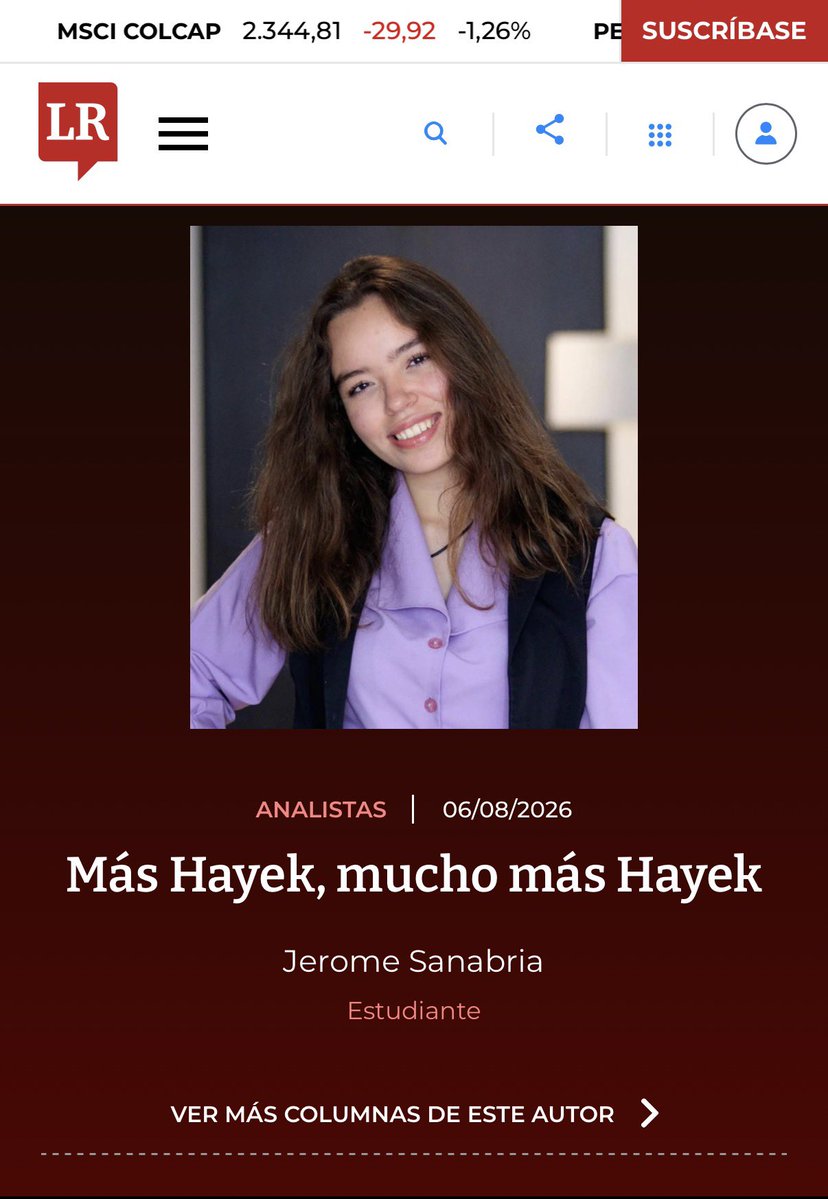
Outfit para la posesión presidencial de Abelardo de la Espriella, y paga conocer a quien tanto me ha inspirado desde que tengo 14 años: al gran @JMilei. No sé cómo ni en qué momento, pero hoy le entregaré a Milei estos regalitos: Más Hayek. https://t.co/S1oSZTlmxp #AbelardoDeLaEspriella #Milei #Hayek

14393
Jerome Aug 6

La declaración de Paloma Valencia sobre Hayek demuestra que todavía falta mucho para que los dirigentes lean, comprendan y hagan suyas las ideas liberales. Que ser “el partido de Hayek y de las libertades económicas” sea el objetivo a alcanzar. Más Hayek https://t.co/5TJmQWMjuq https://t.co/UsmtDtpEyq #Libertad #Economía #Hayek

13217
María Fernanda Cabal Aug 2

El @CeDemocratico enfrenta una crisis ideológica que ya no puede ocultarse. Mientras unos dirigentes dicen ser de derecha, algunos de sus voceros más visibles insisten en presentarlo como un partido de centro. Entonces, ¿qué somos y a quién representamos? Yo no ayudé a construir durante 15 años un partido de derecha para que ahora algunos se avergüencen de decirlo. La vida, la familia, la libertad, la seguridad, la propiedad privada, la iniciativa empresarial y un Estado austero y limitado no son una utilería de campaña. Son nuestras banderas. La historia castiga la tibieza. En España, la ambigüedad del Partido Popular abrió espacio al socialismo y permitió el surgimiento de @vox_es. En Chile nació el Partido Republicano @PRChile; en Argentina, La Libertad Avanza @LLibertadAvanza. Cuando los partidos abandonan sus principios, los ciudadanos buscan a quienes tengan el valor de defenderlos. Colombia también pagó el precio. Después de un @CeDemocratico que fue perdiendo claridad y carácter, llegó Gustavo Petro. Cuando la derecha duda, se esconde o adopta el lenguaje de la izquierda, la izquierda avanza. No necesitamos parecernos a nuestros adversarios para derrotarlos. Necesitamos volver a representar, sin vergüenza y sin pedir permiso, a millones de colombianos de derecha. Los principios no se negocian ni se esconden: se defienden. Por eso quiero trabajar en la construcción de una Nueva Derecha: sin complejos, sin tibiezas y con principios claros. Una derecha que no se excuse por existir, que no se esconda detrás de etiquetas cómodas y que represente con firmeza a millones de colombianos. Más Mises, menos Marx; más Hayek, menos Keynes. Más ciudadanos libres y menos burócratas diciéndonos cómo vivir, qué pensar y qué hacer con el fruto de nuestro trabajo. Defendemos un Estado austero, limitado y eficiente; impuestos bajos, simples y justos; menos regulaciones asfixiantes y más libertad para emprender, producir y prosperar. El dinero de los colombianos les pertenece a quienes trabajan para ganarlo, no a una burocracia insaciable que castiga el éxito y premia la dependencia. Queremos igualdad ante la ley, sin privilegios ni excepciones. Educación de calidad, mérito, productividad, seguridad jurídica y libertad económica. La riqueza no se reparte antes de producirla y la pobreza no se derrota administrándola: se derrota creando oportunidades y ciudadanos libres. Esta es la nueva derecha que quiero construir desde la Fundación Escuela de Libertad @FESLibertad. Una derecha que vuelva a levantar las banderas que otros dejaron caer. Los invito a construirla conmigo. El momento de defender nuestras ideas es ahora. #NuevaDerecha #Libertad #Principios

16301
Jerome Jul 27

Hoy empecé clases de séptimo semestre de Jurisprudencia. Muy emocionada porque este semestre termino materias; solo me falta el consultorio jurídico!! También feliz de continuar con mi doble programa: Historia. Este será otro semestre de menos Marx, MÁS HAYEK. https://t.co/C3hNW5EYZx #Jurisprudencia #Estudios #Educación

17033
Sardoche 🇫🇷 Jul 23

Hallucinant de se dire que certains accèdent à des « études d’économie » en dépensant des fortunes, ou via nos impôts, sans jamais y étudier Sowell, Mises, Hayek, Bastiat… Quel est l’intérêt d’une telle invisibilisation de la pensée libérale ? https://t.co/mAw46yBFXo #Économie #Libéralisme #PenséeCritique

13852
Tomasz Froelich Jul 22

🚨Socialism always ends in kleptocratic dictatorship‼️ A month ago, in my speech on the situation in Nicaragua, I stated that socialism inevitably leads to a kleptocratic dictatorship. Now Nicaragua’s socialist dictator Ortega is banning elections: “Friedrich August von Hayek https://t.co/hSFOImPytL #Socialism #Kleptocracy #Nicaragua #NI

118
Martin Paasi Jul 15

Kuulostaako tutulta? ”Hayekin oivallus ei ollut se, että valtio on aina väärässä. Hänen näkemyksensä oli, että suunnitelmatalouden logiikka ruokkii itse itseään: jokainen askel tekee seuraavasta välttämättömän, ja jokainen vallan lisäys vaatii entistä suuremman vallan tullakseen toimeenpannuksi. Maaorjuuteen ei päädytä yhdellä suurella suunnitelmalla. Sinne liu’utaan – yksi järkevältä kuulostava poikkeustoimi kerrallaan – kunnes liukumisesta itsestään tulee järjestelmä.” #talous #valtio #suunnitelmatalous

12452