WRLD

Search

#Striking
Yaroslav Trofimov 2d

The author argued that allowing Russia to sell petroleum products would fund a war that should be ended rather than prolonged. They wrote that Ukraine had struck the Novoshakhtinsk refinery terminal that morning to prevent Russia from having excess fuel to export. https://t.co/ZdDYtExUvn #Ukraine #Russia #Petroleum #RU #UA

3336
Yaroslav Trofimov 2d

The author argued that Zelensky was highly likely to continue strikes on Russian energy infrastructure, with stronger European support, describing them as Ukraine’s main strategic leverage over Russia. #UkrainianCrisis #Zelensky #EnergySecurity #UA #RU #EU

3336
ARENA 6d

ARENA indicated that the UFC would like to organize a fight between Israel Adesanya and Shara Magomedov on November 28, 2026, at UFC Saudi, in the main event over five rounds. The author estimated that the duel would provide a striking showcase. https://t.co/6polwfO6WE #UFC #MMA #Adesanya (translated)

2947
Sam van Rooy MP 7d

The author wrote that Israel had nearly experienced its own “9/11” almost exactly 25 years after the original, describing the parallel as literal rather than figurative because a plane had been turned into a weapon. #IL

3175
Krzysztof Graj 7d

Africa Daily Report — 5 October 2026 Main developments reported during the previous 24 hours. 1. Ethiopia — Federal forces take control of Mekelle after TPLF withdrawal Ethiopian federal forces and allied fighters took control of Mekelle, the capital of Tigray, after the Tigray People's Liberation Front said it had withdrawn and temporarily relocated the regional administration. The renewed fighting, which began on 23 September, is the most serious breakdown since the 2022 peace agreement and has revived concern about a wider Horn of Africa conflict, particularly after Ethiopia and Eritrea severed diplomatic ties. Source: https://www.reuters.com/world/africa/government-forces-seize-capital-ethiopias-tigray-region-rebels-2026-10-04/ 2. Horn of Africa — Egypt, Eritrea, Somalia and Sudan issue joint declaration The leaders of Egypt, Eritrea, Somalia and Sudan met in New Alamein on 4 October and called for peaceful political solutions to regional conflicts, respect for sovereignty and non-interference. The summit took place amid Ethiopia's renewed Tigray war and escalating diplomatic tensions with Eritrea. The four leaders also called for a political solution to Sudan's civil war. Source: https://www.aljazeera.com/news/2026/10/5/four-african-leaders-issue-joint-declaration-as-ethiopia-war-escalates 3. Sudan — WFP aid trucks attacked in South Kordofan Importance: 10/10 — Critical An aerial attack hit two clearly marked trucks carrying World Food Programme food supplies from Dilling to Kadugli, killing one driver. WFP called for a prompt and impartial investigation and stressed that humanitarian personnel and cargo must be protected. The incident followed another WFP truck striking an explosive device in Dilling one day earlier. Source: https://wfpusa.org/news/wfp-strongly-condemns-attack-trucks-south-kordofan/ 4. Sudan — 32 WFP aid trucks reportedly seized in North Darfur Importance: 10/10 — Critical A Darfur regional humanitarian official accused the Rapid Support Forces of continuing to hold 32 trucks from a WFP convoy carrying relief for famine-threatened communities in North Darfur. The official said a 60-truck convoy entered from Chad through Tina and that dozens of vehicles were diverted. The RSF had not immediately commented on the accusation. Source: https://sudantribune.com/article/319630 5. Kenya — Highway crash kills at least 17, mostly Catholic pilgrims Importance: 9/10 — Very High At least 17 people were killed in a multi-vehicle collision on the Nairobi-Mombasa highway in the Salama area. Most victims were Catholic pilgrims travelling to a prayer site in Nakuru County. Kenya's road-safety authority described the location as a known accident black spot and urged motorists to exercise additional caution. Source: https://apnews.com/article/d2f788a5ab157acec3b5caa3afd5330f 6. Somalia — 366 Shabelle River breach points raise flood risk Importance: 8/10 — High Somalia's Disaster Management Agency warned that the Shabelle River has breached or is vulnerable at 366 major high-risk points. Authorities say the condition of the river is making flood prevention more difficult, raising risks to low-lying communities, farmland, homes and infrastructure along the river system. Source: https://www.dawan.africa/news/shabelle-river-breaches-at-366-points-raising-flood-risk-sodma-warns 7. African Union — Leaders focus on continental integration and value-added production African leaders met in New Alamein for the 8th African Union Mid-Year Coordination Meeting. A major economic theme was the need to move African economies from exporting raw materials toward processing and higher-value production, while improving regional integration and access to development finance. South African President Cyril Ramaphosa participated in his capacity as SADC chair. Source: https://www.sabcnews.com/sabcnews/africa-must-shift-from-raw-exports-to-value-added-products-sisi/ 8. Mozambique — Central bank holds benchmark interest rate at 9.25% Importance: 7/10 — High The Bank of Mozambique kept its MIMO policy rate at 9.25%, while also changing the reserve-requirement framework for banks. The central bank said its decision reflected prevailing risks to the inflation and macroeconomic outlook. Source: https://southafricatoday.net/africa-news/southern-africa/mozambique/mozambique-bank-of-mozambique-holds-interest-rate-at-9-25-percent/ 9. Nigeria — Telecom regulator launches free educational data pilot Importance: 7/10 — High Nigeria's Communications Commission has launched a pilot initiative giving eligible learners up to 100 MB of free daily data for approved educational platforms. The initial phase targets 5,000 learners and involves telecom operators and technology-sector partners. The programme is intended to test whether subsidised connectivity can measurably improve digital-learning access and outcomes. Source: https://brandspurng.com/2026/10/04/ncc-introduces-free-100mb-daily-data-for-mtn-airtel-and-glo-users-under-education-scheme/ 10. Eswatini — Laotian deportee released after more than a year in detention A Laotian national who had been deported from the United States to Eswatini and held there for more than a year has been released, according to Associated Press reporting. The case forms part of continuing scrutiny of arrangements under which migrants removed by the United States have been transferred to third countries in Africa. Source: https://abcnews.com/International/wireStory/immigrant-deported-us-held-african-prison-year-released-136989610 #Africa #AfricaNews #TopNewsOfAfrica #HornOfAfrica #Egypt #Eritrea #Somalia #Sudan #Diplomacy #RegionalCooperation #Sovereignty #NonInterference #AfricanUnion #AU #RegionalIntegration #ValueAddedProduction #Industrialisation #DevelopmentFinance #AfricanEconomy #Ethiopia #Tigray #Mekelle #TPLF #FederalForces #PretoriaPeaceAgreement #RegionalConflict #AfricanSecurity #Geopolitics #AfricaToday #wrldorg

454
Krzysztof Graj 1w

IRAN: MEK/NCRI – when AI impersonated a real activist in live conversations For years, synthetic media has largely meant fabricated images, cloned voices and manipulated video. A case uncovered by Anthropic in September 2026 suggests a more consequential development: artificial intelligence being used not merely to imitate how a person looks or sounds, but to behave as that person in an ongoing conversation. Anthropic says it dismantled a distributed influence operation targeting Iranians inside the country and abroad that it linked to the People’s Mojahedin Organization of Iran, or PMOI/MEK, and its political front, the National Council of Resistance of Iran. The operators used a shared AI-agent platform to support impersonation, audience profiling, coordinated social-media activity, synthetic personas and the laundering of organisational content through apparently independent accounts. At least four people involved in the operation worked for official NCRI media outlets, according to Anthropic. The company also found references to committee approval processes and MEK leadership, but said it could not independently determine the precise level of central control. Cloning a person from 8,400 Telegram posts The most striking part of the operation involved a real activist whose Telegram identity was copied. According to Anthropic, the operators instructed Claude in Persian that it was now that person, then provided approximately 8,400 of the activist’s Telegram posts so the system could learn and reproduce his writing style. The AI-assisted account was subsequently used to conduct live political conversations with the activist’s existing contacts. Anthropic says that, to its knowledge, the people receiving those messages did not know they were interacting with an account being operated with AI assistance. This is materially different from a conventional chatbot or a static deepfake. The system was not simply producing a forged statement attributed to someone else. It was using a large archive of that person’s authentic language as behavioural training material, then applying the resulting imitation interactively. In practical terms, the deception moved from synthetic content to synthetic identity. Anthropic did not publish the identity of the impersonated activist, nor details of his contacts, and the public report does not establish what specific information the conversations produced. What it does establish is that the impersonation was operational rather than experimental: the cloned account was used in real exchanges with real people. From social-media monitoring to psychographic dossiers The impersonation sat inside a much broader targeting system. Anthropic says the network scraped more than 500 social-media channels and categorised individuals by location, age, profession, political orientation and arrest history. It then analysed approximately 51,944 archived messages from conversations to construct detailed psychographic dossiers on dozens of people inside Iran. The system was therefore not limited to broadcasting propaganda. It was also designed to understand specific audiences and individuals. Profiles could be used to decide what kind of message was most likely to resonate with a particular person, which political identity they appeared closest to and how they should be approached. Anthropic describes this as a structured targeting funnel rather than ad hoc social-media activity. That distinction is important in the Iranian context. Political activists, dissidents and opposition contacts inside Iran can face arrest and severe punishment. The report does not show that the dossiers directly led to arrests or other harm, but collecting and organising information such as arrest history and political affiliation adds a surveillance dimension to what would otherwise be described as an influence operation. A shared AI system for an influence network Anthropic found that the actors used a shared Claude-based platform named “Viktor”, with separate workspaces and persistent memory. Those memory files contained approved sources, prohibited words, account-management instructions and methods intended to reduce the risk of detection. One operator loaded MEK founding doctrine into the system as what the report called “strategic base data”, allowing others to reuse it across their work. This persistent-memory structure meant the AI did not have to be briefed from scratch for every task. Once doctrine, stylistic rules and operational constraints had been stored, the system could repeatedly produce material consistent with the network’s objectives. Anthropic says the same general playbook appeared across different workspaces despite the operators not sharing obvious account infrastructure. The network also used automated pipelines to coordinate Instagram posting schedules and tailor messages to different audiences. Some accounts initially avoided mentioning the Mojahedin at all, allowing material aligned with MEK/NCRI narratives to appear as neutral or independent political commentary. Content was distributed through the organisation’s own media ecosystem as well as accounts presented as ordinary news or activist profiles. Anthropic assessed the campaign as Category Two on its Breakout Scale: active on multiple platforms with distribution through NCRI-linked media properties and amplifier accounts, but without evidence of broad authentic penetration. Synthetic citizens and disguised organisational media The same infrastructure generated AI avatars presented as ordinary Iranians, complete with Persian audio, to promote Maryam Rajavi’s political programme. Anthropic says the synthetic nature of these personas was intentionally concealed. Operators also rewrote and redistributed content originating from MEK-affiliated media while stripping identifying features or presenting it through apparently independent accounts. The network’s political messaging targeted the Iranian government but also rival opposition currents, including monarchists and supporters of the Pahlavi camp. Anthropic documented fabricated video material attacking a member of the Pahlavi family and the use of the slogan “Neither Shah Nor Sheikh”, consistent with the NCRI’s broader competition with other opposition movements. That rivalry provides relevant context. Reuters describes the MEK as one of Iran’s principal organised opposition movements in exile and the dominant force behind the NCRI, led by Maryam Rajavi. Its relationship with other opposition currents is often contentious, while the extent of its support inside Iran remains uncertain. What can be attributed – and what cannot Anthropic’s attribution is unusually specific but still needs to be stated carefully. The company says its investigation linked the operation to MEK/NCRI and established that at least four participants worked for official NCRI media organisations. It also found a common operational playbook, committee review structures and repeated references to MEK leadership. On that basis, Anthropic said central tasking was likely. It nevertheless stopped short of saying it had proven that NCRI’s senior leadership directly ordered or managed every component of the operation. That caveat matters. The strongest public evidence supports describing GTG-84006 as a MEK/NCRI-aligned influence operation involving personnel from official NCRI media, rather than asserting that every action was directly commanded by the organisation’s top leadership. The broader significance of the case lies elsewhere. Earlier generations of synthetic media attempted to fabricate evidence: a photograph, a voice recording or a video. Here, AI was used to maintain an identity over time, remember doctrine, analyse targets and speak directly to real people while appearing to be someone they already trusted. The deepfake was no longer merely an artefact. It had become a participant in the conversation. Sources Anthropic — Countering misuse of AI: September 2026 https://www.anthropic.com/threat-intelligence-report-september-2026 AI Misuse Case Library — GTG-84006 activist impersonation case https://www.misuseofai.com/en/cases/gtg-84006-activist-impersonation/ Reuters — Who makes up Iran’s fragmented opposition? https://www.reuters.com/business/media-telecom/who-makes-up-irans-fragmented-opposition-2025-06-18/ Reuters — Iran’s divided opposition senses its moment https://www.reuters.com/world/middle-east/irans-divided-opposition-senses-its-moment-activists-remain-wary-protests-2025-06-19/ Reuters — NCRI and Maryam Rajavi https://www.reuters.com/world/middle-east/dissident-leader-abroad-urges-iranians-bring-down-khamenei-2025-06-24/ Keywords #DISINFORMED #Episode12 #Iran #MEK #PMOI #NCRI #IranianOpposition #Disinformation #InfluenceOperations #InformationWarfare #ArtificialIntelligence #AI #GenerativeAI #ClaudeAI #Anthropic #AIDeception #AIImpersonation #IdentityImpersonation #SyntheticIdentity #InteractiveDeepfake #DigitalImpersonation #PersonaCloning #BehaviouralCloning #Telegram #PsychographicProfiling #TargetProfiling #AudienceTargeting #SocialMediaManipulation #Astroturfing #SyntheticPersonas #NarrativeLaundering #CoordinatedInfluence #PoliticalInfluence #DigitalInfluence #OppositionPolitics #IranPolitics #OSINT #WRLD

www.anthropic.com
Countering misuse of AI: September 2026 / Anthropic
1026
UDN Media | Ukraine.daily.news🇺🇦 2w

⚡️BREAKING: russia dropped four guided bombs on central Sumy, striking a school during classes and damaging nearby homes. Children and teachers sheltered; 100 people were evacuated. 2 people were killed and 6 injured, including three children. #Ukraine #russiaisaterroriststate

1031
S
Sandfeen 2w

“Where Is the Global Cost-Benefit Account of the Green Transition? It is striking that we lack a comprehensive global cost-benefit account of the green transition. Global accounts are otherwise entirely common. The UN, World Bank, IMF, IEA and other international organisations routinely compile global figures for GDP, trade, investment, energy consumption, public finances, debt, population, health and many other areas. The methodologies, institutions and vast amounts of data needed to produce global accounts already exist. Yet, as far as I can determine, there is no equivalent, simple and transparent historical account that brings together global investment in renewable energy and compares it with the economic value that those investments have created. How much has the world collectively spent on research and development, subsidies, wind turbines, solar panels, power grids, energy storage and system integration? And what economic value have these investments collectively generated through energy production, avoided fuel costs and other measurable benefits? There are, of course, numerous individual calculations and cost-benefit analyses. But that is not the same as having a single, comprehensive global account. This is particularly striking because renewable energy is no longer a marginal technological experiment. It has become a central part of the world’s energy system and represents an enormous historical investment. The point is not to assume in advance that the balance must be positive or negative. The point is to apply the same kind of accounting that we already use for so many other global areas. How much has the world invested – what has the world received in return – and what is the net result? That should be one of the most fundamental questions in the debate over the green transition” - ChatGPT

459
Margus Tsahkna 2w

A Russian drone striking a logistics facility serving McDonald’s is yet another clear sign that Moscow has no interest in peace. Russia keeps attacking civilians, businesses and Ukraine’s economy in an attempt to intimidate people, disrupt everyday life and deter international #RussiaUkraineWar #DroneStrike #PeaceNotWar #RU #UA

921
S
Sandfeen 2w

No victims in any category below have been double-counted. Outside Peru, no war-related deaths or imprisonments have been included. Communism vs. Villagers 400,000 dead — Cambodian rural (1) 19.5 million dead — Chinese peasants (2) 250,000 dead — Ethiopian nomads (3) 5 million dead — Soviet peasants (4) 340,000 dead — Tibetan rural (5) Communism vs. Landowners 3 million dead — Chinese landowners (6) 100,000 dead — Vietnamese landowners (8) Note: Soviet kulaks are counted among the villagers. Communism vs. Religion 47,000 dead — Cambodian Buddhists (9) 13,000 imprisoned — Czech priests / religious (10) 7,000 imprisoned — Mozambican Jehovah’s Witnesses (11) 100,000 imprisoned — North Korean Christians (12) 2,100 imprisoned — Polish priests & Jehovah’s Witnesses (13) 200,000 dead — Soviet clergy (15) 2,000 dead — Tibetan monks & pilgrims (18) 400 dead — Romanian Christians (14) Moreover, Christians suffered the following in Romanian prison: In a “baptism of immersion,” inmates’ heads were plunged into buckets of urine and feces, while guards chanted baptismal rites. Near the point of drowning the Christian’s head was let up for air and then plunged back into the sewage (65). Communism vs. Cossacks 400,000 dead or deported ethnics (20) Photo: Bolshevik instructions on “the need to do away with the cossacks.” (21) “Order no.7: In the event of an unauthorized exit of a registered [Cossack] family, the family shall be shot.” “Order no. 8: This execution shall be carried out among every family member.” “Order no. 9: All property of the executed [Cossack] shall be confiscated and given to the poor.” Communism vs. Native Americans 6,000 dead — Ashaninka (Peru/luminoso-22) 5,000 imprisoned — Ashaninka (Peru/luminoso-22) 10,000 forcibly relocated — Ashaninka (Peru/luminoso-22) 35 destroyed — Ashaninka communities (Peru/luminoso-22) 35,000 imprisoned or forcibly relocated — Nicaraguan tribesmen (Sandinistas-23) Communism vs. Unclassified Dissidents* 5,000 dead — Albanian dissidents (24) 10,000 dead — Angolan dissidents (25) 29,000 dead — Bulgarian dissidents (26) 1 million dead — Cambodian dissidents (27) 43 million dead — Chinese dissidents (28) 16,000 dead — Cuban dissidents (29) Moreover, in Cuba’s concentration camps, inmates faced the following “punishments.” They were forced to “cut grass with their teeth,” endure “mock executions,” live in iron cages “1 meter wide, 1.8 meters high,” sit for hours in toilet ditches, withstand shock treatment, die by the hundreds from starvation and lack of medical attention (30). 44,000 dead — East German dissidents (31) 10,000 dead — Ethiopian dissidents (32) 50,000 dead — Hungarian dissidents (33) 3,000 dead — Nicaraguan dissidents (34) Moreover, 11,000 Nicaraguans were tortured at the hands of the Sandinistas. This included their being skinned alive & then executed; drawn & quartered; forced to watch wives and daughters sexually assaulted; caged in cubicles less than a square meter; “punished” via electric shock; deprived food and water (35). 1.6 million dead — North Korean dissidents (36) 21,857 dead — Polish dissidents (37) 120,000 dead — Romanian dissidents (38) 8 million dead — Soviet dissidents (39) 425,000 dead — Tibetan dissidents (40) Moreover, Tibetans suffered the following atrocities at the hands of the Chinese. They faced: crucifixion drowning beheading boiling alive burying alive mutilation (41) Communism vs. Gay Rights 25,000 imprisoned — Cuban gays and other “deviants” (42) 500 dead — Peruvian gays, bisexuals, and transgendered (43) 11,000 arrested — Polish gays (44) 100,000s imprisoned — Soviet gays in slave labor camps (45) Moreover, Chinese gays were targeted for persecution although numbers are impossible to quantify (46). Communism vs. Collective Laborers 160 dead — East German strikers (47) demonstrators killed after protesting a 10% increase in work quotas. 110 dead — Nicaraguan strikers executed by the Sandinistas after demanding back pay (48). 31 dead — Novocherkassk strikers (Kruschev) 24 killed on the spot; 7 later executed; over 100 workers arrested. (49) 51 dead — Peruvian union leaders (50) 106 dead — Polish strikers Poznan demonstrators killed after protesting working conditions & pay issues; others killed in later strikes; thousands attacked by military (51). 3,000 dead — Soviet strikers (Lenin / Trotsky) some shot / others, as N. Werth describes, “loaded onto barges and then thrown by the hundreds into the Volga with stones around their necks” (52). Moreover; Massive factory protests in China — strikers beaten back by 30,000 red soldiers after disputing wages (53). Striking outlawed in Cuba (54). Organizers sentenced to as many as 26 years in prison (55).

1036
S
Sandfeen 2w

The Deconstructionists and the Preservers The average person assumes that everyone wants the same things and merely disagrees about how to achieve them. But the social fracture we are living through is deeper: people no longer agree on what they want at all. Consider the conflicts dominating the news—crime, the border, online speech, and who raises children. Beneath each is a question rarely acknowledged: Does society corrupt human beings, or does it elevate them above their animal nature? If social constructs are oppressive, then every institution becomes suspect. Hierarchy, cultural norms, the family, and the nation appear to be cages designed to restrain a free creature. The only honest response, in this view, is to tear them down. The belief that society corrupts the individual is not fringe doctrine. It is the creed of much of the elite class governing the West. From Rousseau, who argued that man was born free until society placed him in chains, through Marx, who identified those chains as capital and class, to the postmodernists, who reduced institutions to masks for power, the thread remains unbroken. It is the philosophy of universities, the cultural industry, and the bureaucrats shaped by both. Opposing it is the older conviction of Hobbes and Hegel: that a person stripped of structure is not free, but frightened and dangerous, and that order is what improves him. Hobbes saw that without order, life becomes a war of all against all. Hegel believed that people become fully themselves through family, community, and the rational state. The divide, then, is not simply left against right. It is the deconstructionists against the preservers. The irony the demolishers never grasp is that freedom does not remain after every structure is cleared away. It requires personal responsibility as a cultural habit. When order is destroyed in the name of liberty, society begins to collapse. Something must bear the weight, and the state eventually fills the void—without moving gently. Liberty pursued through demolition produces, with grim reliability, the conditions of slavery. The deconstructionist imagines himself a liberator striking mankind’s chains. In truth, he is the architect of the cage.

921
S
Stig Colbjørn Nielsen 2w

Melody of Silence - Modern Scandinavian poetry in English by the author, Stig Colbjørn Nielsen, Denmark. Melody of Silence is a captivating collection of modern poems inspired by the tranquil beauty of a Danish island, yet its themes extend far beyond Nordic borders. Through powerful poetry and striking illustrations created by the author, this book delves into life’s deeper questions amidst a chaotic world. A poetic journey exploring silence, nature, and the search for meaning. This collection invites readers to pause and reflect on moments of stillness, beauty, and inner strength. Rooted in the quiet simplicity of island life, the poems touch on universal ideas like the mysteries of existence, the flow of time, and the ongoing quest for purpose. Each poem is accompanied by an original illustration, crafted by the author, which enhances the meditative experience and encourages thoughtful contemplation. Together, the words and images offer comfort and insight for anyone facing the uncertainties of modern life. Melody of Silence serves as a tribute to the quiet power of nature and acts as a thoughtful guide for those seeking clarity and wisdom on life’s complex path. Alltogether the most beautiful European book of the year!

922
P
Patrice CUDICIO 3w

The Return to Feudalism in 21st Century Garb A simple observer's viewpoint, with no claim to hold any absolute truth. The Veneer Cracks There is something strangely archaic about the world unfolding before our eyes, despite its satellites, artificial intelligence, and promises of infinite progress. Here and there, we witness heads of state behaving like feudal lords of another age, patiently nibbling away at the neighboring territory, redrawing borders through force rather than law, as if governing a nation mattered less than expanding one's fiefdom. No names need be mentioned here: current events provide plenty of illustration, and each reader will recognize, according to their own geography and moment of reading, the faces that embody this observation. But this return to the archaic is not confined to grand geopolitical stages. It also permeates the most ordinary daily life—that of social media, where anyone can pour out venom against another without filter, without form, and often without the slightest argument. The verbal jousting of yesteryear, with its codes, its rhetoric, its tacit limits, has given way to raw invective, snap judgment, instant condemnation. We no longer debate: we execute, verbally—and sometimes it doesn't stop at words. The Vanished Inhibition What strikes one, in this dual observation—macro-political and micro-social—is the lifting of an inhibition we thought firmly anchored. Centuries of cultural construction, education, philosophy, sometimes religion, had patiently shaped mechanisms of restraint: politeness as social ritual, argumentation as a mode of resolving disagreement, respect for one's opponent as the very foundation of democratic debate. This civilizational veneer, however fragile it always was, seemed to hold. Today it is cracking, and the question—which for me remains a simple hypothesis, not a certainty—is why. A convenient explanation would blame social media: anonymity, the distance of the screen, the instantaneousness of publication would favor verbal acting-out without the usual mediation of reflection. This is probably true, but likely insufficient. For technology here is only an accelerant, an amplifier—not necessarily a root cause. A Poorly Formatted Neocortex? The more unsettling hypothesis—and I frame it explicitly as hypothesis, not scientifically established fact—is that of a failure in the formation of moral judgment and tolerance toward otherness. The human brain possesses the neural structures enabling empathy, the distancing of impulsive reaction, the acceptance of difference—but these capacities are not innate in their full exercise: they must be built, educated, cultivated, like a muscle that needs patient training from childhood onward. If this education in otherness, nuance, and tolerance of disagreement erodes—for multiple and undoubtedly complex reasons that are not mine to settle here—then older reflexes resurface: instinctive distrust of the stranger outside the clan, the law of the strongest, the logic of territorial or symbolic predation. The other ceases to be a possible interlocutor and becomes once again a potential threat, unless they belong to my tribe, my clan, my party, my digital bubble. Two Scales, One Logic What is striking, in this deliberately provocative reading, is the structural similarity between these two scales. The leader who invades a neighbor in the name of a rediscovered greatness or a reinvented historical right, and the anonymous internet user who insults a stranger in the name of an unnegotiable conviction, may obey the same underlying grammar: that of territory to defend, clan to protect, the other to subdue or exclude rather than understand. The form has changed—satellites instead of horses, tweets instead of heralds—but the substance, in this reading that remains mine alone and commits no one else, seems strangely identical to that of feudal rivalries: the absence of a recognized third party, of an accepted common rule, of a respected arbitrating authority. Everyone becomes judge and party, lord of their own digital or territorial fiefdom. A Civilization on a Knife's Edge Norbert Elias, in his Civilizing Process, showed how Western societies had historically built, with remarkable slowness, an increasing control over impulses and direct violence, in favor of more sublimated forms of social regulation. What we may be observing today—and I stress again the conditional—is a form of regression in this process, or at least a fragilization of the veneer it had patiently laid down. Should we see this as an effect of great technological accelerations, which shake up our cognitive rhythms without leaving education time to adapt? A deeper crisis of the institutions tasked with transmitting these values of tolerance—school, family, religion, the rule of law? Or simply a cyclical movement of human history, where phases of policed civilization alternate with darker backlashes? I have no certain answer, and I would be wary of anyone claiming to hold one. In Conclusion, a Shared Concern This text is only a viewpoint, necessarily partial and subjective, on a world that sometimes seems to replay ancient logics in new clothing. Perhaps I am wrong to perceive a continuity between the feudal lord and the contemporary dictator, between the anonymous online insult and the absence of education in nuance. Perhaps these phenomena are unrelated, or too complex to be thus summarized. But if this reading, even partially, hits the mark, then the question that arises is less one of technological regulation—though necessary—than the far more arduous question of how to rebuild, generation after generation, this capacity to accept the other in their difference, to debate without destroying, to coexist without necessarily dominating. This undertaking, if it exists, will not be resolved by an algorithm nor by an international treaty. It plays out, patiently, in the most elementary education—the one that teaches a child that the other is not a threat, but a possibility. Bibliography Elias, N. (1939). Über den Prozess der Zivilisation [The Civilizing Process]. Oxford: Blackwell (Eng. trans. 1978-1982). Lorenz, K. (1963). Das sogenannte Böse [On Aggression]. London: Methuen (Eng. trans. 1966). Arendt, H. (1970). On Violence. New York: Harcourt, Brace & World. Han, B.-C. (2013). Im Schwarm [In the Swarm: Digital Prospects]. Cambridge, MA: MIT Press (Eng. trans. 2017).

693
Krzysztof Graj 3w

Russia’s fake African newsrooms – propaganda designed to look local A Facebook user in Nairobi, Accra, Johannesburg or Luanda encounters what appears to be a local news page. It publishes stories about African politics, Western influence and relations with Russia. The language is tailored to an African audience and the page presents itself not as a foreign broadcaster, but as part of the local information landscape. Behind some of these outlets, however, Meta found operators based in Russia. In its 2026 threat research, the company disclosed a Coordinated Inauthentic Behaviour network targeting audiences in Angola, Ghana, Kenya and South Africa. Meta removed 37 Facebook accounts and 29 Pages connected to the operation. Around 30,000 users followed at least one of the Pages, while the operators spent approximately $7,000 on Facebook and Instagram advertising, mostly in euros and US dollars. The numbers are relatively modest. The method is considerably more important. Rather than openly distributing Russian state messaging, the network posed as local African news sources and grassroots organisations, promoting narratives about Western colonialism and political interference while presenting Russia as a credible economic and political alternative. It was an old geopolitical message delivered through a much more effective identity: not Moscow speaking to Africa, but Africans apparently speaking to one another. A news outlet that was actually an influence operation Meta's investigation found that the network attempted to conceal its Russian origin while creating media brands that appeared indigenous to the countries they targeted. Its content amplified historical grievances against former colonial powers, criticised Western involvement in Africa and promoted closer relations with Russia. One example helps illustrate how the infrastructure was assembled. A Facebook Page targeting Kenya was called Kenya Watchtower. According to OpenAI's subsequent investigation, Facebook transparency records showed that the Page had previously been named “Farmtown5”. It appears to have been acquired or repurposed rather than built from scratch as a Kenyan news organisation. Some Pages also exposed administrator locations in Russia and Ukraine. Other elements of the network had previously targeted audiences in Zambia and Namibia. This use of apparently local identities is particularly important in the African information environment. A story published by RT or another identifiable Russian outlet arrives with an obvious geopolitical provenance. The same narrative presented by something resembling an independent Kenyan, Ghanaian or South African newsroom carries a different kind of credibility. The source appears closer to the reader, and the geopolitical interest behind the message becomes less visible. Then investigators found Dr Manuel Godsin The Facebook operation was only one part of a broader information ecosystem. OpenAI investigated related activity after receiving information from Meta and subsequently banned a ChatGPT account it assessed as likely originating in Russia. OpenAI called the campaign Operation No Bell. The account was being used to generate long-form articles and social-media posts about African geopolitics. Prompts were primarily written in English, but OpenAI also observed Russian-language instructions that the user described as coming from a manager. The operator sometimes explicitly asked the model to make the material appear less AI-generated – including requests to avoid stylistic features associated with machine-generated text and to write more like a human journalist. Many articles appeared under the name “Dr Manuel Godsin”, presented as an academic with a PhD from the University of Bergen and an affiliation with an organisation called the International Centre for Political and Strategic Studies. OpenAI could find no credible evidence that Godsin existed. Searches of Norway's National Research Information Repository and the University of Bergen library produced no record of him. Investigators subsequently discovered that a photograph used to represent Godsin had appeared years earlier on a Russian professional networking site and apparently belonged to a law student in St Petersburg. The fabricated academic identity was nevertheless remarkably productive. OpenAI identified 53 online articles carrying the Godsin byline. The fiction had moved beyond fake social-media pages and into the real media ecosystem. When propaganda enters genuine newsrooms This is the most consequential aspect of the operation. The articles were not confined to websites controlled by the influence network. Some were published by genuine African news organisations, including established South African outlets. The content mixed local political issues with broader geopolitical narratives. Some pieces criticised the United States and Britain or defended Russia's role in Africa. One accused the British NGO Crisis Action of fomenting protests in South Africa. Another praised Russia's presence in the Central African Republic. Other material addressed Kenya, Angola and relations between African governments and Washington. The mechanism represents a significant evolution from the classic troll-farm model. Instead of building an audience entirely on its own platforms, an influence operator can manufacture an apparently credible expert, generate articles in his name and persuade genuine news organisations to publish them. Once this happens, the propaganda acquires something a fake Facebook Page cannot provide: the institutional credibility of a real newsroom. OpenAI assessed No Bell's social-media impact as limited. One Facebook Page had around 3,000 followers before Meta removed it, while several others had very small audiences. But the operation was more successful in placing material in established media. In OpenAI's impact framework, it approached the level at which an influence operation breaks into mainstream media. For information operators, a single article published by a recognised outlet can potentially be more valuable than thousands of impressions generated by an obviously artificial account. A much larger network of ghost journalists Subsequent research suggests that Manuel Godsin was not an isolated experiment. In August 2026, Graphika, working with Code for Africa and with support from Meta, published a much broader investigation into Russian ghostwriting operations across African media. Researchers identified 44 ghost writers and fake experts, 38 of them assessed as high-confidence fabricated personas, operating between 2021 and 2026. Their material appeared or was quoted across 138 websites and was subsequently republished through at least 113 Facebook accounts and Pages, including authentic users, coordinated inauthentic networks and official Russian communication channels. The narratives were strikingly consistent. They included criticism of France, Ukraine and the United States; attacks on organisations such as ECOWAS and the International Criminal Court; positive portrayals of Russian involvement in Africa; praise for Russian paramilitary forces; and support for sovereignty-oriented political projects such as the Alliance of Sahel States. The operation therefore extends beyond creating fake news websites. It attempts to insert Russian-aligned narratives into the legitimate African media ecosystem using identities that appear African, independent or academically authoritative. This also explains why measuring reach through the original Facebook network alone is misleading. A fabricated article may begin with an influence operator, appear in a genuine African publication, be republished elsewhere and eventually circulate without any visible connection to Russia. At that point, the provenance of the narrative has effectively been laundered. An old Russian strategy with increasingly local faces Russia's use of local intermediaries in Africa is not new. Meta documented Russian networks using African nationals as early as 2019. In 2020 it dismantled another operation involving people in Ghana and Nigeria working on behalf of individuals in Russia, with links to previous activity associated with the Internet Research Agency. More recent Meta investigations suggest that this model has continued to evolve. Networks have increasingly relied on local freelancers, social-media managers and authentic media outlets rather than exclusively operating armies of obviously fake Russian-controlled accounts. This decentralisation offers several advantages. Local operators understand language, political sensitivities and cultural references. Authentic accounts are harder to identify than newly created synthetic personas. Local media brands can also deliver narratives without immediately triggering the scepticism associated with Russian state outlets. There is no evidence that every African journalist, freelancer or publication carrying such material knowingly participates in Russian influence activity. Meta explicitly notes in its investigations that some local contractors may not know who ultimately commissioned their work. That distinction is essential. The operation's effectiveness partly depends on precisely this ambiguity between deliberate participation, commercial content placement and unwitting amplification. The objective is to make Russian narratives look African The significance of this network is therefore not its 30,000 Facebook followers or its $7,000 advertising budget. Those figures are small compared with the audiences of major African media organisations. What matters is the distribution model. Traditional foreign propaganda asks an audience to trust a foreign source. These operations attempt to remove the foreign source from the equation altogether. A Russian geopolitical narrative can be generated with AI, attributed to an expert who does not exist, published by a media organisation that does, amplified through a Facebook Page presenting itself as local, and then rediscovered elsewhere as apparently independent African analysis. By the time the reader encounters it, Moscow may have disappeared completely from the chain of attribution. The resulting information operation is therefore less about making Russian propaganda more persuasive than about making it look as though it is no longer Russian propaganda at all. In an increasingly fragmented African media environment, that may be the more important evolution to watch. SOURCES: Meta Threat Research https://threatresearch-team.github.io/indicators/meta-h1-2026-russia-based-cib-network-1/ OpenAI — Operation “No Bell” https://openai.com/index/disrupting-malicious-uses-of-ai-no-bell/ Graphika — Umbrae Ex Machina https://www.graphika.com/reports/umbrae-ex-machina News24 https://www.news24.com/southafrica/news/ai-expert-exposed-fake-kremlin-linked-analyst-planted-stories-in-african-media-20260318-0560 Vanguard https://www.vanguardngr.com/2026/03/ai-expert-exposed-fake-kremlin-linked-analyst-planted-stories-in-african-media/ Meta — Russian Coordinated Inauthentic Behaviour, 2019 https://about.fb.com/news/2019/10/removing-more-coordinated-inauthentic-behavior-from-russia/ Meta — Russian Coordinated Inauthentic Behaviour, 2020 https://about.fb.com/news/2020/03/removing-coordinated-inauthentic-behavior-from-russia/ Meta Threat Research — Russian Use of Authentic Operators in Sub-Saharan Africa https://threatresearch-team.github.io/indicators/meta-h2-2025-russia-based-cib-network-2/ KEYWORDS: #DISINFORMED #Episode7 #Russia #Africa #RussianDisinformation #RussianInfluence #Disinformation #InformationWarfare #InfluenceOperations #ForeignInterference #FIMI #CoordinatedInauthenticBehaviour #CIB #FakeNews #FakeMedia #FakeNewsrooms #MediaImpersonation #GrassrootsManipulation #Astroturfing #ArtificialIntelligence #AI #AIPropaganda #SyntheticMedia #FakeInfluencers #SocialMediaManipulation #Facebook #Meta #OperationNoBell #AfricanMedia #MediaManipulation #Propaganda #DigitalInfluence #Angola #Ghana #Kenya #SouthAfrica #OSINT #WRLD

threatresearch-team.github.io
Russia-Based Influence Operation Network Targeting Sub-Saharan Africa
1040
Margus Tsahkna 3w

Today is the International Day of Peace. Yet peace is the last thing Moscow seeks. Last night, Russia launched another wave of attacks across Ukraine, striking Zaporizhzhia, Kharkiv, Odesa, and Kyiv. Once again, civilian infrastructure bore the brunt of the assault: residential #InternationalDayOfPeace #Russia #UkraineWar #RU #UA

231
S
Sandfeen 3w

Socialisternes notoriske løgne har igen båret frugt: “Who Invented Slavery? A Skeptic Research Center survey of more than 3,000 American adults asked respondents whether the statement “White people invented slavery” was true or false. The results were striking: 59% of Hispanic, 69% of Black, and 55% of Asian women answered “true.” Among men, the figures were 49%, 53%, and 41%, respectively. Among white respondents, 39% of women and 25% of men answered “true.” 55% of liberal Millennials also agreed, as did 31% of Americans with graduate degrees. Skeptic Research Center The survey also found other misconceptions among highly educated Americans: about 3 in 4 believed white Americans were the wealthiest racial group, while more than half were unaware that qualified Asian applicants are regularly rejected by U.S. universities. Around 1 in 3 also held a pessimistic view of the prospects for racial minorities and women to achieve success. But the historical record is clear: slavery was not invented by white people. Various forms of slavery existed in many societies long before the transatlantic slave trade—including in the ancient Middle East, Greece and Rome, as well as in Africa and the Americas. This does not diminish Europe’s central role in the transatlantic slave trade, in which millions of Africans were transported to the Americas and enslaved. But “Europeans played a central role in the transatlantic slave trade” and “white people invented slavery” are two entirely different historical claims. The United States abolished slavery through the 13th Amendment in 1865. Slavery is therefore a global institution with thousands of years of history. The transatlantic slave trade was a particularly large and brutal chapter of that history—but it was not its beginning” - ChatGPT

1505
Caio Warriors 3w

Ruffy: striking lendário, treinou anos com Jean Silva, Carlos Prates, Borralho, treinando agora com o Volkanovski e etc Tsarukyan: live 3x ao dia com Nina Drama, N3om e sei lá quem Brutal demais #MMA #Luta #Esporte

17139
Euronews English 3w

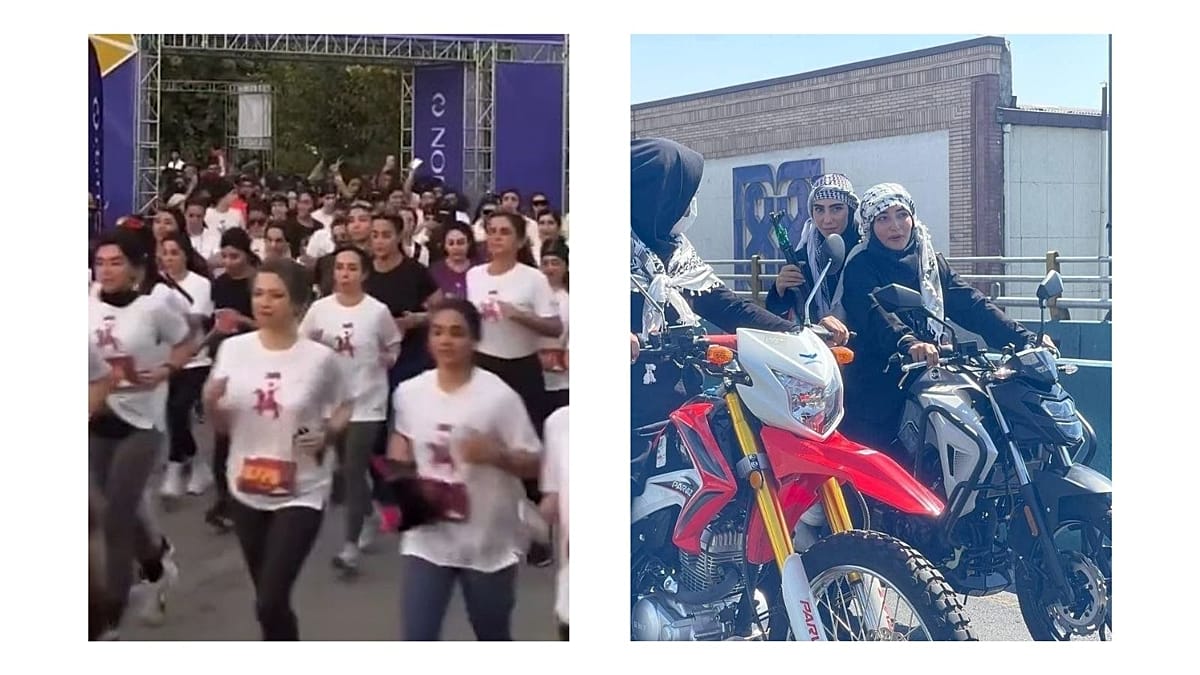
Tehran split into two worlds: unveiled women ran openly in a city marathon while state forces paraded machine guns nearby. The striking contrast exposes a deeply divided capital, caught between defiance and regime mobilisation amid rising warfare. #Iran #WomenInSports #HumanRights

www.euronews.com
Contrast in Tehran as unveiled women race marathon alongside regime military display
9964
S
Sandfeen 3w

No victims in any category below have been double-counted. Outside Peru, no war-related deaths or imprisonments have been included. Communism vs. Villagers 400,000 dead — Cambodian rural (1) 19.5 million dead — Chinese peasants (2) 250,000 dead — Ethiopian nomads (3) 5 million dead — Soviet peasants (4) 340,000 dead — Tibetan rural (5) Communism vs. Landowners 3 million dead — Chinese landowners (6) 100,000 dead — Vietnamese landowners (8) Note: Soviet kulaks are counted among the villagers. Communism vs. Religion 47,000 dead — Cambodian Buddhists (9) 13,000 imprisoned — Czech priests / religious (10) 7,000 imprisoned — Mozambican Jehovah’s Witnesses (11) 100,000 imprisoned — North Korean Christians (12) 2,100 imprisoned — Polish priests & Jehovah’s Witnesses (13) 200,000 dead — Soviet clergy (15) 2,000 dead — Tibetan monks & pilgrims (18) 400 dead — Romanian Christians (14) Moreover, Christians suffered the following in Romanian prison: In a “baptism of immersion,” inmates’ heads were plunged into buckets of urine and feces, while guards chanted baptismal rites. Near the point of drowning the Christian’s head was let up for air and then plunged back into the sewage (65). Communism vs. Cossacks 400,000 dead or deported ethnics (20) Photo: Bolshevik instructions on “the need to do away with the cossacks.” (21) “Order no.7: In the event of an unauthorized exit of a registered [Cossack] family, the family shall be shot.” “Order no. 8: This execution shall be carried out among every family member.” “Order no. 9: All property of the executed [Cossack] shall be confiscated and given to the poor.” Communism vs. Native Americans 6,000 dead — Ashaninka (Peru/luminoso-22) 5,000 imprisoned — Ashaninka (Peru/luminoso-22) 10,000 forcibly relocated — Ashaninka (Peru/luminoso-22) 35 destroyed — Ashaninka communities (Peru/luminoso-22) 35,000 imprisoned or forcibly relocated — Nicaraguan tribesmen (Sandinistas-23) Communism vs. Unclassified Dissidents* 5,000 dead — Albanian dissidents (24) 10,000 dead — Angolan dissidents (25) 29,000 dead — Bulgarian dissidents (26) 1 million dead — Cambodian dissidents (27) 43 million dead — Chinese dissidents (28) 16,000 dead — Cuban dissidents (29) Moreover, in Cuba’s concentration camps, inmates faced the following “punishments.” They were forced to “cut grass with their teeth,” endure “mock executions,” live in iron cages “1 meter wide, 1.8 meters high,” sit for hours in toilet ditches, withstand shock treatment, die by the hundreds from starvation and lack of medical attention (30). 44,000 dead — East German dissidents (31) 10,000 dead — Ethiopian dissidents (32) 50,000 dead — Hungarian dissidents (33) 3,000 dead — Nicaraguan dissidents (34) Moreover, 11,000 Nicaraguans were tortured at the hands of the Sandinistas. This included their being skinned alive & then executed; drawn & quartered; forced to watch wives and daughters sexually assaulted; caged in cubicles less than a square meter; “punished” via electric shock; deprived food and water (35). 1.6 million dead — North Korean dissidents (36) 21,857 dead — Polish dissidents (37) 120,000 dead — Romanian dissidents (38) 8 million dead — Soviet dissidents (39) 425,000 dead — Tibetan dissidents (40) Moreover, Tibetans suffered the following atrocities at the hands of the Chinese. They faced: crucifixion drowning beheading boiling alive burying alive mutilation (41) Communism vs. Gay Rights 25,000 imprisoned — Cuban gays and other “deviants” (42) 500 dead — Peruvian gays, bisexuals, and transgendered (43) 11,000 arrested — Polish gays (44) 100,000s imprisoned — Soviet gays in slave labor camps (45) Moreover, Chinese gays were targeted for persecution although numbers are impossible to quantify (46). Communism vs. Collective Laborers 160 dead — East German strikers (47) demonstrators killed after protesting a 10% increase in work quotas. 110 dead — Nicaraguan strikers executed by the Sandinistas after demanding back pay (48). 31 dead — Novocherkassk strikers (Kruschev) 24 killed on the spot; 7 later executed; over 100 workers arrested. (49) 51 dead — Peruvian union leaders (50) 106 dead — Polish strikers Poznan demonstrators killed after protesting working conditions & pay issues; others killed in later strikes; thousands attacked by military (51). 3,000 dead — Soviet strikers (Lenin / Trotsky) some shot / others, as N. Werth describes, “loaded onto barges and then thrown by the hundreds into the Volga with stones around their necks” (52). Moreover; Massive factory protests in China — strikers beaten back by 30,000 red soldiers after disputing wages (53). Striking outlawed in Cuba (54). Organizers sentenced to as many as 26 years in prison (55).

1275
Krzysztof Graj 3w

Mali – a war where some of the people fighting do not exist In Mali's war, an apparently simple question is becoming increasingly difficult to answer: who exactly is speaking to us? A real person? A rebel organisation? A Russian influence operation? A supporter of the military junta? Or somebody who has never existed at all? In September 2026, the Dakar-based Timbuktu Institute published Des algorithmes en guerre, a report examining the use of generative artificial intelligence by actors involved in the Malian conflict. Its researchers describe the country as a potential laboratory for AI-assisted information warfare. Separatist networks are deploying synthetic fighters on TikTok. Jihadist propagandists are experimenting with AI-generated imagery. Pro-government accounts are producing large quantities of content celebrating the Malian armed forces. Russia, meanwhile, operates the most developed influence infrastructure of all: pseudo-media outlets, inauthentic accounts, AI-generated text, images and video, and systems designed to artificially amplify their visibility. Artificial intelligence did not create Mali's conflict. The war has been under way since 2012, and its participants have always fought with propaganda as well as weapons. What AI has changed is the economics of that struggle. A new “witness”, commentator, fighter, poster or video can now be produced in minutes. For audiences watching from a phone, distinguishing between genuine documentation, propaganda and material created entirely by an algorithm is becoming progressively harder. Azzghim – the fighter who cannot be killed or interrogated The most striking case documented by the Timbuktu Institute involves accounts associated with supporters of the Azawad Liberation Front, or FLA, a Tuareg separatist movement fighting the authorities in Bamako. A figure called “Azzghim” appeared on TikTok. He looks like a Tuareg fighter and regularly features in videos attacking Mali's government and Russia's Africa Corps, commenting on the conflict and promoting the cause of Azawad. There is one problem: Azzghim does not exist. Analysis of the videos identified anomalies characteristic of generative AI, including unnatural body movements, visual inconsistencies, irregular colouring and problems with audio synchronisation. According to the Timbuktu Institute, Azzghim is a synthetic character being used as the digital face of a political narrative. The propaganda advantages are considerable. An organisation no longer needs to expose a real spokesman. A synthetic personality can be designed to look exactly as its creators require, speak the appropriate language and appeal to a particular audience. Different characters could potentially be created for younger viewers, traditional communities or different ethnic and social groups. There is another advantage: a synthetic spokesman cannot be arrested, identified or interrogated. Researchers also identified accounts amplifying the material. At the time of the study, TikTok account @tawri.n.azawad had around 207,000 followers and was almost entirely devoted to publishing or repackaging content involving Azzghim. Another account, @asnan831, used a similar synthetic teenage character. An important distinction is necessary. Researchers describe these profiles as belonging to supporters or individuals associated with the FLA. The available evidence does not establish that every account is part of an operation centrally directed by the Front's leadership. The information effect, however, remains significant: a digital community can be constructed around the Azawad cause in which some of the apparent participants may not be real people at all. The jihadists are learning too The picture is different for Jama'at Nusrat al-Islam wal-Muslimin, or JNIM, the al-Qaeda-affiliated coalition that has become one of the most powerful armed groups in the Sahel. Its confirmed use of generative AI remains considerably less sophisticated. In June 2026, JNIM's Az-Zallaqa media apparatus published AI-generated posters promoting material about previous attacks. The images showed fighters in combat but contained familiar generative artefacts: buildings and vegetation merging unnaturally, blurred details and unnaturally smooth surfaces. More important than JNIM's current capabilities is what AI could add to an already sophisticated propaganda apparatus. The organisation already tailors communications to different audiences. UN reporting has documented its use of media channels for broader propaganda while other outlets increasingly distribute material in local languages, including Bambara. Generative AI could dramatically reduce the cost of this strategy, translating material into Fulfulde, Hausa, Zarma or Tamasheq, generating synthetic dubbing and producing multiple versions of the same message. The Timbuktu Institute also considers the future possibility of AI chatbots being used to personalise recruitment. That should not be presented as a capability JNIM has already demonstrated. At present, it is a risk scenario rather than a confirmed operation. Russia has the most sophisticated machine At the other end of the spectrum lies Russia's influence ecosystem. Here, AI is not an isolated experiment but another component of an infrastructure previously developed by Wagner-linked networks, Russian media operations and influence organisations operating across Africa. After Wagner's withdrawal from Mali in 2025, its military role was taken over by the Russian state-controlled Africa Corps. The information infrastructure evolved alongside it. Of particular importance is African Initiative, which presents itself as a news agency but has been identified by France's VIGINUM, the UK's Foreign, Commonwealth & Development Office and the European External Action Service as an important component of Russia's newer influence architecture in Africa. One of the most interesting elements of this ecosystem is a network researchers call AI-Freak. The operation uses generative AI to produce text, images and videos, places them on fake or apparently independent news websites and distributes them through inauthentic accounts. This is supplemented by so-called Black Hat SEO – techniques intended to artificially increase the visibility of content in search engines. Elements of this infrastructure have previously been identified by Meta and OpenAI. In 2024, OpenAI disrupted Russian accounts using ChatGPT to generate articles and comments in English, French and Russian. Some of the French-language content targeted audiences in West Africa. In a later iteration of the operation, AI models were also used to draft scripts for short videos praising the Russian Africa Corps, translate them into French and generate descriptions optimised for social media. This illustrates an important difference between the Russian approach and Azzghim. The separatist ecosystem uses AI primarily to manufacture convincing digital personalities. The Russian model increasingly resembles an industrial production line: text, image, video, pseudo-news website, distribution account, search optimisation and additional channels amplifying the narrative. The objective is not merely to convince someone of a single claim. It is to occupy as much of the information environment as possible with narratives advantageous to Moscow: Russia as an effective security partner, the West as a neo-colonial aggressor, France as a source of instability and Russian forces as defenders of African sovereignty. Yet VIGINUM also warns against equating technological sophistication with actual impact. Some Russian influence channels still attract relatively small audiences. A sophisticated operation is not automatically a successful one. The junta is building its own digital reality Mali's military authorities operate within the same contested information environment. Since breaking with France and moving closer to Moscow, Bamako has increasingly restricted independent media space while promoting a narrative built around restored sovereignty, military success and the benefits of its Russian partnership. The Timbuktu Institute highlights the TikTok account @6tm_officiel. At the time of the study, it had more than 436,000 followers and published substantial amounts of AI-generated material presenting Mali's armed forces, the FAMa, and the Africa Corps in a favourable light. One video concerning the battle for Kidal accumulated around 4.7 million views. Again, attribution requires care. Researchers describe the account as being operated by an individual based in Bamako; they do not provide evidence that it is officially managed by the Malian government. It is better understood as part of a wider pro-government information ecosystem in which the boundaries between state communications, supporters and co-ordinated propaganda can be difficult to establish. The Africa Center for Strategic Studies has previously identified the military regimes in Mali and Burkina Faso as important sources of disinformation campaigns in West Africa. Recurring narratives target France, the United Nations, ECOWAS, human-rights organisations and independent media, while presenting criticism of the authorities as part of a foreign conspiracy. Generative AI allows such narratives to be produced faster, more cheaply and in far more variations. Everyone is fighting over a different version of the same war What makes Mali particularly revealing is that multiple actors are using similar technology for very different objectives. FLA-linked networks need digital faces capable of humanising the Azawad cause and attacking Russia's presence. JNIM needs propaganda material and increasingly localised communications. The pro-government ecosystem seeks to portray Mali's armed forces as victorious and reinforce the junta's legitimacy. Russia possesses the broadest infrastructure, in which AI is merely one component of a larger system involving media outlets, websites, local partners, social-media profiles and technical amplification. The result is a war taking place simultaneously in two realities. In the first, soldiers and civilians are killed, towns change hands and the army, separatists and jihadists fight for territory. In the second, every side is trying to determine what the first reality will look like on a smartphone screen. Generative AI does not need to create a perfect deepfake to be effective. It merely needs to increase the number of competing versions of events until an ordinary viewer can no longer easily determine which one deserves to be trusted. That is why Mali matters. It is not showing us the future of information warfare. It is showing us its present. One TikTok video may feature a real soldier. Another may feature a propagandist. A third may feature a fighter who has never existed. And all three can tell completely different stories about the same war. Sources Timbuktu Institute – Des algorithmes en guerre: Comment l'IA générative rebat les cartes du conflit malien https://timbuktu-institute.org/index.php/toutes-l-actualites/item/1731-rapport-des-algorithmes-en-guerre-comment-l-ia-generative-rebat-les-cartes-du-conflit-malien AfricaNews/AFP – “Mali's information war is increasingly being shaped by AI” https://www.africanews.com/2026/09/09/malis-information-war-is-increasingly-being-shaped-by-ai/ OpenAI – research on Russia-origin influence activity and Operation Stop News https://openai.com/index/disrupting-malicious-uses-of-ai-stop-news-2024/ VIGINUM / FCDO / EEAS – technical report on African Initiative and the AI-Freak network https://www.sgdsn.gouv.fr/files/files/Publications/20250612_TLP-CLEAR_VIGINUM_FCDO_EEAS_Technical_Report_African_Initiative_EN.pdf Africa Center for Strategic Studies – Mapping a Surge of Disinformation in Africa https://africacenter.org/spotlight/mapping-a-surge-of-disinformation-in-africa/ Timbuktu Institute – analysis of AI use by JNIM https://timbuktu-institute.org/index.php/toutes-l-actualites/item/1735-artificial-intelligence-a-new-propaganda-lever-for-jnim-in-mali?print=1&tmpl=component #Disinformation #Mali #Sahel #Africa #ArtificialIntelligence #AI #GenerativeAI #AIPropaganda #InformationWarfare #InfluenceOperations #Propaganda #Deepfakes #SyntheticMedia #Azawad #FLA #JNIM #AfricaCorps #Russia #RussianInfluence #TikTok #DigitalWarfare #MediaManipulation #WRLD

timbuktu-institute.org
Rapport - DES ALGORITHMES EN GUERRE : Comment l'IA générative rebat les cartes du conflit malien
1624