WRLD

Search

#Factcheck
Observador 3d

The claim that Puma withdrew its sponsorship from the Portugal National Football Team after the controversy involving Cristiano Ronaldo is false, as the brand confirmed that the partnership remains active and in good standing until 2030. #FactCheck #CristianoRonaldo #Futebol (translated)

observador.pt
Puma retira patrocínio a Portugal após a polémica Ronaldo?

2684
Marcel Crok 3d

Marcel Crok suspected that Tijs was referring to him with the term 'climate deniers' because he claimed to be about the only dissenting voice during an external expert day in March 2025. He called the term derogatory and pointed out that CDA leader Henri Bontenbal had also used it regularly, according to him. Crok invited Tijs to a lecture by Clintel given by Roger Pielke Jr. the following Sunday in Driebergen. He referred to an article by Pielke about a campaign against climate scientists with dissenting views. According to Crok, Australian activists, including a cartoonist, with the support of influential American climate scientists, created blacklists. Among those listed were Pielke, his father, and Judith Curry, according to him. Crok wrote that their academic careers were thereby hindered and called the issue concerning for Members of Parliament. Regarding his own participation in the Citizen's Assembly, Crok stated that the selection of citizens went well and that his discussions with KNMI director Maarten van Aalst were respectful. However, in hindsight, he claimed that the organization published an incorrect fact-check. He said he should have filed a forty-page complaint before he received any response. Crok argued that the debate about climate, just like the debate about corona which Tijs had previously struggled with as a journalist, was, in his view, being stifled. He spoke of a suffocating atmosphere in the academic world and wrote that no journalist had signed up to attend Pielke's lecture. #klimaat #wetenschap #discussie (translated)

2914
Vatnik Soup 4d

The author claimed that Russia spent $5 billion a year on propaganda and subversion to build support for its invasions through tailored narratives, which they said were later spread by people including Marco Travaglio. They used derogatory language to describe those spreading the narratives and added that fact-based research to counter them took time and effort. #Propaganda #Disinformation #FactChecking #RU

3376
Krzysztof Graj 5d

Nigeria – how pro-Russian influence networks sell military rule as the answer When Nigerians took to the streets in August 2024 to protest soaring living costs and frustration with government, some demonstrations acquired an unexpected symbol: the Russian flag. In Kano, Kaduna and other northern cities, protesters were filmed carrying Russian colours and calling for Moscow’s intervention. Some demanded a military takeover. What initially looked like an unusual expression of anger has since become part of a much larger picture. A September 2026 assessment by the Africa Center for Strategic Studies describes Nigeria as a major target of overlapping foreign information operations, with Russia the most active external actor in its information space. The report does not identify a single centrally controlled campaign. Instead, it maps an ecosystem in which genuine dissatisfaction over insecurity, corruption and living standards is repeatedly redirected towards a broader proposition: democratic government has failed, while the military-led regimes of the Sahel offer a more effective alternative. Turning a real protest into a pro-Russian message The clearest example emerged during the 2024 #EndBadGovernance protests. Nigerian investigative reporting found that a Kano-based TikTok influencer with more than 100,000 followers had been paid through a Telegram channel associated with African Initiative, a Moscow-based media operation linked by researchers to Russian influence activity in Africa. The influencer said the channel supplied photographs, videos and talking points for redistribution on TikTok and Instagram. Among the messages provided were phrases such as “Putin please come and save Nigeria” and “The army is the answer for Nigeria”. Influencers were encouraged to use Hausa-language hashtags including #Zangazanga – “protest” – alongside references to Putin and Russia. Investigators identified 38 accounts circulating similar pro-Russian and pro-military narratives during the demonstrations. Russian flags subsequently appeared among protesters in several northern cities. This does not mean the protests themselves were created by Russia. They were driven by genuine economic and political grievances, and Nigerian protesters gave different reasons for carrying Russian flags. The important feature of the influence activity was precisely that it did not need to manufacture the original anger. It could attach a geopolitical message to an existing domestic crisis. From frustration to the idea of military government The narrative fits a wider pattern seen across West Africa. Russia has developed close relations with the military governments of Mali, Burkina Faso and Niger, while pro-Russian media ecosystems routinely portray those states as examples of sovereignty, stability and resistance to Western influence. Nigeria, by contrast, has remained under constitutional civilian government since 1999. Africa Center researchers say information networks targeting Nigerians increasingly contrast these two models. Recurring messages depict elections as wasteful or predetermined, civilian institutions as incapable of protecting citizens and military governments as more decisive on security and development. Some content portrays the Sahelian juntas as delivering better roads, lower prices and stronger security even where available evidence points to continuing or worsening instability. Language is central to the strategy. Hausa is spoken across northern Nigeria and neighbouring Niger, allowing political narratives to travel across borders that are far less important online than they are on maps. HumAngle documented efforts involving Nigerien state-linked actors to cultivate Hausa-speaking journalists and distribute material favourable to Niger’s junta and hostile to France and Western influence. The Russian and Sahelian-junta information ecosystems are not identical, but their narratives frequently reinforce one another. Fake journalists inside real Nigerian media The campaign environment extends beyond social media. A 2026 investigation by Graphika and Code for Africa identified 44 ghost reporters and fake experts whose identities were used to place Russia-aligned narratives in African media. Thirty-eight were assessed with high confidence to be fabricated. Their articles or quotations appeared across 138 websites and were amplified by at least 113 Facebook accounts and Pages. Nigeria was one of the most heavily targeted countries. According to the Africa Center’s analysis of the research, Daily Post Nigeria carried 39 articles involving 14 identified ghost authors. Once published by a genuine Nigerian outlet, such material could then be cited by other websites, social-media accounts or even Russian official channels as though it had originated independently in Africa. This is information laundering rather than simple propaganda: the most valuable asset being borrowed is the credibility of the local newsroom. Generative AI added another layer. OpenAI and Meta separately disrupted a Russia-origin network that produced Africa-focused political content and operated Facebook Pages posing as local media organisations. One fabricated commentator, “Dr Manuel Godsin”, was presented as a European-trained geopolitical expert although investigators found no evidence supporting his academic biography. ChatGPT had been used to generate articles under the persona’s name, while Meta removed 37 Facebook accounts and 29 Pages connected to the broader network. Different networks, similar strategic direction It would be misleading to merge all these activities into a single Russian command structure. The African Initiative-linked influencer campaign, the ghost-reporter network and the AI-enabled operation disrupted by OpenAI and Meta were uncovered separately and used different infrastructure. Public evidence does not demonstrate that every actor reported to the same organisation. What connects them is a recurring set of themes and methods: portraying Western partnerships as exploitative, presenting Russia as an alternative security partner, amplifying failures of civilian government, and giving military-led rule greater legitimacy. Investigative reporting on leaked Russian documents has meanwhile described a much wider influence apparatus operating across Africa, involving political consultants, paid journalists, influencers and locally tailored campaigns intended to reduce Western influence and expand Moscow’s position. The underlying technique is less about inventing dissatisfaction than redirecting it. Nigeria faces real security threats, economic pressure and public frustration. Influence operators do not need to persuade Nigerians that those problems exist. They need only influence the explanation for why they exist – and which political model appears to offer the answer. That is what makes the Nigerian case significant. The most effective propaganda does not necessarily introduce a completely false reality. It takes a real crisis and changes where the audience is encouraged to look for the solution. Sources Africa Center for Strategic Studies — The Raging Information Battle in Nigeria https://africacenter.org/spotlight/the-raging-information-battle-in-nigeria/ Graphika — Umbrae Ex Machina https://www.graphika.com/reports/umbrae-ex-machina OpenAI — Operation “No Bell” https://openai.com/index/disrupting-malicious-uses-of-ai-no-bell/ TheCable — Ghost reporters in African media https://www.thecable.ng/ghost-reporters-how-fabricated-african-voices-carried-pro-russia-narratives/ HumAngle — Nigeria Is Facing an Information War in Its Own Language https://www.humanglemedia.com/nigeria-is-facing-an-information-war-in-its-own-language DAIDAC / CJID — Russian influence during #EndBadGovernance https://daidac.thecjid.org/how-telegram-tiktok-aided-russian-disinformation-that-led-to-incarceration-of-nigerian-minors/ FactCheckHub — How Nigeria’s hunger protest took a radical turn https://factcheckhub.com/from-economic-protests-to-coup-agitation-how-nigerias-hunger-march-took-a-radical-turn/ News24 — Fake Kremlin-linked analyst planted stories in African media https://www.news24.com/southafrica/news/ai-expert-exposed-fake-kremlin-linked-analyst-planted-stories-in-african-media-20260318-0560 Vanguard — AI ‘expert’ exposed https://www.vanguardngr.com/2026/03/ai-expert-exposed-fake-kremlin-linked-analyst-planted-stories-in-african-media/ Africa Confidential — How Moscow wages social media war https://www.africa-confidential.com/article/id/15961/how-moscow-wages-social-media-war Keywords #DISINFORMED #Episode15 #Nigeria #Russia #RussianInfluence #RussianDisinformation #Africa #WestAfrica #Disinformation #InformationWarfare #InfluenceOperations #ForeignInterference #FIMI #Propaganda #MilitaryRule #MilitaryGovernment #Democracy #PoliticalManipulation #NarrativeManipulation #AfricanInitiative #EndBadGovernance #Hausa #LocalInfluencers #GhostReporters #FakeExperts #ArtificialIntelligence #AI #AIPersonas #SyntheticMedia #AIPropaganda #Astroturfing #SocialMediaManipulation #Telegram #TikTok #DigitalInfluence #SourceLaundering #NarrativeLaundering #MediaManipulation #Sahel #Geopolitics #OSINT #WRLD

africacenter.org
The Raging Information Battle in Nigeria
904
N. Dupont-Aignan 6d

The author claimed that Arcom now wanted to regulate political podcasts that were outside its control. He also accused the government of launching its own X account dedicated to fact-checking to silence critics, believing that its policy was leading to a budgetary disaster accompanied by austerity. https://t.co/vgCzoxGcUB #podcast #politique #factchecking #FR (translated)

2943
Krzysztof Graj 6d

Brazil’s synthetic voters – when AI manufactures public opinion They look like ordinary street interviews. A reporter approaches a passer-by in a Brazilian square and asks a simple question: who will you vote for? A young voter explains why Luiz Inácio Lula da Silva deserves another term. An elderly woman says Brazil needs Flávio Bolsonaro because he represents political renewal and greater security. The locations look plausible, the microphones are visible and the answers sound much like the brief political opinions heard in television vox pops around the world. None of the people are real. Ahead of Brazil’s presidential election on 4 October, fact-checking organisation Aos Fatos identified at least 50 TikTok videos in which artificial intelligence was used to manufacture voters, reporters and apparently spontaneous political interviews. Together, the videos had accumulated around 7.4 million views by mid-August. Some promoted Lula, others Flávio Bolsonaro, while another group used synthetic characters to ridicule or stereotype supporters of one side. Aos Fatos found no apparent evidence linking the accounts producing the videos to either presidential campaign. The opinion poll that never took place The format is important. These were not conventional deepfakes in which a recognisable politician is made to say something he never said. Instead, the creators reproduced the visual language of the vox pop – the short street interview used by broadcasters and social-media creators to illustrate what ordinary people supposedly think. In pro-Lula videos, synthetic voters described themselves as beneficiaries of social programmes or credited the president with improving their lives. In videos supporting Flávio Bolsonaro, artificial interviewees associated him with political renewal, public security and fighting corruption. Other clips were openly hostile: AI-generated characters presented as poor or living in parts of Brazil’s north-east were shown in dirty clothes or run-down surroundings, declaring support for Lula because they supposedly preferred welfare payments to work. The deception is therefore subtler than fabricating a candidate’s statement. It manufactures something that political communication normally treats as evidence of public sentiment. A real vox pop may be unscientific, but the people interviewed at least exist. These videos created the appearance that identifiable social groups – young people, pensioners, welfare recipients or residents of particular regions – were spontaneously expressing political preferences when no such encounters had taken place. An electoral-law specialist interviewed by Aos Fatos described the technique as the fabrication of a “social fact that never occurred”. That captures the central innovation: AI is being used not merely to falsify political speech, but to manufacture the impression of grassroots opinion. Fifty videos, but not one proven network The available evidence does not support describing the 50 posts as a centrally controlled influence operation. Aos Fatos located them through TikTok searches and recommendations produced by the platform itself, then examined the accounts responsible for publication. Most had relatively small individual audiences, although their combined reach was substantial. The first examples identified by the investigation appeared as early as March 2026. Activity increased in June and was concentrated particularly in July and the first half of August as Brazil’s election calendar intensified. Some accounts specialised in AI-generated videos generally, including fabricated podcast-style material. Others were explicitly political or supportive of a candidate, but Aos Fatos found no apparent links between those profiles and the official Lula or Bolsonaro campaigns. That distinction is essential. The evidence demonstrates a common technique and a shared political environment, not a single command structure. Some creators may have been motivated by ideology, others by engagement or monetisation. Publicly available evidence does not establish who commissioned the individual videos or whether any coordination existed between the accounts. This decentralised model also creates a different enforcement problem from a traditional bot network. There may be no headquarters to expose and no infrastructure whose removal disables the entire operation. The format itself can be copied by anyone with access to inexpensive generative-video tools. When the algorithm mixes real and synthetic citizens Aos Fatos documented another important feature of the phenomenon: TikTok’s recommendation system placed AI-generated interviews alongside genuine street interviews. For a user scrolling quickly through the platform, the transition between an authentic citizen and an entirely fabricated one could therefore be almost invisible. In 18 per cent of the 50 videos analysed, there was no indication that the people shown had been generated using AI. After Aos Fatos provided TikTok with the videos, the company said it had removed all of them for violating its rules on edited and AI-generated media. TikTok said its policies require creators to identify synthetic content and prohibit manipulated media capable of misleading users about matters of public importance or impersonating genuine journalistic material. The issue extends beyond one platform. Factchequeado’s review of Brazil’s 2026 election campaign found that synthetic endorsements and other deepfakes had become one of the most visible forms of AI-assisted electoral misinformation, alongside fabricated candidate statements and invented scenes. Brazil already had rules for synthetic politics Brazil entered the campaign with unusually detailed electoral rules governing artificial intelligence. The Superior Electoral Court, the TSE, requires electoral propaganda using synthetic multimedia to disclose clearly that AI was used. More importantly for the fake-voter videos, its rules prohibit synthetic audio or video used to favour or harm a candidacy when it creates or alters the image or voice of a living, deceased or fictitious person. The difficulty is attribution and enforcement. When a synthetic video is published by an official campaign, responsibility can be relatively straightforward to investigate. When it comes from an apparently independent account with no demonstrated relationship to a candidate, lawyers interviewed by Aos Fatos said responsibility is more likely to fall on the individual creator, while imposing electoral sanctions on a campaign would require evidence of a connection. For the final 72 hours before the election and the 24 hours following it, the TSE has imposed additional restrictions on newly published or republished synthetic material involving candidates or public figures, reflecting the particular difficulty of correcting fabricated content immediately before voting. From deepfake politicians to synthetic electorates The Brazilian case illustrates a broader change in political manipulation. The first generation of electoral deepfakes concentrated on famous people: make a politician appear to say something damaging, or fabricate an endorsement from a celebrity. Synthetic vox pops reverse the perspective. The politician can remain completely authentic; it is the electorate around the politician that is fabricated. That changes the psychological proposition of the message. Instead of saying the candidate believes this, the video suggests people like you believe this. Age, clothing, accent, neighbourhood and social class can all be generated to construct an artificial constituency around almost any political claim. There is no evidence that the 50 Brazilian videos identified by Aos Fatos constitute a single centrally directed campaign, nor evidence that they changed voting intentions. What they demonstrate is a technique whose barrier to entry has become extremely low. AI no longer needs to forge the politician. #DISINFORMED #Episode14 #Brazil #BrazilElection2026 #Elections #ElectionDisinformation #ArtificialIntelligence #AI #GenerativeAI #SyntheticVoters #SyntheticMedia #AIAvatars #AIGeneratedVideo #VoxPop #FakeInterviews #Astroturfing #AIPropaganda #PoliticalDisinformation #InfluenceOperations #InformationWarfare #SocialMediaManipulation #TikTok #PublicOpinion #ManufacturedConsent #SyntheticPublicOpinion #DigitalInfluence #Deepfakes #ElectionIntegrity #TSE #AosFatos #FactChecking #OSINT #MediaManipulation #WRLD (translated)

www.aosfatos.org
Eleitores gerados por IA fazem campanha no TikTok e põem em xeque regra do TSE
680
Manuel Bompard 7d

The author criticized government checks that, according to him, showed budget increases without taking inflation into account, and wondered if a "ministry of truth" would soon come into existence. #FactChecking #Gouvernement #Inflation #FR (translated)

2949
Le Parisien 7d

The French government has launched a fact-checking account on X to ensure the transparency of the 2027 budget, while criticizing the president of Medef. #FactChecking #Budget2027 #Gouvernement (translated)

www.leparisien.fr
« Soyons précis » : le gouvernement lance un compte de fact-checking du budget 2027 sur X, le président du Medef épinglé
1703
Cerfia 7d

Cerfia indicated that the government had launched a fact-checking account on X called "Let's Be Precise." According to the media, it was meant to address information deemed false or misleading, particularly regarding the 2027 budget, relying on facts, figures, and official sources, and to promote a debate based on verifiable data. #FactChecking #Budget2027 #Vérité (translated)

3407
Observador 2w

Um vídeo que circula nas redes sociais alegando mostrar milhões de pessoas em protesto recente nos EUA é enganador, pois as imagens são de uma manifestação de outubro de 2025, não refletindo eventos atuais. #FactCheck #Protestos #DonaldTrump

observador.pt
Vídeo mostra protesto recente que juntou "milhões" nos EUA?
1377
Sam Pancher 2w

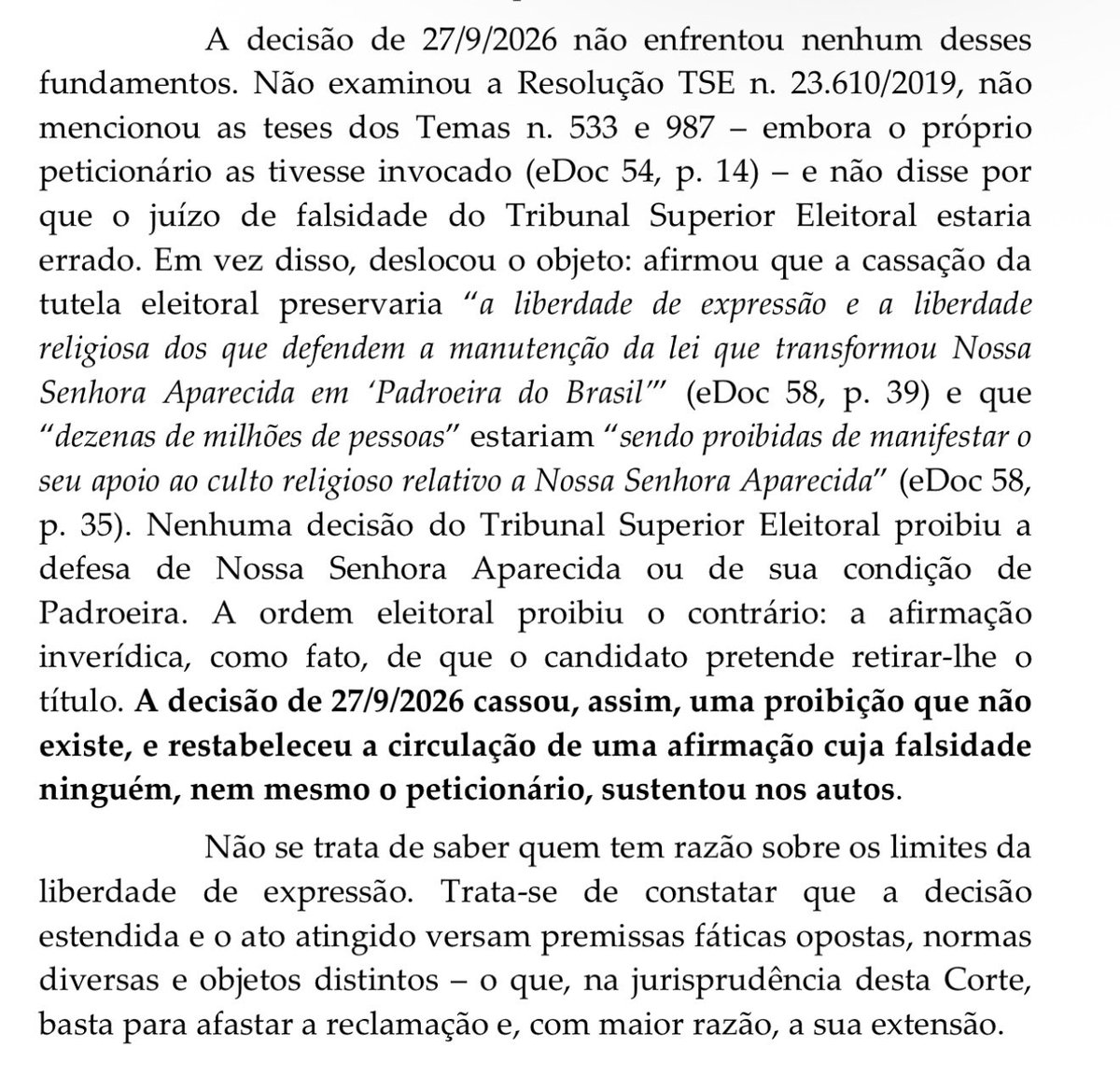
Luiz Fux faz uma espécie de ‘fact checking’ da decisão de Flávio Dino: “Nenhuma decisão do TSE proibiu a defesa de Nossa Senhora Aparecida ou de sua condição de Padroeira. A ordem eleitoral proibiu o contrário: a afirmação inverídica, como fato, de que o candidato pretende retirar-lhe o título. A decisão (de Dino) cassou, assim, uma proibição que não existe, e restabeleceu a circulação de uma afirmação cuja falsidade ninguém, nem mesmo o peticionário, sustentou nos autos.” #Justiça #FactChecking #Eleições

22966
Observador 2w

Informações que circulam nas redes sociais sobre a suposta ocorrência de um AVC grave de Xi Jinping durante a cimeira dos BRICS na Índia foram desmentidas, pois não há evidências que sustentem tais alegações. #XiJinping #BRICS #FactCheck

observador.pt
Presidente chinês sofreu um AVC na cimeira dos BRICS?
1953
José Luís Carneiro 2w

“Se fosse primeiro-ministro oferecia-me para receber metade dos imigrantes de Ceuta na nossa Vila Real de Santo António em solidariedade com o meu amigo Pedro Sánchez”A frase atribuída a Carneiro é a seguinte: “Se fosse primeiro-ministro oferecia-me para receber metade dos imigrantes de Ceuta na nossa Vila Real de Santo António em solidariedade com o meu amigo Pedro Sánchez”. #FactCheck #Imigração #Desinformação

Carneiro defendeu acolher imigrantes de Ceuta no Algarve?
observador.pt
1379
Observador 2w

É falso que José Luís Carneiro, líder do PS, tenha insinuado que acolheria metade dos imigrantes de Ceuta em Vila Real de Santo António, já que a declaração atribuída a ele é uma montagem sem qualquer fundamento. #FactCheck #Imigração #Desinformação

observador.pt
Carneiro defendeu acolher imigrantes de Ceuta no Algarve?
1379
Ana Pastor 🇪🇸 2w

Lo del condenas 👇🏾 Así funciona la red de ‘La Derecha Diario’ en 11 países, según una investigación de fact-checkers latinoamericanos https://t.co/2onJqOzdUB vía @Newtral #LaDerechaDiario #FactChecking #Desinformación #AR #CL #CO #MX #PE #UY #BO #EC #GT #HN #SV

115
Gunther Fehlinger-Jahn 2w

مسؤول في الناتو يقترح تقسيم سوريا إلى خمس جمهوريات ديموقراطية؟ النهار تتحقق FactCheck https://t.co/GNiFXmaxnJ #سوريا #الناتو #تقسيم #SY #FR #DE

Rob Roos 🇳🇱 2w

Kijk tot het eind. @LeftLaser laat zien hoe naïef @jpaternotte (@D66) denkt over nucleaire dreiging uit Rusland. Poseidon? Kent-ie niet. Factcheck? ‘Stom.’ Als dít de retoriek is van onze grootste coalitiepartij, is opstaan voor vrede geen luxe meer. #StopDeOorlogsKoorts https://t.co/QLgIFlEwQf #Vrede #NucleaireDreiging #Politiek

13018
Javier Gallego Crudo 2w

"Hay que desmonetizar la desinformación. Hay personas que han visto el consumo en la desinformación una manera de vivir que además cada vez es más lucrativa" ¿Cuál es el trabajo de fact checkers y por qué es tan importante en estos tiempos de bulos y desinformación? Lo contamos https://t.co/BU0SXQGFYD #Desinformación #FactCheckers #Verificación #Nocountrycodesfound.

Rik Torfs 2w

Typisch voor de zogenaamde factcheckers. Ze storten zich op vaak moeilijk verifieerbare details omdat ze de essentie van de boodschap niet kunnen ontkennen. Maar om ideologische redenen zeker niet willen bevestigen. #factcheckers #desinformatie #verificatie

12108
Geert Noels 3w

@vrtnws Als ik dit lees is de factcheck een poging om @cauwelaert tegen te spreken of zijn credibiliteit in twijfel te trekken, terwijl zijn uitspraak ende cijfers die in de factcheck staan alleen hetzelfde exact bevestigen: de toestand van Brussel is dramatisch. #Brussel #Factcheck #Media

14077