WRLD

Search

#Konstytucja
Piotr Stanisław Wielgucki 4h

Piotr Stanisław Wielgucki wrote that the constitution was trampled in Krakow and expressed concern over the silence of Krakow's authorities. He pointed out that Maciej Stuhr did not speak up, Rafał Trzaskowski said nothing in French, and Maciej Maleńczuk did not sing a vulgar slogan aimed at PiS. He added that in his opinion, "this is not how we will enter Europe." #Kraków #konstytucja #Polska (translated)

1779
r00t🇪🇺 2d

The author turned to Pobożny, pointing out that introducing term limits for deputies and senators requires changing the Constitution, which — as he wrote — results from Article 99 and the opinion of the Bureau of Expertise and Impact Assessment of the Chancellery of the Sejm from February 27, 2025. He noted that Stefaniak announced his intention to change the Constitution, not to bypass it, and criticized Pobożny's irony. He asked whether he and his environment oppose term limits or merely do not believe in the possibility of obtaining a constitutional majority. #Konstytucja #dwukadencyjność #polityka (translated)

3168
Krystyna Pawłowicz 3d

The author argued that the regulations under which the parliamentary Constitutional Responsibility Committee adopted the report regarding the impeachment of the President of the National Bank of Poland, Adam Glapiński, were unconstitutional. He referred to the Constitutional Tribunal's judgment of August 20, 2024, in case K 8/24, which — as he wrote — was binding universally, including the Sejm. https://t.co/glbm9VQv5P #Konstytucja #Sejm #TrybunałStanu #PL (translated)

3347
Sebastian Kaleta 3d

The author wrote that the government bill on the KRS appealed to the lowest instincts of public life. He claimed that it subordinated Poland to EU institutions in matters of competencies that—he noted—were never transferred to Brussels. In his opinion, the bill grossly violated the Constitution of the Republic of Poland. https://t.co/FOcpG5vQkJ #Polska #Konstytucja #UE #PL #EU (translated)

2912
TeJot 88 4d

TeJot 88 wrote that regulations, the law on the safety of mass events, the Constitution, and other Polish sources of law were in effect at the stadiums, not fan agreements. Addressing Marciniak, he added that the recipient could have held a conversation at most with his mentor in prison. #prawo #stadiony #dyskurs (translated)

3374
Agnieszka Ścigaj 4d

The author wrote that the Constitutional Tribunal should not be the prey of any party. He pointed out that the conflict surrounding this institution has been ongoing for almost a decade and stated that instead of serving as an apolitical safeguard of the state and a guardian of the Constitution, rights, and freedoms, the Tribunal has found itself at the center of the dispute. https://t.co/1g94VkRTsP #TrybunałKonstytucyjny #Konstytucja #PrawaCzłowieka #PL (translated)

2701
r00t🇪🇺 5d

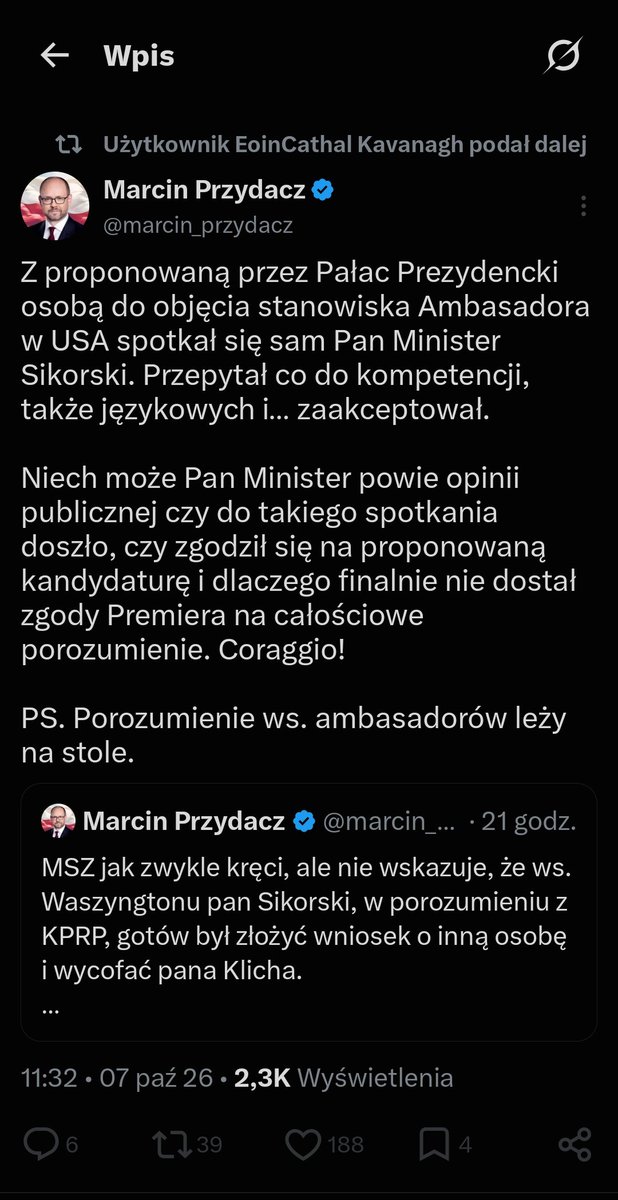
The author accused Marcin Przydacz of inconsistency in statements regarding the embassy's staffing in Washington. He reminded that on October 5, Przydacz had written that Nikodem Rachoń might not have been the agreed candidate and that another name was considered. In a later statement, Przydacz claimed that Minister Radosław Sikorski met with the person proposed by the Presidential Palace, checked their qualifications, including language skills, and accepted them. The author requested the name of that person. He noted that the meeting itself and the positive assessment of the candidate do not prove that a final agreement regarding the embassy in Washington or the entire package of nominations was reached. He added that Przydacz's repeated claim that Donald Tusk blocked the agreement does not become a fact just because it was stated. The author also reminded that, in his opinion, the president appoints ambassadors but does not conduct foreign policy. He cited a ruling by the Constitutional Tribunal in case Kpt 2/08, which — as he wrote — indicated that foreign policy is conducted by the Council of Ministers, and the president cooperates in this area with the prime minister and the relevant minister. He asked who, when, and to what extent agreed on the candidacy and on what basis Przydacz claimed that Tusk personally blocked the entire agreement. He characterized his account of the behind-the-scenes negotiations as presented to the public in a way that suggested it was an established fact. #Polityka #Ambasadorzy #Polska (translated)

3043
Kancelaria Prezydenta RP 5d

The spokesperson for the President of the Republic of Poland, Rafał Leśkiewicz, said on Radio Jedynka that the United States conducted a review of its military forces in Europe. Its results were to be included in a document that would first go to Secretary of War Pete Hegseth and likely be presented to Donald Trump around the turn of November and December. According to Leśkiewicz, a decision about the deployment of American forces in Europe would then be made. He added that Poland should strive to have a base located in the country and assessed that the statements of Prime Minister Donald Tusk suggesting a different course for the conversation between Trump and Władysław Kosiniak-Kamysz did not help in this regard. Leśkiewicz stated that the president hoped until the end for the ruling party to prepare a solution in accordance with the constitution but did not want Poles to remain hostages of Tusk's politics. He accused the prime minister of using fuel prices in political disputes and attributed the responsibility for their high prices during the summer period to the ruling party. The spokesperson also argued that the laws vetoed by the president left several billion zlotys in the pockets of Poles, which they could manage in a difficult economic situation. Speaking about the president's visit to the Philippines, Leśkiewicz described it as the first historic visit of a Polish president to that country. He informed that Karol Nawrocki opened the Polish-Filipino business summit dedicated to the IT industry, organized since 2022, and delivered a lecture at the University of Santo Tomas in Manila. He added that the Philippines bought Polish Black Hawk helicopters and were to acquire more, and he regarded the development of economic cooperation with this country as important. The spokesperson said that the international actions of the president conducted since the beginning of the year aimed to support Poland's permanent presence in the G20 group, develop economic cooperation, attract capital, and facilitate Polish companies in obtaining contracts. He emphasized that Poland was interested in ensuring that the invitation to the G20 was not a one-time event. He pointed out that good relations with the United States were key, reminding that it was Donald Trump's decision that invited Poland to the group. He added that President Karol Nawrocki sought further allies, and the government should support these efforts. At the same time, he described the economic situation as a deepening crisis, indicating a high deficit and budget gap. #Polska #G20 #USA (translated)

3269
Adam Szejnfeld 5d

The author of the entry expressed support for a return to the principle that the Constitutional Tribunal should serve the Constitution, not the political majority, the ruling party, or the interests of individuals. He emphasized that the independence of the Constitutional Tribunal is a value for the entire state, not just one side of the dispute. #Konstytucja #Niezależność #TrybunałKonstytucyjny #PL (translated)

2932
Adam Szejnfeld 5d

The author of the entry wrote that the dispute over the Tribunal should not be reduced to personal conflicts, as it is — as he assessed — a matter of the credibility of the rule of law. He added that citizens should be assured that the body safeguarding the Constitution operates independently and can perform its tasks without hindrance. #Prawo #Konstytucja #Wolność #PL (translated)

2932
Adam Szejnfeld 5d

The author of the entry wrote that the Constitutional Tribunal should not be dependent on internal disputes, as its main task is to protect the Constitution and the rights of citizens. He added that obstacles to the performance of duties by judges should raise serious concern. https://t.co/mofd1eBw3T #TrybunałKonstytucyjny #Konstytucja #PrawaObywateli #PL (translated)

2706
r00t🇪🇺 5d

The author accused Marcin Przydacz of inconsistency in his statements about who decided on Donald Tusk's assumption of the office of Prime Minister. He wrote that after Mateusz Morawiecki's government failed to secure a vote of confidence, the Sejm elected Tusk in a constitutional parliamentary procedure, and Władysław Kosiniak-Kamysz and Szymon Hołownia had no power to transfer to him. The author stated that by Przydacz's logic, one could argue that Hołownia also decided on the assumption of office by Karol Nawrocki because he convened the National Assembly and enabled the swearing-in. However, he pointed out that in Nawrocki's case, he saw a constitutional problem related to the validity of the elections, the handling of protests, the determination of the validity of the election, and the swearing-in despite objections. He assessed that Hołownia's decision had constitutional significance in this matter. The author also rejected the accusation that Kosiniak-Kamysz prioritized party interests over state interests, claiming that Przydacz equated the interests of the state with preventing Tusk from coming to power. #Polityka #Konstytucja #Debata (translated)

3502
r00t🇪🇺 6d

The author of the entry agreed with Fogiel that Poles should choose their authorities, but called for the consistent application of this principle. He pointed to the presidential elections of 2025 and questioned the method of constitutional verification of their results. He recalled that Article 129 of the Constitution, as he wrote, guarantees voters the right to submit protests, and the election oversight should be conducted in a procedure that meets constitutional standards. He stated that 55,274 protests had been submitted to the Supreme Court. He also claimed that the National Electoral Commission indicated the need to address the protests and to determine the validity of the election by a Supreme Court panel whose institutional and personal status would not raise doubts. According to the author, the Electoral Commission recorded recurring errors in the protocols of some polling stations and called for a more thorough analysis of their causes. The author emphasized that the validity of the election was determined by the Chamber of Extraordinary Control and Public Affairs, whose status as a court established by law—as he noted—remained a subject of dispute. He added that proceedings regarding irregularities in vote counting were still ongoing. He mentioned cases of incorrect assignment of votes to candidates, allegations against commission members, and acts of accusation. He stated that in one of the cases, the prosecutor accused 24 commission members of dishonestly counting votes and preparing protocols. He noted that he did not claim that a change in the overall election result had been proven. As he wrote, the prosecutor is examining individual commissions separately, which allows establishing what happened in a specific commission but does not determine the overall scale of irregularities in the country. According to the author, it cannot be assumed that the errors confirmed in successive commissions could not be significant in a cumulative sense until their scale has been established. The author considered that the mere assertion that Poles elected a president does not end the discussion about the integrity of the elections. He asked whether all votes were counted correctly, whether the protests were addressed in accordance with constitutional requirements, and whether the body stating the validity of the election met the Supreme Court's standard required by Article 129. He also wrote that Speaker Szymon Hołownia was aware of these doubts, yet convened the National Assembly, allowing the office to be assumed. He emphasized, however, that he could not say that politicians chose a president instead of citizens, because it was Poles who voted. #wybory #Polska #konstytucja (translated)

3053
Jakub Jakóbowski 6d

The author wrote that Germany and France jointly supported the creation of a "trade nuclear weapon" by the EU, and among the new instruments mentioned was an immediate cutoff from the single market. He compared this situation to the Constitution of May 3, pointing out that its adoption and defense are two different matters. He also mentioned something crucial that was to happen in two weeks, but his entry cut off at this point. #UE #handel #bezpieczeństwo #DE #FR (translated)

3853
Marcin Przydacz 7d

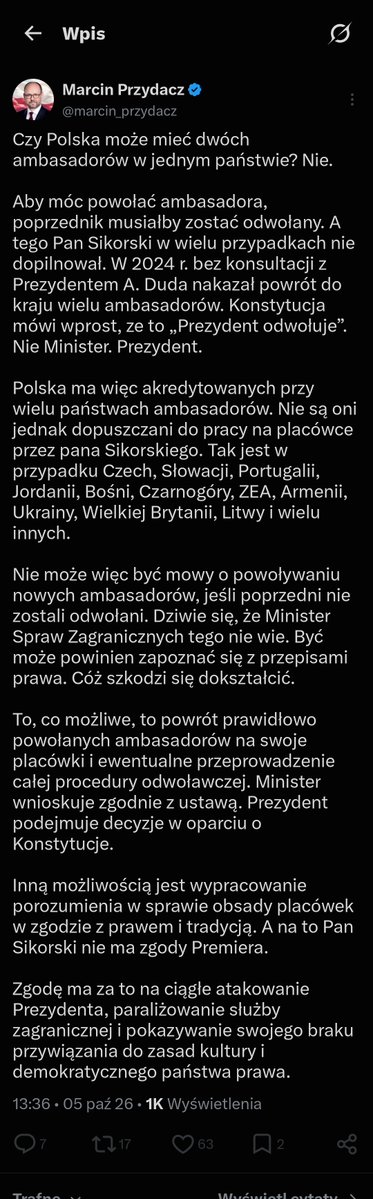
Marcin Przydacz claimed that Poland could not appoint new ambassadors until their predecessors were formally dismissed. He wrote that in 2024, Radosław Sikorski ordered many ambassadors to return to the country without consulting President Andrzej Duda, although — as he pointed out — the Constitution granted the president the authority to dismiss them. According to Przydacz, Poland had accredited ambassadors in many countries, but Sikorski did not allow them to work at the missions. He mentioned the Czech Republic, Slovakia, Portugal, Jordan, Bosnia, Montenegro, the UAE, Armenia, Ukraine, the United Kingdom, and Lithuania. Przydacz assessed that it was possible for properly appointed ambassadors to return to the missions or for dismissal procedures to be conducted, in which the minister would submit a request, and the decision would be made by the president. He added that it was also possible to agree on the staffing of the missions in accordance with the law and tradition, but — as he claimed — Sikorski did not have the prime minister's consent for that. He accused Sikorski of attacking the president, paralyzing the foreign service, and lacking attachment to the principles of culture and a democratic rule of law. #Polska #dyplomacja #prawo (translated)

3061
r00t🇪🇺 7d

The author of the entry accused Marcin Przydacz of presenting the regulation on the presidential appointment and dismissal of plenipotentiary representatives of the Republic of Poland without considering the other constitutional principles. He pointed out that Article 146 of the Constitution entrusts the conduct of foreign policy to the Council of Ministers, while Article 133 sec. 3 obliges the president to cooperate in this matter with the prime minister and the relevant minister. He also cited the judgment of the Constitutional Tribunal in the case Kpt 2/08, which — as he wrote — stated that the president does not have the competence to conduct or generally direct foreign policy. He added that the formal dismissal of an ambassador by the president does not mean that the minister of foreign affairs lacks competence regarding the organization of the foreign service or that the president can independently shape the personnel policy of diplomatic missions. The author reminded that in the Ministry of Foreign Affairs announcement from March 2024, it was mentioned that the missions of ambassadors were ending and the procedure for their dismissal was commencing, and not that the minister had made their constitutional dismissal. He accused Przydacz of presenting the minister's actions as contrary to law based on a single element of the dispute. He emphasized that Przydacz could criticize Radosław Sikorski's actions or the way the changes were conducted, but he should — according to the author — present a complete constitutional model. #Konstytucja #Polityka #Prawo (translated)

3175
Krystyna Pawłowicz 7d

The author claimed that the dispute over the Polish Constitutional Tribunal led to undermining the supremacy of the Constitution and granting EU regulations precedence over Polish law, contrary to EU treaties. He described this as depriving Poland of sovereignty and undermining the will of the Poles as the sovereign. #Polska #Konstytucja #Suwerenność #PL (translated)

Zbigniew Bogucki🇵🇱 7d

Zbigniew Bogucki wrote that under Prime Minister Donald Tusk's government, force was supposed to replace law, and reality was increasingly to be determined by state services and ministries subordinate to the prime minister, rather than by the Constitution, statutes, and court rulings. He assessed that this situation meant a departure from a democratic rule of law in which law sets the limits of executive power. He added that during the current government, there had been cases in which force violated the law and shaped reality instead of solutions adopted through democratic and legal processes. #Demokracja #Prawo #Konstytucja (translated)

13954
Donald J. Trump 7d

A few days ago, Donald Trump signed something at the White House that he called the "AI constitution." #sztucznainteligencja #etykaAI #technologia (translated)

Szadkowski: AI już samo wybiera cele. To powinno nas przerazić
www.onet.pl
1932
Mariusz Ciarka 🇵🇱 1w

Dorota Kania wrote that the state of emergency and the state of martial law were introduced by the President of the Republic of Poland by regulation at the request of the Council of Ministers, while the state of natural disaster was introduced by the Council of Ministers. She added that the declaration of war was decided by the Sejm of the Republic of Poland, in accordance with Article 116 paragraphs 1 and 2 of the Constitution of the Republic of Poland. #Polska #Konstytucja #stanwojenny #PL (translated)